What Size Engine Hoist Do You Need?
For most home garages, a 2 ton folding engine hoist is the right size. It covers most car and light truck engines, and the extra capacity gives you a safety margin. Pick by the weight of the load you will lift and the boom reach you need, not only by the number on the box.
 Garvee bGc-OaKS-Gnv75Tn3-XOiBest overall
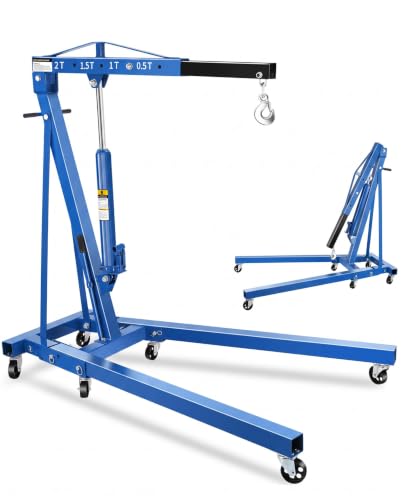 Maxsa Innovations bxt-zZ9Zfp9tz6J8R1c-P-sVYbkDuLightest hoist
 Maxsa Innovations YellowHeaviest-built frame option
Start with the weight you actually need to lift
The size of an engine hoist is its rated capacity, usually shown in tons. Hydraulic shop cranes are commonly sold as 1 ton and 2 ton models, so those are the two sizes most people choose between.
Start by finding the published weight of your engine. Then add what comes out with it. A transmission still bolted on, an intake, accessories or a flywheel all add weight. If the engine and transmission come out together, add both weights.
Next, leave a safety margin. Do not plan to lift a load that sits right at the hoist's rating. A load well below the rating is easier on the hydraulics, the boom and the casters, and it gives you room for weight you did not count.
How boom positions change capacity
Most folding hoists have a boom with several positions. The hoists on our spec sheet have four, rated at 0.5, 1, 1.5 and 2 tons. The 2 ton rating applies only to the shortest boom setting. Extending the boom to reach farther lowers what the hoist can safely lift.
This matters more than the headline number. If you need the boom at its longest setting to reach the engine, your working capacity is the rating for that position, not the full 2 ton figure.
| Boom position | Rated capacity (tons) | Typical use |
|---|---|---|
| Shortest, retracted | 2 | Heavy loads close to the hoist |
| Second | 1.5 | Larger engines with moderate reach |
| Third | 1 | Mid-size engines with more reach |
| Longest, extended | 0.5 | Light loads at full reach |
Compare the 2 ton hoists on our list
The 2 ton hoists in our best engine hoist comparison list a rated capacity of either 4400 or 4000 lb. Check the number in the listing you are considering, and remember it is the maximum, not the rating at every boom position.
Weight and folded length matter for storage and for moving the hoist around the garage. The table below uses the published specifications.
| Hoist | Rated capacity (lb) | Weight (lb) | Folded length (in) | Leveler listed |
|---|---|---|---|---|
| Garvee 2 Ton Engine Hoist with Lever | 4400 | 101.41 | 51.18 | Yes |
| Maxsa Innovations 2 Ton Engine Hoist | 4400 | 100 | 64.17 | No |
| Maxsa Innovations 2 Ton Engine Hoist (Yellow) | 4400 | 145.51 | 61 | No |
| Maxsa 2 Ton Hydraulic Engine Hoist | 4400 | 147.71 | 53.54 | No |
| Maxsa 2 Ton Cherry Picker Shop Crane | 4000 | 127.87 | 51.97 | Yes, 1500 lb |
| Oekaafvi 2 Ton Folding Engine Hoist | 4000 | 141.92 | Not listed | No |
Check reach and lift height too
A hoist can have plenty of capacity and still be the wrong one. The boom has to reach the engine's lift points over the fender and radiator support. It also has to raise the engine high enough to clear the front of the vehicle.
Our list includes one hoist with a telescopic boom that reaches from 38 to 57 in., and another with a maximum lift height of 82.68 in. Compare those figures to your vehicle. A tall truck needs more height and reach than a low sedan.
Also consider whether you need a leveler. It tilts the engine as it comes out or goes in, which helps it clear the bay and line up with the transmission. Some of the hoists above include one.
A quick sizing checklist
Work through these steps before you buy:
- Look up the published weight of your engine, and of the transmission if it comes out too.
- Add the weight of anything that stays attached, such as accessories.
- Add a safety margin so you are not lifting near the rating.
- Find the boom position you will need to reach the lift points, and check the rating at that position.
- Check the lift height against the front of your vehicle.
- Measure your storage space and compare it to the folded length.
- Decide whether you want a leveler included.
Safety notes before you lift
Never work under a load held only by a hydraulic hoist. Hydraulics can leak down. Support the vehicle on proper stands, and lower the engine onto a stand or blocks before you work on it.
Lift only from the engine's designated lift points, using chains or a leveler rated for the load. Lock the casters when the hoist is not moving, and move the load slowly on a flat, smooth floor. Wear safety glasses and steel-toe boots, and keep your hands and feet clear of the boom and the load.
If you are choosing between sizes, a 2 ton folding hoist is the usual choice for home use, and our engine hoist comparison shows the specifications side by side.
Frequently asked questions
Is a 1 ton hoist enough?
It can be for a light engine on its own. Many people choose 2 ton because it leaves more margin, especially when the boom is extended or when the transmission comes out with the engine.
Can I lift a transmission with an engine hoist?
Yes, listings for the hoists on our list say they can lift transmissions and axles. Use proper lifting points and a way to support and balance the transmission.
Do I need a leveler?
It is not required, but it helps. A leveler lets you tilt the engine so it clears the bay and lines up during installation.
Can I use a hoist outdoors?
Some listings mention indoor or outdoor use. Use it only on a hard, level surface, and keep it dry so the steel and hydraulics last.