What Size Electrician Tool Bag Do You Need?
Most electricians do well with a bag around 15 to 19 inches long for a daily service kit, and a tall backpack style when the kit is bigger or the walk is long. Choose the size by what you carry and how far you carry it, not by the biggest pocket count. If the packed bag is too heavy to carry comfortably up stairs, it is too big for you.
 DEWALT DWST560104Best overall
 LOKASS 8605Highest load rating
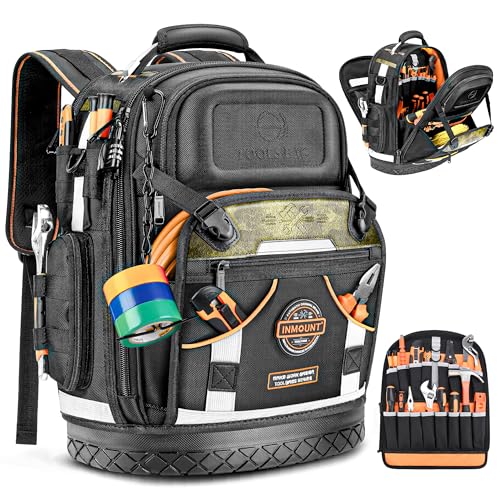 LOKASS 8603Most pockets overall
Start with what actually goes in the bag
Size is really a question of inventory. Before you look at dimensions, lay out the tools you reach for on a normal day and sort them into three piles: daily hand tools, testers and meters, and spare parts like connectors and fasteners.
A small pile fits a compact tote. A large pile, or one with a laptop and a drill, points to a backpack or a deeper tote. Here is a quick checklist to build your pile:
- Hand tools: screwdrivers, pliers, strippers, a hammer and a tape measure.
- Testers and meters: a voltage tester, a multimeter and any small test leads.
- Parts: wire connectors, cable ties, screws and anchors in small containers.
- Power tools: a cordless drill, spare batteries and a charger if you carry them.
- Extras: a flashlight, a notebook, gloves, and a laptop or tablet for service calls.
Match the bag to the kind of work
Think in three rough categories. These are general guidelines, not fixed rules, and your own kit may sit between them.
A homeowner or light-repair kit is a small tote that stays in a closet or a car trunk. A working service electrician usually wants a mid-size tote or a backpack with organized pockets. Someone who carries a drill, a laptop and a full set of meters needs the most volume and the strongest base.
| Kind of work | Bag style to look at | Why |
|---|---|---|
| Home repairs and occasional jobs | Compact open-top tote | Holds basic hand tools and a tester without a lot of extra weight |
| Daily service calls | Mid-size tote with a molded base | Easy to set down and grab from, and stays upright on wet floors |
| Long walks, stairs, big jobsites | Backpack with padded straps | Spreads the load across both shoulders |
| Tools plus laptop or drill | Large tote or tall backpack | Dedicated space keeps electronics away from hand tools |
What real bag sizes look like
Published dimensions show how much the size range varies. The table below uses the specs from our best electrician tool bag comparison. All weights are for the empty bag.
One thing to watch: a product name and its listed dimensions do not always agree. The DEWALT bag is named a 20in bag, but its listed length is 18.72 inches. Always compare the measured dimensions, not just the name.
| Bag | Dimensions (in) | Empty weight | Pockets |
|---|---|---|---|
| Amazon Basics TB002 | 15.9 x 8.3 x 9.1 | 1.79 lb | 26 |
| Ytonet 6731 | 16 x 10.24 x 9.45 | 3.97 lb | 46 |
| DEWALT DWST560104 | 18.72 x 11.31 x 12.09 | 5.42 lb | 33 |
| LOKASS 8605 backpack | 13 x 7 x 18.5 | 5 lb | 56 |
| LOKASS 8603 backpack | 15.1 x 7.8 x 19 | 6 lb | 78 |
| Klein Tools 62800BP | 10 x 10 x 10 | 7.5 lb | 40 |
Tote or backpack?
A tote is quick to open and easy to set down next to the work. The Ytonet bag, for example, lists a 25L capacity at 16 inches long, which is a manageable size for one hand. The Amazon Basics bag is the lightest of the group at 1.79 lb, but it lists no molded base.
A backpack is taller and narrower. The two LOKASS backpacks are 18.5 and 19 inches tall but only 7 to 8 inches deep, so the weight sits close to your back. That helps on stairs and long walks, and it keeps your hands free for a rail or a ladder.
If you are still deciding what goes inside either style, our best electrician tool kit page shows what a ready-made set includes, which is a useful way to gauge how much room you need.
Check weight and load, not just volume
A bigger bag invites you to pack more, and the weight adds up fast. Empty weights in our comparison run from 1.79 lb to 7.5 lb, and your tools go on top of that.
Load ratings are listed for only some products. The LOKASS 8605 lists a 110 lb max load, and the Ytonet lists a base that supports up to 100 lb. Those numbers describe what the bag is built to hold, not what you should carry on your shoulder. Pack for what you can comfortably lift, then use the rating as a margin of strength.
A molded base and a high denier fabric, such as the 1680D listed on several of these bags, help a larger bag keep its shape. A tall bag with no rigid base can slump when it is half empty.
Safety notes for carrying and packing
A bag is storage, not protection, so a few habits matter more than the size you pick.
- Lift with your legs and keep heavy items low and close to your back.
- Do not climb a ladder with a heavy bag on one shoulder. Use a backpack with both straps on, or raise the bag with a hand line.
- Keep loose metal pieces, like cut wire ends and screws, in closed pockets so they cannot touch live parts or each other.
- Set the bag down on a dry surface, away from panels and open boxes. A molded base helps keep it off wet concrete.
- Store testers in padded pockets and check them on a known live source before relying on them.
- Wear eye protection when working overhead, since debris falls toward your face.
A simple way to choose
Pack your real kit into a box or onto a table and measure its longest tool and its total height. The bag should be a bit longer than the longest tool you carry daily, with room to close the zipper without forcing it.
Then check three things from the spec sheet: the dimensions, the empty weight and whether it has a molded base. If a number you care about is missing, confirm it on the maker's page before you buy. When your kit grows, it is usually better to add a second small bag for parts than to carry one oversized bag that is hard to lift.
Frequently asked questions
Is a bigger electrician tool bag always better?
No. A larger bag fills up with extra tools and gets heavy. Pick the smallest bag that holds your daily kit with a little spare room.
How many pockets do I need?
It depends on how many separate items you carry. Among the bags we compare, pocket counts run from 26 to 78. Count your small items first and match the pocket total to that.
Can a tool backpack hold a laptop?
Some can. The LOKASS 8605 listing mentions a dedicated laptop compartment. Check each listing, and keep the laptop away from hand tools.
Does a molded base matter for size?
Yes, especially for larger bags. A rigid base keeps a bigger bag upright and off damp floors. Not every bag lists one, so check the specs.
Should I buy a bag with room to grow?
A little extra room is fine, but avoid buying far larger than your kit. Extra space tends to get filled, and the added weight is what you feel at the end of the day.