What Size Core Drill for Soil and Waste Pipes?
For 110mm soil pipe, a 127mm core drill is the usual choice. For 32mm and 40mm waste pipes, a 50mm core works well for both, and a 40mm waste pipe can also pass through a 52mm or 56mm hole if you prefer a tighter fit. The core must be larger than the pipe's actual outside diameter so you have room to align it, add a sleeve and seal the gap.
 VEVOR Z1Z-9230Best overall
 VEVOR (8260H)Z1Z-9260Largest hole capacity
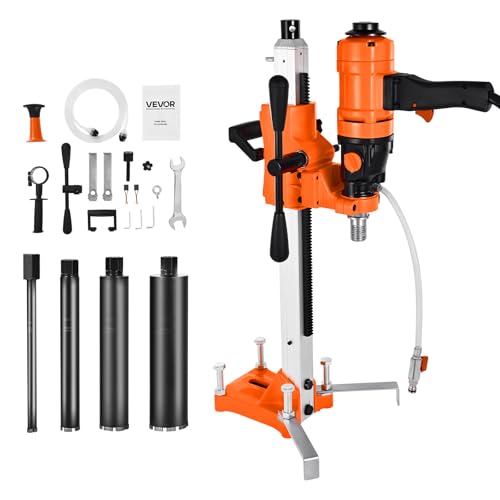 VEVOR Z1Z-CF03-80SHandheld or stand with four bits
The short answer by pipe size
Core bits are sold by the diameter of the hole they cut, and that hole needs to be bigger than the pipe. The extra space lets you tilt the pipe slightly to match its fall, slide in a sleeve or fire collar if one is needed, and fill the gap with sealant or mortar.
The table below shows common pairings. Treat it as a starting point, then confirm against your own pipe and fittings before you drill.
| Pipe | Typical core size | Notes |
|---|---|---|
| 32mm waste (basin, bath trap) | 40mm to 50mm | 50mm gives easy room for a sleeve or sealant |
| 40mm waste (sink, shower, washing machine) | 50mm to 56mm | 50mm is the common pick if it clears your pipe |
| 50mm waste | 65mm | Leaves room for a collar or sleeve |
| 110mm soil pipe | 127mm | Most common pairing for a straight wall pass-through |
| 110mm soil pipe at an angle | 127mm to 152mm | Angled holes become oval, so go bigger |
Why the core is bigger than the pipe
A pipe that fits a hole with no gap is hard to install and hard to seal. Soil and waste pipes also need a gentle fall so water drains away, and that means the pipe rarely sits perfectly square to the wall.
A hole that is about 10 to 20mm larger than the pipe is a practical target for most wall pass-throughs. It is enough to adjust the pipe, but small enough that a sleeve, sealant or mortar can close the gap neatly.
Check these before you choose
Pipe sizes are nominal. A 110mm soil pipe, a 40mm waste pipe and a 32mm waste pipe are names for a size, and the real outside diameter can vary a little between makers and pipe types. Fittings such as couplings, bosses and collars are wider than the pipe itself.
Measure the widest part that has to pass through the wall, then pick the core bit that clears it.
- Measure the outside diameter of the pipe, not the inside.
- Measure any coupling or fitting that must go through the hole.
- Decide whether you want a sleeve, a fire collar or acoustic wrapping, and add its thickness.
- Check wall thickness against the depth of the core bit barrel.
- Think about the angle. A hole cut on a slope is longer on one side than the other.
Choosing a core drill for the job
Small cores up to about 65mm are easier to handle than a 127mm bit. A large core takes real torque and cuts a heavy plug of masonry, so the drill you pair with it matters as much as the bit.
If you are comparing machines, our best core drill page lines up the published specifications side by side, including power and the bit sizes each model supports. If you only need a small hole for waste pipes now and then, a standard rotary drill with a suitable core bit may be enough, and our best drill page covers those options.
Match the bit to the machine. Check the manufacturer's maximum core diameter and whether the drill is rated for wet or dry use. A drill working near its limit will stall, overheat or kick back, so leave some margin.
Wet or dry cutting
Wet core drilling uses a water feed to cool the bit and keep dust down. Dry cutting is simpler to set up indoors but makes a lot of fine dust and can wear a bit out faster if it is not designed for it.
Use the method your bit and drill are made for. Never use water with a tool that is not rated for it, and never let water reach a power tool or its cable.
Safety before you drill
Core drilling is more hazardous than ordinary drilling. The bit is large, the torque is high and the wall may hide cables or pipes.
Work through this list first:
- Scan the wall for electric cables and existing pipes, and mark them.
- Use an RCD on the supply when working with water or on site.
- Wear eye protection, hearing protection and a suitable dust mask, as masonry dust can harm your lungs.
- Hold the drill with both hands using the side handle, and brace for a sudden stall.
- Support the plug of masonry as it frees, since it can be heavy and drop.
- If you work from a ladder or platform, make sure it is stable. A core drill that grabs can pull you off balance.
Cutting the hole cleanly
Mark the centre and the outline, and make sure the line of the pipe is clear on both sides of the wall. Start the bit slowly so it does not wander. Many people use a pilot bit or a guide plate to keep the start true.
Once the bit is cutting, let it work at its own pace. Pushing hard does not speed things up and can jam the core. If the barrel fills with debris, pull back and clear it.
When you are about halfway through a thick wall, consider finishing from the other side. This avoids blow-out and chipped edges on the exit face.
Frequently asked questions
Can I use one core bit for both 32mm and 40mm waste pipes?
Yes, in most cases. A 50mm core usually clears both, and you then fill the gap around the pipe with sealant or sleeve it. Check that any fittings also fit through the hole.
Is a 110mm core bit big enough for 110mm soil pipe?
No. The hole needs to be larger than the pipe so it can be aligned and sealed, which is why 127mm is the usual choice for a 110mm pipe.
Do I need a special drill for a 127mm core?
Large cores need a drill with enough power and a suitable chuck or thread for the bit. Check the maximum core diameter in the drill's published specifications before buying.
How do I seal the gap around the pipe?
Many installers use a sleeve, then fill the gap with a suitable sealant or mortar. If the wall is fire-rated or needs sound control, follow the rules for that wall.