What Size Cooling System Pressure Tester Do You Need?
There is no single size of cooling system pressure tester. What matters is the adapter that fits your radiator or expansion tank neck, and a gauge that reads above your cap's pressure rating. For most passenger vehicles, a kit with a gauge that reaches 35 psi and an adapter set that names your make will cover the job.
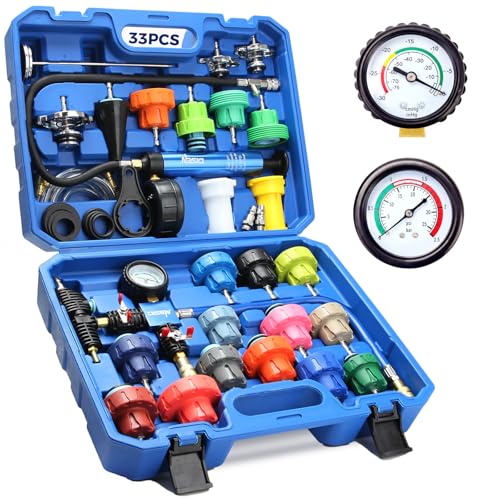 DISEN DS-33LQYZKJZTJBest overall
 Orion Motor Tech RCPDual-scale 35 psi gauge
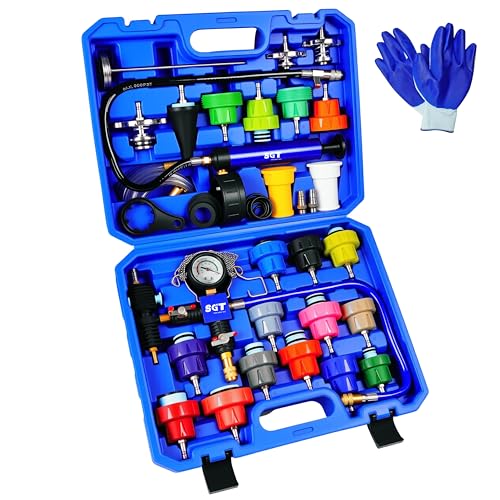 SGT SUPER GARAGE TOOLS SGT-Q295-BLUEListed pressure and vacuum ranges
Size really means three things
When people ask about size, they usually mean one of three things: the adapter that seals to the filler neck, the pressure range of the gauge, and how big the whole kit is. Each one answers a different question, so it helps to check them in order.
The adapter is the part that must match your vehicle exactly. The gauge range is a safety and accuracy issue. The kit size is mostly about how many vehicles you plan to work on and where you will store it.
Start with the adapter
The adapter replaces the radiator cap or expansion tank cap while you pump pressure into the system. If it does not seat and seal on the neck, the gauge will drop for the wrong reason and you will chase a leak that is not there.
Neck designs vary by manufacturer. Some are a simple twist-on design, others use different thread pitches, lug shapes, or diameters. That is why most kits come with a set of adapters instead of one. Many also include a universal adapter as a backup, though a model-specific fit is usually a better seal.
Check three things before you buy:
- Look at the makes named in the product listing and find yours.
- Compare the adapter to your own cap or neck. Molded size markings on the adapter help here.
- If you work on several brands, favor a larger adapter set. If you only service one or two, a smaller set can be enough.
How many adapters do kits include?
Adapter count is the easiest number to compare. On our best cooling system pressure tester page, three kits list 23 adapters and two list only 3. The numbers below come from the published listings.
A bigger count does not guarantee a fit for every car, so read the named makes. A smaller set can work well if the listing names the brands you drive.
| Kit | Adapters | Vehicle coverage listed | Pieces |
|---|---|---|---|
| DISEN DS-33LQYZKJZTJ | 23 (22 specific, 1 universal) | Japanese, German, American, Korean, European makes | 33 |
| SGT SGT-Q295-BLUE | 23 | Mercedes-Benz, GM, Jeep, Toyota, Honda, BMW, Ford, and more | 33 |
| VTG VOGTEN radiator pump kit | 23 | Mercedes-Benz, GM, Jeep, Toyota, Honda, VW, Audi, and more | 30 |
| Orion Motor Tech RCP | 15 | BMW, Ford, VW, Mercedes-Benz, and more | 19 |
Check the gauge range and test pressure
Most cooling systems run at modest pressure. Common guidance puts many modern vehicles at roughly 13 to 16 psi, but your cap is the real reference. The rating is usually stamped on the cap itself or listed in your owner's manual.
You want a gauge that reads comfortably above that number, so the needle is not pinned at the top of the dial. On our page, three of the five ranked kits list a 35 psi maximum test pressure, and the other two do not publish a figure. For example, the Orion Motor Tech kit lists a 2.5 in. gauge that reads in psi and bar, tested up to 35 psi (2.5 bar). The SGT kit lists a 0-35 psi gauge, psi only.
A dual-scale gauge is handy if your manual quotes bar or kPa. If the gauge only shows psi, a quick conversion is all you need.
Do you need vacuum refill?
A pressure tester finds leaks. A vacuum refill tool does a different job: it pulls air out of the system so coolant can go in without air pockets. Trapped air can lead to overheating, so many people want both functions in one kit.
If you list vacuum refill as a must for your work, look for a stated vacuum gauge range. The SGT kit lists 0-30 inHg, and the VTG kit lists a 30 inHg gauge. Not every kit includes this function. One kit on our page has 21 adapters and tests to 35 psi but lists no vacuum refill.
How to test once you have the right fit
Always work on a cold engine. The steps below are the basic routine, and your vehicle's service manual comes first if it says otherwise.
1. Let the engine cool fully, then remove the cap slowly. Wear safety glasses and keep your face and hands back.
2. Top off coolant to the proper level, then attach the correct adapter and tester.
3. Pump slowly until the gauge reaches the pressure stamped on your cap. Do not go above it.
4. Watch the gauge. A steady needle suggests the system is holding. A falling needle points to a leak.
5. Look for drips at hoses, the radiator, the water pump, the heater connections, and the expansion tank. Then release pressure before removing the tester.
Safety notes
Never open a hot cooling system. Hot coolant under pressure can spray and cause serious burns. Wear eye protection and gloves, and keep clear of belts and electric fans, which can start on their own on some vehicles.
Do not pump past the cap rating. Over-pressurizing can damage hoses, the radiator, or the heater core and create new leaks. Coolant is toxic to pets, so wipe up spills and dispose of used coolant properly.
Choosing a kit size
If you only service one or two brands, a compact set may be all you need. If you work on a mix of vehicles, a larger adapter set saves trips to the parts store. Carrying cases help keep adapters sorted, and weight matters if you move between jobs. The SGT kit lists a weight of 10.25 lb, while our lightest listed kit weighs 4.85 lb but has no vacuum refill.
Compare the full specs side by side on our cooling system pressure tester comparison before you decide.
Frequently asked questions
Can one adapter fit every car?
Not reliably. Some kits include a universal adapter, but neck shapes and threads vary by manufacturer. A model-specific adapter usually seals better.
What psi should I pump to?
Pump to the rating on your radiator or expansion tank cap, and never above it. If the cap has no marking, check your owner's manual.
Is a bigger kit always better?
No. A larger kit helps if you work on many makes. If you only service a few, a smaller set that names your vehicles can do the job.
How long should I hold the pressure?
Hold it long enough to watch the gauge and inspect the system for drips. If the needle keeps falling, there is likely a leak.