What Size Concrete Vibrator Do You Need for Your Project?
Match the head diameter to the thickness of the pour and the spacing of your rebar. Heads around 1.375 in suit thick slabs and footings, while 1 in to 1.125 in pencil heads fit tight forms and dense steel. Then check frequency, shaft length and power so the vibrator can finish the job without stalling.
 XtremepowerUS 61064Best overall
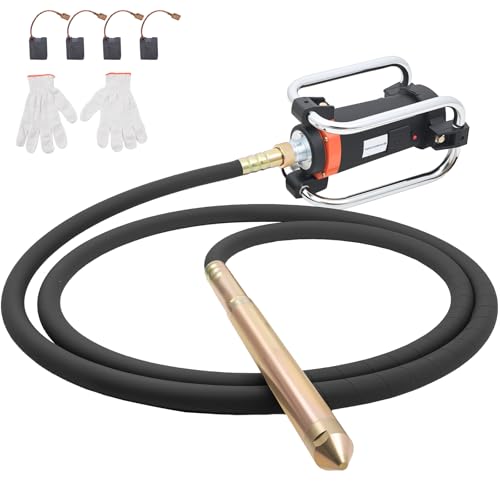 MECHINHUB MGCCFastest vibration, longest reach
 Seeutek SY-BZ-496Wide head, 6.6 ft shaft
Start with head diameter
Head diameter is the main sizing choice. It controls how much concrete the head treats at once and whether it fits between the bars. A wide head covers more ground per insertion, so a big pour goes faster. A narrow head can reach into tight spots, but you must make more passes.
On our best concrete vibrator page, the largest listed heads are 1.375 in, on two corded models. The smaller heads are 1.125 in on one cordless model and 1 in on two cordless Makita models. Some listings do not give a head diameter at all, so check the manufacturer's page before you buy if size matters for your forms.
Match the size to your project
Use this table as a starting point. It gives direction, not exact limits, because rebar spacing and mix stiffness change what works on your site.
| Project | Head size to look for | Why |
|---|---|---|
| Thick slab or footing | Larger, such as 1.375 in | Treats more concrete per insertion and suits deep pours |
| Walls and columns with dense rebar | Smaller, 1 in to 1.125 in | Fits between bars and into narrow forms |
| Small repairs, steps, posts | Pencil style, 1 in to 1.125 in | Light and easy to carry for short pours |
| Wide, shallow slab | Internal vibrator plus a surface tool if needed | A surface vibrator or screed handles the top layer, and an internal one can still help at edges |
What a pencil concrete vibrator is
A pencil vibrator is a slim insertion vibrator with a small head and a flexible shaft. The head looks like a thick pencil, which is where the name comes from. You push it into wet concrete, hold it briefly, and pull it out slowly so air can escape and the mix settles around the steel.
In our data, the pencil-style models are cordless and use 1 in to 1.125 in heads. They are a good fit for tight rebar and small jobs. They treat a smaller area per insertion than a 1.375 in head, so a large slab will take much longer with one.
What a high cycle concrete vibrator is
"High cycle" usually describes a vibrator that runs at a high frequency. Frequency is measured in vibrations per minute (VPM). A higher number means the head shakes faster, which helps release trapped air, especially in stiffer mixes.
Do not judge a unit by one number, though. In our lineup, the 2200 W model runs at 5000 VPM, while the 1500 W MECHINHUB model reaches 18000 VPM. Power tells you how hard the motor can work under load. Frequency tells you how fast the head moves. Read both together, and read the listing carefully, because some brands list speed under load and others do not.
Power, shaft length and corded or cordless
Corded models with a listed motor power run from 1500 W to 2200 W on 110 V. Cordless models list 18 V or 20 V and give no motor power figure, so compare them by head size, frequency and runtime instead. The two Makita models list 41 and 25 minutes of runtime, and the DEWALT lists an 80 Wh battery.
Shaft length sets your reach. A longer shaft means fewer moves and less lifting of the motor. Listed shafts run from 4 ft to 14.7 ft. For a deep wall form or a big footing, extra reach saves effort. For a small job, a short shaft is lighter and easier to handle.
Use these points to decide:
- Large pours and long days: choose corded, with a wider head and a longer shaft.
- Tight rebar and narrow forms: choose a smaller head, even though it works a smaller area.
- Remote sites or short jobs: choose cordless and check the runtime.
- Carrying and fatigue: check the weight. The listed models run from 7.7 lb to 15.4 lb.
Spec comparison from our data
Here is how several listed models line up. A dash means the figure is not listed in our data.
| Model | Power source | Head | Frequency | Shaft |
|---|---|---|---|---|
| XtremepowerUS 2200W | Corded, 2200 W | 1.375 in | 5000 VPM | 5 ft |
| Seeutek SY-BZ-496 | Corded, 1500 W | 1.375 in | 13000 VPM | 6.6 ft |
| MECHINHUB MGCC | Corded, 1500 W | - | 18000 VPM | 14.7 ft |
| DEWALT DCE531M1 | Cordless, 20 V | 1.125 in | 14000 VPM | 4 ft |
| Makita XRV02T | Cordless, 18 V | 1 in | 12500 VPM | 8 ft |
| Makita XRV01Z | Cordless, 18 V | 1 in | 13000 VPM | 4 ft |
Safety and use tips
Concrete work mixes electricity, water and heavy tools, so take a few precautions before you start.
Wear safety glasses, hearing protection, gloves and waterproof boots. Splashing concrete is caustic, and a running vibrator can be loud. Plug corded tools into a GFCI-protected outlet, keep cords out of wet concrete and standing water, and never carry the tool by its cord.
Do not run the head in open air. One listing warns that the head overheats when it is not immersed, because the concrete helps cool it. If a unit has overheat or overload protection, let it cool before restarting. When working on forms or scaffolding, keep your footing stable and do not lean while holding the vibrator.
Frequently asked questions
Can a bigger vibrator hurt the concrete?
Yes, if you overdo it. Leaving the head in one spot too long can push the mix apart. Insert it, hold it just until bubbles slow, then pull it out steadily.
How far apart should I place the head?
Overlap each insertion so no area is skipped. The right spacing depends on the head size and the mix, so follow the manufacturer's guidance for your model.
Do I need a lock-on switch?
It is not required, but it reduces hand strain on long pours. Most corded models in our data list one.
Is a cordless vibrator enough for a slab?
It can work for small slabs, but the smaller heads treat less area per pass and runtime is limited. For larger slabs, a corded model with a wider head is usually the better fit.