What Size Chainsaw Chain Do I Need?
You need a chain that matches your saw's guide bar on four numbers: bar length, pitch, gauge and drive link count. Those numbers are usually stamped on the bar itself or listed in the owner's manual. If all four match, the chain will fit and run safely.
 KAKEI 18" 3/8"LP .050" 62DL- German Steel *3Best overall
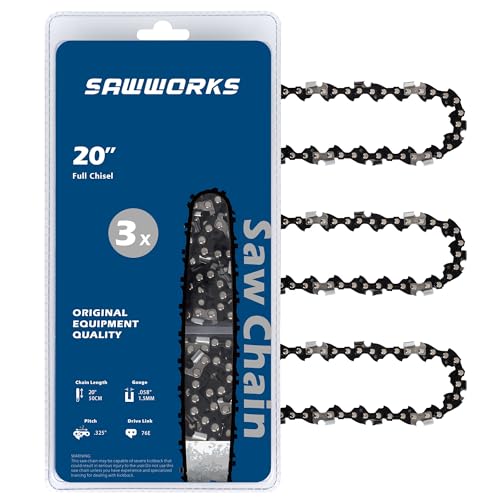 SawWorks 20" 76DL .325" .058"-GermanSteel *3PcsBest for big saws
 GSSHBR 18Inch 3/8 050 62 5PackBest 18 in value pack
The four numbers that set your chain size
Chainsaw chains are not sold in small, medium and large. A chain is sized by measurements that have to line up with your guide bar and your saw's drive sprocket. Get one wrong and the chain may not fit at all, or it may fit badly and wear out the bar.
Here is what each number means in plain terms.
- Bar length: the length of the guide bar, given in inches. It is the nominal cutting length, so the chain itself is a bit longer than the number suggests.
- Pitch: the spacing between the chain's rivets. It has to match the teeth on your drive sprocket.
- Gauge: the thickness of the drive links, which are the small tabs that ride inside the bar's groove.
- Drive link count: the number of those tabs around the full loop of the chain.
Where to find the numbers on your saw
The quickest place to look is the guide bar. Many bars have a stamp on the side near the mounting end, often with the length, pitch, gauge and drive link count printed together. You may need to wipe off oil and sawdust to read it.
If the bar is unreadable, check the owner's manual. It lists the correct chain specification for each bar length the saw supports. The old chain sometimes has a part number on a drive link too, which a parts dealer can look up.
Some saws accept more than one bar length. Always go by the bar that is actually mounted now, not by the saw's model name alone.
What pitch means and how to check it
Pitch is the distance between rivets, and it is the number people most often get wrong. Common pitches on consumer saws include 1/4 inch, 3/8 inch low profile (written 3/8 LP), .325 inch, 3/8 inch and .404 inch. Low profile 3/8 and full 3/8 are different chains, even though both show a 3/8 on the label.
If you have no stamp to read, you can measure. Take three rivets in a row and measure from the first to the third. Divide that distance by two to get the pitch. Your sprocket may also carry a pitch marking.
Do not guess between close sizes. A chain with the wrong pitch will not sit properly on the sprocket and can jump or break.
What gauge means and how to check it
Gauge is the width of the drive link tab, which has to fit the groove in your guide bar. Common gauges are .043, .050, .058 and .063 inch. Two chains with the same pitch and the same length can still differ in gauge, so check this number every time.
A too-thick chain will not seat in the bar groove. A too-thin chain will wobble in it, cut crooked and wear the bar faster. If you can, measure the groove width with calipers or compare it with the stamp on the bar.
How to count drive links
Drive link count is the most reliable way to confirm length. Counting is easy once you know what to look for.
Lay the chain flat and look at the underside. The drive links are the tabs that point down into the bar groove. Mark one with a marker or a dab of paint, then count every tab around the loop until you return to the mark.
Do this with the chain off the saw. Make sure the chain brake is off and the chain is cool, and wear cut-resistant gloves. Sharp cutters can slice skin even when the chain is not moving.
Real examples from published specs
The table below shows how the four numbers appear in listings we compare. These are published specifications, and they show why you cannot buy by bar length alone. Both 18 inch chains here share a pitch, a gauge and a drive link count, but the 20 inch chain is a different design altogether.
For a wider look at options once you know your numbers, see our best chainsaw chain comparison.
| Bar length | Pitch | Gauge | Drive links | Example listing |
|---|---|---|---|---|
| 10 in | 3/8 LP | 0.050 | 40 | JINFFR 10in semi-chisel 5-pack |
| 14 in | 3/8 LP | 0.050 | 52 | Fifchall 14in low-kickback 4-pack |
| 18 in | 3/8 LP | 0.050 | 62 | KAKEI 18in semi-chisel 3-pack |
| 18 in | 3/8 LP | 0.050 | 62 | GSSHBR 18in 5-pack |
| 20 in | 0.325 | 0.058 | 76 | SawWorks 20in full chisel 3-pack |
Safety and a few buying tips
Before you take a chain off or put one on, disconnect the power. For a gas saw, pull the spark plug cap. For a battery or corded saw, remove the battery or unplug it. Wear gloves and eye protection while handling chains and cutting.
Once the numbers match, check the cutter type and kickback design. Our guide pages note that low-kickback chains suit most homeowners, and that semi-chisel cutters stay sharp longer in dirty wood, while full chisel cutters cut faster in clean wood but dull sooner. One listing we compare, the SawWorks 20 inch chain, carries a warning that it may be capable of kickback and should only be used with experience and training.
Buying a pack of several chains also helps. You can swap a dull chain quickly and sharpen later. You can see how packs of different sizes stack up on our chainsaw chain comparison.
A quick checklist before you buy
Run through these steps to avoid a return.
- Read the stamp on the guide bar, or check the owner's manual.
- Write down bar length, pitch, gauge and drive link count.
- Confirm each number against the product listing, not just the brand compatibility list.
- Choose a cutter type and kickback rating that suits how you use the saw.
- Check that the packaging says what you expect, including how many chains are included.
Frequently asked questions
Is the chain length the same as the bar length?
No. The bar length is a nominal measurement of the cutting area. The chain loop is longer because it wraps around the bar and sprocket, which is why the drive link count matters.
Can I use a chain with a different gauge if the pitch matches?
No. Gauge has to match the bar groove. A mismatch means the chain either will not seat or will wobble and wear the bar.
Is a brand compatibility list enough to pick a chain?
Not on its own. Listings often name many saw brands, but your own bar may differ from the typical one. Always confirm the four numbers on your bar.
Do cordless and corded saws use the same chain sizes?
They can. Size depends on the bar and sprocket, not the power source, so check the numbers on your specific saw.