What Size Ceiling Light Do You Need for a Kitchen?
For most kitchens, add the room's length and width in feet. That number in inches is a good target diameter for a single centered fixture, so a 10 by 12 foot kitchen suits about 22 inches. Most round flush mounts run 12 to 13 inches across, so larger kitchens usually need two fixtures or one long panel, and brightness matters as much as width.
 LUTEC XDD-7Best overall
 Brightever XD300-09Slimmest, most efficient fixture
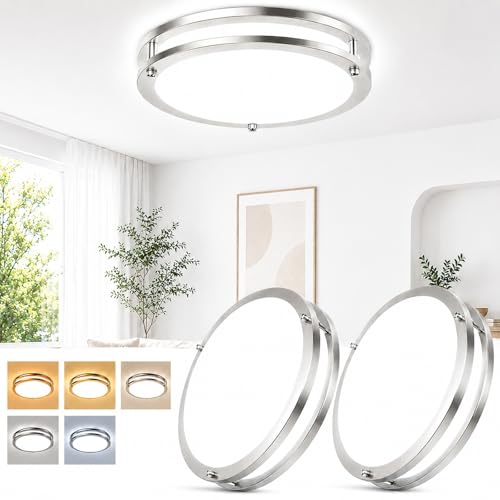 weddeg 63633008-03Most color-accurate light
The quick sizing rule
A common designer rule works well for kitchens. Measure the room's length and width in feet and add them together. The total, read as inches, is the approximate diameter for a fixture that sits alone in the middle of the ceiling.
Take a 10 by 12 foot kitchen. Ten plus 12 is 22, so a 22 inch fixture would look balanced. Treat the result as a starting point, not a strict limit. A fixture a few inches smaller or larger usually still looks fine.
The rule is about looks and proportion. It does not tell you whether the kitchen will be bright enough, which is why the next sections cover brightness and layout.
What the rule means for common kitchen sizes
Notice that many round LED flush mounts are smaller than the rule suggests for mid-size kitchens. That is normal. Splitting the light across two fixtures often looks better and lights the counters more evenly than one large disc in the middle.
| Kitchen size | Rule-of-thumb diameter | Practical approach |
|---|---|---|
| 8 x 10 ft | About 18 in | One 12 to 13 in round fixture, or one long panel |
| 10 x 12 ft | About 22 in | One larger fixture, or two round fixtures spaced apart |
| 12 x 15 ft | About 27 in | Two or more fixtures so the light reaches every counter |
| Galley, 8 x 14 ft | About 22 in | A long rectangular panel or a row of two round lights |
Size is only half the question: brightness
A wide fixture can still leave the counters dim if its output is low. Check lumens, which measure how much light the fixture puts out. On our best lighting for kitchen ceiling page, output runs from 1300 lumens to 4200 lumens, so two fixtures of the same width can differ a lot.
Where a maker lists a coverage area, use it. The LUTEC 13in model is listed at 4200 lumens for rooms up to 250 sq ft, and the weddeg 2-pack is listed at 3600 lumens per fixture, also up to 250 sq ft. If no coverage area is listed, plan on two fixtures for a larger kitchen.
A low-output light, such as the 1300 lumen model on that page, suits a pantry or small nook better than a main kitchen.
Real fixture sizes to compare
Published dimensions help you picture how much ceiling a fixture covers. These figures come from the product data on our comparison page.
Diameter is not the whole story in a kitchen with a low ceiling or a tall cabinet near a door. Height matters too. The Brightever 12in model is only 0.67 in tall, while the weddeg 13in fixture is 2.6 in tall. On a low ceiling, the slimmer one stays further out of the way.
- Brightever 12in round: 12 in across, 0.67 in tall, 3200 lumens.
- LUTEC 13in round: 12.99 in across, 4200 lumens, listed for up to 250 sq ft.
- weddeg 13in 2-pack: 13 in across and 2.6 in tall, with 3600 lumens per fixture.
- Lithonia 1x4 flat panel: 11.85 in by 47.8 in and 1.26 in tall, 4000 lumens, damp rated.
- Six-pack of 12 in fixtures: 2640 lumens each, useful when you want several matching lights.
Choosing a layout: one, two or a panel
One fixture works in a small, squarish kitchen where the light can reach all the counters from the center. In that case, pick the brightest fixture that fits the rule above.
Two fixtures work better when the room is long or has counters on several walls. Spread them roughly evenly so each one covers its own zone. This also reduces the shadows you cast when you stand at the counter with a light behind you.
A long panel suits a galley kitchen. The Lithonia 1x4 panel is nearly four feet long, which matches the shape of a narrow room better than a round disc would. If you hang pendants over an island, a common guideline is to keep the bottom of each about 30 inches above the counter, and to use general ceiling light for the rest of the room.
Safety notes before you install
Ceiling work involves electricity and heights, so slow down and prepare.
Always switch off the circuit at the breaker, not just the wall switch, and confirm the power is off with a voltage tester before touching any wires. Use a stable ladder or step stool on a level floor, and ask someone to steady it if you can.
Wear safety glasses when you work overhead, since dust and debris fall when you remove an old fixture. Make sure the electrical box is rated to hold the weight of the new light. Near the stove or sink, look for a damp location rating. If you are unsure about wiring, hire a licensed electrician.
Finally, set the color temperature before you mount the fixture. Most models on our page use a switch you set before install, so decide on your setting first. You can compare settings and other details on the kitchen ceiling lighting comparison.
Frequently asked questions
Does ceiling height change the size I need?
Height changes how a fixture looks more than how wide it should be. On a higher ceiling, a slightly larger fixture or a second light helps the room feel balanced. On a low ceiling, a slim flush mount keeps clearance.
Can I use one big light instead of two small ones?
You can in a small kitchen. In a longer room, one fixture tends to leave the far counters dimmer, so two lights spread apart usually work better.
Is a bigger fixture always brighter?
No. Brightness depends on lumens, not width. A 12 in fixture can put out more light than a wider one, so compare the lumen figures.
Do I still need under-cabinet lights?
A ceiling light alone can leave shadows on counters when you stand in front of them. Task lighting under the cabinets fills that gap and works alongside the ceiling fixture.