What Size Cable Cutters Do You Need for 4 Gauge Wire?
For 4 gauge wire, choose a cutter that states a copper or aluminum rating clearly above 4 AWG, in a shear or ratchet design. Do not use a wire rope cutter. On our spec sheet, the Klein Tools 63050 (listed for 2/0 soft copper) and the HKS Cable Cutter 36D (listed at 300 mm²) clear that bar, while the 3/16 inch models sit too close to the limit.
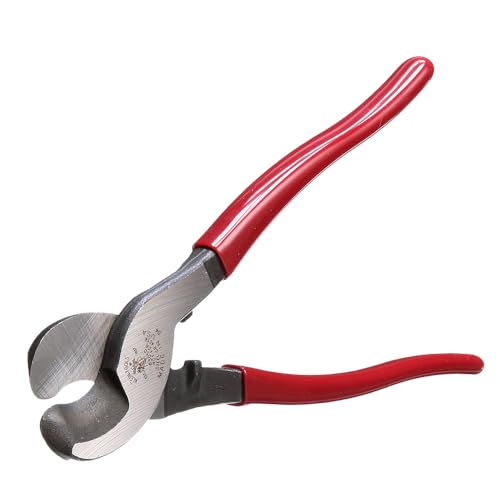 KLEIN TOOLS 63050Best overall
 Muzata MZZ1616Highest wire rope rating
 HKS Cable Cutter 36DLargest copper capacity
How thick is 4 gauge wire?
Wire gauge numbers run backward. A smaller AWG number means a thicker conductor, so 4 AWG is much heavier than the 12 or 14 AWG wire used in household outlets. A bare solid 4 AWG copper conductor measures about 5.2 mm, or roughly 0.2 inch, across. Stranded cable is a little bigger, and insulation adds more on top.
That is why a small pair of side cutters will not do. Thick, soft, stranded copper needs a tool with real leverage and jaws made for cable. The rating on the box matters more than the length of the handles alone.
What cutter rating to look for
The most useful number is a stated copper or aluminum capacity. Wire rope figures describe hard steel strands, which behave very differently from soft power cable. Our best cable cutter page makes the same point: match the tool to the cable, and check the maximum copper size before cutting thick conductors.
Use this short checklist when you read a listing:
- A named copper or aluminum rating, such as 2/0 soft copper, 4/0 aluminum or a size in mm².
- A rating that is clearly larger than 4 AWG, not just equal to it. Equal ratings leave no margin for stranding or insulation.
- A shear or ratchet design made for cable, not a rope cutter.
- A note on whether the tool may cut steel. Some cable cutters must never touch steel wire.
- A safety lock or quick-release lever if you carry the tool or work in tight spaces.
How the cutters on our page compare for 4 gauge
We compare published specifications, so the table below only shows what each maker states. A blank cell means the listing gives no figure.
The Klein Tools 63050 is the clearest match on paper. Its listing names 4/0 aluminum and 2/0 soft copper, and both are larger than 4 AWG. The HKS 36D lists 300 mm² (600 MCM), the largest copper figure among the five. You can see the full side-by-side on our cable cutter comparison.
| Cutter | Type | Stated cable rating | Fit for 4 AWG |
|---|---|---|---|
| Klein Tools 63050 | Shear, 3.8 in, 0.9 lb | 4/0 aluminum, 2/0 soft copper | Clears it on paper |
| HKS Cable Cutter 36D | Ratchet, 10.74 in, 1.68 lb | 300 mm² copper and aluminum (600 MCM) | Clears it with wide margin |
| WORKPRO W015066AE | Wire rope cutter, 7.5 in, 0.82 lb | 3/16 inch aluminum and copper | Too close to the limit |
| GRENPRO 071360 | Wire rope cutter, 7.5 in, 0.67 lb | 3/16 inch aluminum and copper | Too close to the limit |
| Muzata MZZ1616 | Wire rope cutter, 3.54 in, 0.66 lb | No copper rating, 4 mm wire rope | No basis for use |
Shear or ratchet: which design fits
A shear cutter works like a pair of scissors with offset blades. It gives a clean cut in a compact body, which suits confined spaces and a tool pouch. The Klein 63050 is a shear model with one-hand operation. The tradeoff is that short handles ask for more squeeze on thick stranded cable.
A ratchet cutter closes the blade in small steps, so each squeeze needs less force. The HKS 36D uses this approach, and it also has a quick-release lever that lets the blade open at any time. The cost is size and weight. At 10.74 in and 1.68 lb it is the longest and heaviest tool on our page.
If you cut 4 gauge cable once in a while, a rated shear cutter can be enough. If you cut it often, or work with larger sizes, a ratchet gives more margin.
Why rope cutters are the wrong choice
Wire rope cutters are built for hard steel strands. Soft, thick copper can be crushed or frayed between those jaws, and a mismatch can damage the blades. The WORKPRO and GRENPRO list 3/16 inch aluminum and copper cable. That is about 4.8 mm, which is below the roughly 5.2 mm of a bare 4 AWG conductor.
The Muzata lists a 4 mm wire rope maximum, the highest rope figure on our page, but it gives no copper size at all. That is a fine spec for railing and fence cable. It does not tell you anything about 4 gauge power cable.
Safety and cutting tips
Always cut cable that is fully disconnected from power. An insulated handle, rated 1000 volts on the HKS, adds protection but is not a reason to cut live cable. The HKS maker says not to cut live cables, and also says the tool must not be used on steel or iron wire.
Follow these steps for a clean, safer cut:
- Turn off and disconnect the circuit, then confirm it is dead with a tester.
- Wear safety glasses, since cut strands can spring or fly.
- Mark the cut point and keep the cable steady, ideally supported on a bench.
- Place the cable deep in the jaws, square to the blade, not at the tip.
- Cut in one smooth motion or ratchet steadily, and do not twist the tool.
- Check the cut end, and trim again if strands are crushed or uneven.
Frequently asked questions
What does 600 MCM mean?
MCM is an older unit for large conductors, where one MCM equals 1,000 circular mils. The HKS 36D listing gives 300 mm² and notes 600 MCM as the equivalent. Both describe a conductor far larger than 4 AWG.
Can I use bolt cutters on 4 gauge wire?
It is not a good idea. Bolt cutters are made for hard rods and chain, and they tend to crush soft stranded copper instead of shearing it. A cutter with a stated cable rating gives a cleaner end for lugs.
Is aluminum 4 gauge cable harder to cut than copper?
Aluminum is generally softer, so the cutter rating matters in the same way. Check that the listing names aluminum. The Klein 63050 lists 4/0 aluminum and the HKS lists copper and aluminum.
Should I strip the insulation before cutting?
No. Cut through the cable as it is, then strip the end afterward. Insulation adds to the total thickness, so leave extra margin between the cutter rating and the cable size.