What Size Box Cutter Do You Need?
For most cardboard work, you need a box cutter that takes the standard trapezoid utility blade, which is about 61 mm long and 19 mm wide. A body of around 6 inches closed gives a full grip for big cartons, and a 4.5 inch folder is easier to carry. Pick a blade depth that cuts through the carton wall and no deeper.
 WORKPRO W013053Best overall
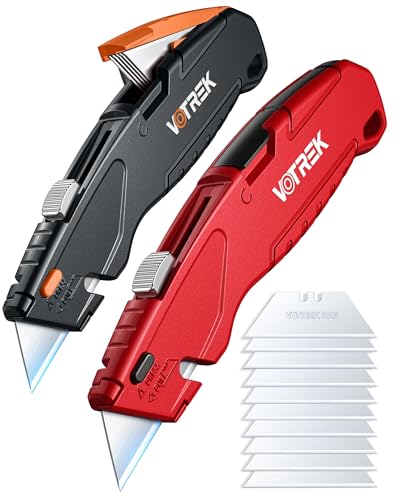 VOTREK UK003Best for one-handed use
 WORKPRO W011047Most blades included
Two sizes to think about: the blade and the body
When people ask what size box cutter they need, they usually mean one of two things. The first is the blade size, which decides whether replacement blades will fit. The second is the body size, which decides how the tool feels in your hand and how easy it is to carry.
These two choices are mostly separate. Many bodies of very different sizes take the same standard blade. That means you can pick the body for comfort and carry, then buy blades to match. Our best box cutter page lines up weight, closed length and blade count so you can compare bodies directly.
The standard blade size and what it is called
The common replacement blade for a box cutter is a trapezoid utility blade. People also call it a razor blade, a utility blade or a standard blade. It measures about 61 mm long, 19 mm wide and 0.65 mm thick, or roughly 2.4 by 0.75 by 0.027 inches. Most retractable and folding utility knives are built around this shape.
Snap-off blades are a different type. They are narrower, often 9 mm or 18 mm wide, and you break off a dull segment to expose a fresh edge. They fit snap-off knives, not trapezoid-style cutters, so do not mix them up when you shop for refills.
Always check the listing before you buy spares. Some makers say their tool works with universal utility blades, which is a good sign. If a listing does not say, match the blade shape to the one you already have. Some tools also take special blades, such as hook blades, so confirm which one your cutter uses.
Blade depth: how far the edge should stick out
Blade depth is a size too, and it matters for cardboard. A shallow cut is safer and less likely to damage what is inside the box. A deeper cut suits thick material but puts more edge in play.
Some retractable cutters let you set the depth in steps. For example, the VOTREK UK003 lists three blade lengths: 3 mm, 8 mm and 15 mm. Its listing describes the 3 mm setting for unboxing, 8 mm for general DIY and 15 mm for carpet and flooring. The WORKPRO W013053 lists three adjustable blade positions, and the EQUIPTZ UK1 lists a 3-step slider.
For single-wall cartons, use the shortest setting that cuts through. Extend further only for double-wall board or other thick material.
Body size and weight: matching the tool to the job
Body size comes down to grip, reach and carry. A longer body gives you more to hold on to when you cut along a big carton. A shorter body slips into a pocket or tool pouch more easily. Lighter tools are easier on your hand over a long shift.
The table below uses the closed length and weight from our product data. A dash means the figure is not listed for that model.
See the full lineup on our best box cutter comparison if you want more models side by side.
| Model | Design | Closed length | Weight | Blades included |
|---|---|---|---|---|
| WORKPRO W013053 | Retractable | 6.3 in | 3.2 oz | 10 |
| VOTREK UK003 | Retractable | Not listed | 3.8 oz | Not listed |
| WORKPRO W011047 | Folding | 4.5 in | See listing | 13 |
| Klein Tools 44306 | Folding | Not listed | 5.92 oz | 3 |
| WORKPRO W011045 | Folding | 4.5 in | 4 oz | 10 |
| EQUIPTZ UK1 | Retractable | 6.9 in | 7.05 oz | 10 |
What size for big boxes, small boxes and everyday use
Match the tool to how you work. These starting points should cover most cases:
- Big boxes and heavy cartons: choose a retractable body around 6 inches or longer, with a depth setting you can raise for thick board. The WORKPRO W013053 at 6.3 in and the EQUIPTZ UK1 at 6.9 in fit this range.
- Small parcels and light packaging: a short depth setting matters more than body length. A 3 mm setting is enough for many parcels.
- Pocket or toolbox carry: a folding design at 4.5 in, such as the WORKPRO W011045 at 4 oz, tucks the edge away and rides on a belt clip.
- High volume shipping: look for a larger blade supply and on-board storage so you are not stopping to find a spare. The WORKPRO W011047 lists 13 blades.
- Occasional use at home: one blade and a simple lock are plenty.
Safety when you cut boxes
A dull blade is a bigger hazard than a sharp one, because it needs more force and can skid. Swap blades as soon as cuts start to tear. Tool-free blade release makes that quick, but check that the new blade is seated before you cut.
Follow these habits every time:
- Cut away from your body and keep your other hand out of the cutting path.
- Never cut toward your hand when you hold the box.
- Retract or fold the blade before you set the tool down or put it in a pocket.
- Check the blade lock on any folding knife before a hard cut.
- Wear cut-resistant gloves when you break down large stacks, and eye protection if you cut strapping or tight bands that can spring back.
- Dispose of used blades in a rigid container, such as a sealed can, not loose in the trash.
A simple way to decide
Start with the blade. Confirm the cutter takes standard trapezoid blades, since those are easy to find and replace. Then choose a depth setting that fits your cartons, and pick a body length you can grip comfortably for the time you spend cutting.
If you want to compare specific models by weight, length, blade count and storage, our best box cutter page puts them on one sheet. We compare published specifications, so check the maker's listing for blade compatibility before you buy refills.
Frequently asked questions
Are all box cutter blades the same size?
No. Standard trapezoid blades are the most common, but snap-off blades are narrower and fit different knives. Some cutters also use hook blades or other shapes. Check your tool's listing before ordering refills.
Is a longer box cutter better?
Not always. A longer body gives more grip for big cartons, while a shorter folder is easier to carry. Choose based on where you use it and how long you hold it.
How do I know when to change the blade?
Change it when the cut starts to tear the cardboard, snag or need extra pressure. A dull blade can slip, so replacing it early is the safer choice.
Can I cut other materials with a box cutter?
Many listings mention items like carpet, vinyl and drywall, but you should use a depth and blade suited to the material. Thick or tough materials may need a longer exposed edge and more care.