What Size Benchtop Jointer Do You Need?
For most home workshops, a 6-inch benchtop jointer is the right size. It handles typical face frames, drawer parts and small furniture stock, and it is easy to set up and put away. Step up to 8 inches only if you regularly flatten wider boards and have the bench space and power to support a larger machine.
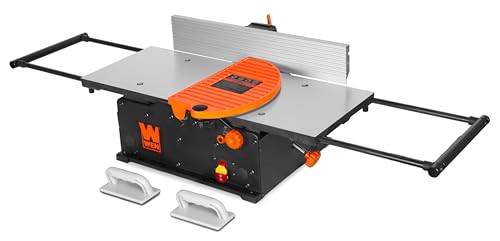 WEN JT1224HBest overall
 CUTECH 401120HI-IF#1 on our Best Score
 CUTECH 40180HBMid-size 8 in spiral
Start with the widest board you flatten
Jointer size is named for the cutting width, which is how wide a board can be and still be flattened in a single pass. A 6-inch jointer flattens a face up to about 6 inches wide. An 8-inch model takes boards up to about 8 inches wide.
Look at your last few projects and find the widest board you needed to flatten on one face. If most of your stock is 5 inches wide or less, a 6-inch machine covers you. If you often work with 7 or 8 inch boards, a wider machine will save you a lot of workarounds.
Boards that are wider than your jointer are not off limits. Many woodworkers rip them narrower first, joint the pieces, then glue them back together. That works, but it adds steps, so it helps to know how often you would do it.
Compare the common size classes
Benchtop jointers are usually sold in a few cutting widths. The table below sums up how they usually fit different kinds of work. For exact widths, bed lengths and weights on specific models, check the published specifications for each one.
| Size class | Best for | Main tradeoff |
|---|---|---|
| 6-inch | Small furniture, boxes, cabinet parts, general home shop work | Wide boards need to be ripped or flattened another way |
| 8-inch | Wider tabletops, shelving and panels, more varied stock | Takes more bench and storage space, and is heavier to move |
| 10-inch | Shops with room to spare and frequent wide stock | Moves toward stationary machine territory in size and handling |
Cutting width is not the only number that matters
Width gets the most attention, but bed length affects how well a jointer flattens long boards. Longer infeed and outfeed tables give a board more support, so it is easier to keep it from rocking or dipping at the ends. A short bed on a long board is a common cause of snipe-like dips and tapered edges.
Cutterhead type also matters. Some machines use straight knives and others use small carbide inserts. Inserts can be turned or replaced individually, which many people find convenient, while straight knives can be resharpened. Neither is wrong, so pick the one that suits how you maintain tools.
A sturdy fence that locks square to the tables is just as important. If the fence flexes or drifts, you will not get square edges no matter how wide the machine is.
- Cutting width: sets the widest face you can flatten.
- Bed length: helps with long boards.
- Cutterhead type: affects how you maintain or replace the cutters.
- Fence quality: determines how square your edges come out.
- Weight and footprint: decide how easy it is to store and set up.
Match the size to your shop space
A benchtop jointer needs a solid bench or stand, plus room at both ends for the board to pass through. A larger machine needs more of both. If you have to move the jointer in and out of a cabinet every time you use it, a lighter 6-inch model will likely get used more often than a heavier 8-inch one.
Think about dust too. Jointers throw a lot of chips, and a small shop fills up fast. Plan for a dust port connection to a collector or shop vacuum that suits the machine's port size, and check the published specs for the port diameter.
Think about the rest of your tool setup
A jointer works best alongside a planer. The jointer flattens one face and one edge, and the planer then brings the opposite face parallel. If you already own a benchtop planer, check its maximum width. Buying a jointer much wider than your planer gives you little benefit, because you cannot finish those wider boards to thickness.
If you are still deciding between machines, our best benchtop jointer comparison lines up the published specifications side by side. If you are also weighing larger floor-standing models, see our best jointer page for a broader view.
Safety before you start
A jointer has an exposed, spinning cutterhead, so treat it with care. Always keep your hands above and away from the cutters, and use push blocks rather than your fingers to feed the board, especially near the end of a pass.
Wear eye protection and hearing protection every time. Jointers are loud, and chips can fly. Unplug the machine before changing cutters or making adjustments, and keep the guard in place. Avoid very short or very thin boards, which are hard to hold safely. Check that the bench is stable and secured before you power on.
A quick way to decide
Run through these steps to land on a size.
- Measure the widest board you plan to flatten most often.
- Check the longest board you handle and compare it with each machine's bed length.
- Measure your bench and storage space, including room at both ends.
- Check the width of your planer so the two tools work together.
- Pick the smallest size that comfortably covers your regular work.
Frequently asked questions
Is an 8-inch benchtop jointer better than a 6-inch?
Not always. It handles wider boards, but it is also larger and heavier. If you rarely work with stock wider than 6 inches, the smaller machine is often the more practical pick.
Can a benchtop jointer flatten a long board?
Yes, with care. Use outfeed support such as a roller stand, and take light passes. A longer bed helps, so check the published bed length before you buy.
Do I need a jointer if I already have a planer?
A planer makes the second face parallel to the first, but it does not reliably flatten a warped board on its own. A jointer creates the flat reference face and a square edge to start from.
What dust collection does a benchtop jointer need?
Jointers produce a lot of chips, so connect one to a dust collector or a shop vacuum that fits its port. Check the port size in the published specs and wear a dust mask if you work in a closed space.