What Size Battery Charger and Air Compressor Combo Do You Need?
Match the starter to your engine and the compressor to your tires. For most cars and small SUVs, a combo with a 150 PSI to 160 PSI pump and a gas engine rating that covers your engine is plenty. Larger gas engines and diesels need a bigger starter, and the biggest units often have no air pump at all.
 birvsw DM1264Strongest truck jump power
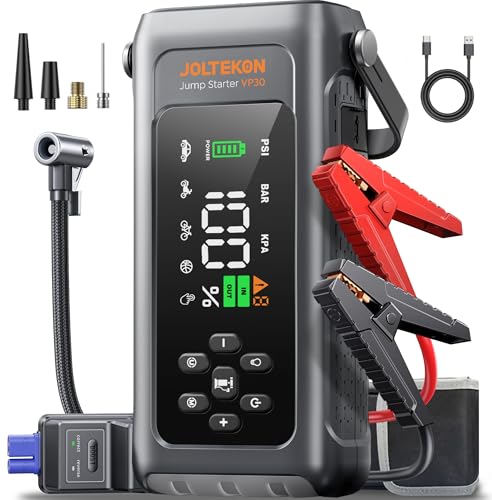 Joltekon VP30Balanced combo for cars
 NACKEO N30High pressure, light body
The short version: size for the engine, then check the pump
A combo unit does two separate jobs, and each one has its own size rating. The starter side is sized by peak current and by the largest engine the maker says it can start. The compressor side is sized by its maximum pressure, and sometimes by air flow.
Start with your engine. Find your engine size in liters, and whether it runs on gas or diesel. Then look for a unit whose listed engine limit is comfortably above that. Once the starter fits, confirm the unit actually has a pump and that the pump reaches the pressure your tires need.
The tire side is usually the easy part. Passenger car tires typically run in the 30s PSI, and your door jamb sticker gives the exact number. Almost any built-in pump can reach that figure, so the starter rating is the one that deserves most of your attention.
Sizing the jump starter side
Peak current is the number most listings lead with, but it is only one clue. Makers measure and report it in different ways, so two units with the same figure may not behave the same. The max engine size is often the clearer guide, because it tells you what the maker expects the unit to start.
On our best battery charger and air compressor combo page, listed gas engine limits run from 8L to 99L. That is a huge spread, which is why a one-size answer does not work. A compact car engine and a diesel truck engine sit at opposite ends of it.
Here is a simple way to think about it:
- Small car or crossover: a mid-range starter with a modest engine limit is usually enough.
- Large SUV, pickup, or van: choose a higher peak current and a higher engine limit, and leave some margin.
- Diesel truck, farm, or fleet use: look at heavy-duty starters, and plan on a separate inflator if the unit has no pump.
- Motorcycle, mower, or boat: a small starter works, but check that the clamps and cables suit the battery you have.
Sizing the air compressor side
Look for a max tire pressure figure in the specs. If it is missing, the unit is a starter and power bank only. Across our comparison page, rated pressure runs from 100 PSI to 180 PSI.
Keep in mind that max PSI is the pump limit, not a fill speed. A 160 PSI pump can still take a while to fill a large tire. Air flow in L/min helps compare speed, but many makers do not publish it, so do not rule out a unit just because the number is absent.
Useful extras on the pump side include auto shut-off, which stops inflation at your set pressure, and a choice of PSI, BAR, or KPA units. A detachable hose and several nozzles help if you also fill bike tires or sports balls.
How real products line up
The table below uses published specs from three products on our comparison page. It shows how different the size choices can be.
The Joltekon VP30 and the NACKEO N30 both include a pump, and both suit smaller engines. The birvsw DM1264 is far stronger, but its listing does not show a tire pressure figure, so treat it as a starter and power bank, not a combo. If you want a deeper look at ranking and scores, our combo comparison page has the full list.
| Product | Peak current | Max gas engine | Max tire pressure | Weight |
|---|---|---|---|---|
| Joltekon VP30 | 4500A | 9L | 150 PSI | 2.65 lb |
| NACKEO N30 | 8000A | 12L | 160 PSI | 1.43 lb |
| birvsw DM1264 | 30000A | 50L | Not listed | Not listed |
Other specs that affect fit
Weight matters if you keep the unit in a glovebox or a motorcycle bag. Weights on our page run from 1.2 lb to 21.8 lb, so a heavy-duty unit is a different kind of purchase than a pocketable one.
Operating temperature also matters. Both the VP30 and the N30 list a range of -4°F to 140°F, which covers many winter mornings and hot parked cars. If you live somewhere more extreme, check the range before you buy.
Built-in protections guard against reverse polarity, short circuits, over-current, and overheating. Counts on our page run from 3 to 14. The VP30 lists 10, and the DM1264 lists 8. More protections do not make a weak starter strong, but they do make mistakes less costly.
Safety notes before you use one
Read the manual before the first use. Jump starters connect to a car battery that can release flammable gas, so keep sparks and flames away.
Follow these basics every time:
- Connect the positive clamp first and the negative clamp to bare metal on the engine, if your manual says so.
- Never connect the clamps to each other, and never leave them touching.
- Do not use a swollen, cracked, or damaged unit.
- Keep the unit out of hot, sealed cars for long periods, and stay within its listed temperature range.
- Wear eye protection when working near a battery, and wear hearing protection if you use a pump for long stretches, since small compressors can be loud.
- Do not inflate beyond the pressure printed on the tire sidewall.
When a combo is not the right size
Sometimes the answer is to split the jobs. If you own a diesel truck or run a fleet, a heavy-duty starter with no pump may be the right fit, paired with a separate inflator. If you fill many tires or run air tools, a garage unit is a better match than a portable one.
In those cases, browse our best air compressor for home garage page for a stationary option. If you work on cars often, see best air compressor for automotive shop too. For hoses and connectors, our best air compressor fittings page can help you match parts.
Frequently asked questions
Can a small combo start a large truck?
Not reliably. Check the listed max engine size first. A unit rated for 9L or 12L of gas engine is built for smaller engines, while heavy-duty starters list limits like 50L.
Do all jump starters include an air compressor?
No. Some are starter and power bank only. If the specs show no max tire pressure, assume there is no pump.
Is a higher PSI rating always better?
Only to a point. Most car tires need far less than the pump limit. A higher rating gives you headroom for larger tires, but it does not mean faster filling.
How do I know the starter is big enough for cold weather?
Check the operating temperature range in the specs and choose a unit with margin above your engine size. Cold weather makes engines harder to start.
Can I use the power bank ports while the unit is low on charge?
It is better not to. Keep enough charge in reserve for a jump start, since the same battery powers both the starter and the pump.