What PSI to Use When Pressure Testing a Radiator
Pressure test your radiator at the rating stamped on the radiator cap, or the figure in your vehicle's service manual. Do not go above it. Many passenger cars use caps in the low to mid teens of psi, but always check your own cap rather than trusting a general number.
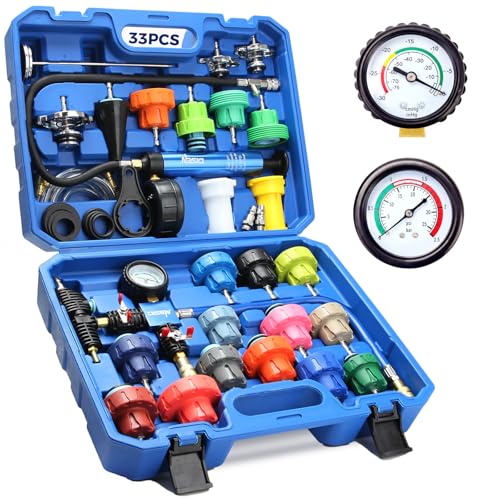 DISEN DS-33LQYZKJZTJBest overall
 Orion Motor Tech RCPDual-scale 35 psi gauge
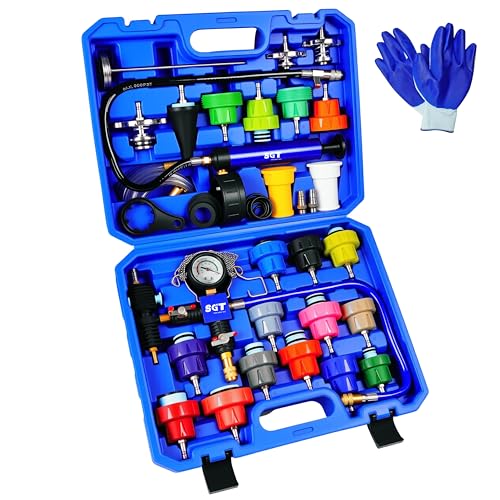 SGT SUPER GARAGE TOOLS SGT-Q295-BLUEListed pressure and vacuum ranges
Use the cap rating as your test pressure
The radiator cap is a pressure valve. It holds the cooling system at a set pressure and releases the excess. That rating is the highest pressure the system is designed to see in normal use, so it is the right target for a test.
Look for a number on the top of the cap, usually marked in psi, kPa, or bar. If the cap is missing or unreadable, use the figure in your service manual or on the expansion tank. A worn aftermarket cap with a different rating is a poor reference, so confirm it matches what the manufacturer specifies.
Pumping past the rating does not make the test more thorough. It can split an old hose, crack a plastic tank, or push a weak seam past the point where it would normally fail, which turns a diagnosis into a repair.
Why the gauge limit is not your target
Test kits list a maximum gauge range, and that number can look like a goal. It is not. On our best cooling system pressure tester page, three of the five ranked kits list 35 psi as the maximum test pressure, and the other two do not publish a figure. That is the top of the gauge, not a pressure to apply to your car.
A gauge that reads high is useful because it leaves room above your cap rating, so the needle sits in a readable part of the dial. If your manual lists bar instead of psi, a dual-scale gauge saves you from converting. One kit in our data, the Orion Motor Tech 19pc, reads in both psi and bar and lists a 2.5 psi-to-bar match of 35 psi (2.5 bar).
How to run the test
The process is simple, but the order matters. Start with a cold engine so the system is not under heat pressure and the coolant is not hot enough to burn you.
- Make sure the engine has been off long enough to be fully cool, then top off the coolant to the proper level.
- Choose the adapter that fits your radiator or expansion tank neck and attach the tester so it seals well.
- Pump slowly until the gauge reaches the pressure printed on your cap. Stop there.
- Watch the needle. A steady reading means the system is holding. A dropping needle points to a leak.
- Look over hoses, clamps, the radiator seams, the water pump, and the heater hoses for drips, wet spots, or coolant residue.
- Release the pressure slowly using the tester's release valve before you remove anything.
How long to hold the pressure
Hold the pressure for a few minutes at first, long enough to watch the needle and check for obvious drips. Slow leaks can take longer to show, so some technicians let the system sit under pressure for 15 to 30 minutes, checking the gauge periodically.
If the needle drops but you cannot see any coolant outside, the leak may be internal. Signs include white exhaust smoke, a sweet smell, or coolant that disappears with no puddle. A failed head gasket or a cracked heater core can behave this way, and a pressure test is one of the first steps to point you toward it.
Test the cap separately if your tester includes a cap adapter. A cap that cannot hold its rated pressure can cause coolant loss and overheating even when the rest of the system is sound.
Testing the system versus testing the cap
These are two different checks that use the same tool. Keeping them apart helps you read the results correctly.
The table below shows how they differ.
| Check | What you test | Target pressure | What a drop means |
|---|---|---|---|
| System test | Hoses, radiator, water pump, heater core, gaskets | The rating on the cap or in the manual | A leak somewhere in the system |
| Cap test | The pressure valve in the radiator cap | The rating stamped on the cap | The cap is not sealing or releases early |
Safety notes
Never open a hot radiator or expansion tank. Hot coolant under pressure can spray out and cause serious burns. Let the engine cool completely first.
Wear eye protection. A hose or adapter can pop loose under pressure, and coolant is irritating to eyes and skin. Wipe up spills right away, because coolant is toxic and attractive to pets.
If the engine has an electric fan, keep your hands and tools clear. Some fans can start on their own, even with the key off, when the engine bay is warm.
Pump slowly and never exceed the cap rating. If a part starts to bulge or weep heavily, release the pressure at once.
Choosing a tester that fits your car
The right adapters matter as much as the gauge. Three kits on our cooling system pressure tester comparison list 23 adapters, while two list only 3. If you work on one or two common vehicles, a smaller set may be enough. If you work on several brands, a larger set saves trips and workarounds.
A vacuum refill tool is also worth a look. It pulls air out of the system before you add coolant, which helps prevent air pockets that can cause overheating after a repair. The DISEN 33-piece kit, for example, lists 23 adapters, vacuum refill, a thermometer, and a carrying case, while the SGT 33-piece kit lists a 0 to 35 psi pressure range and a 0 to 30 inHg vacuum range. You can compare both side by side on our best cooling system pressure tester page.
Frequently asked questions
Can I test at a higher pressure to find small leaks?
No. Stay at the cap rating. Going higher risks damaging hoses, tanks, and seams, and it can create new leaks that were not there before.
Do I test with the engine running or off?
A standard system test is done with the engine off and cool. Running the engine adds heat and moving parts, which raises both the risk and the pressure in the system.
What if my cap has no visible rating?
Check your service manual or the manufacturer's parts listing for the correct cap and its pressure. Replace a cap you cannot identify with one that matches the specification.
Is a needle that drops slowly a real leak?
Usually yes. Check for external drips first, then consider an internal leak if you find none. Rule out a loose adapter by wetting the seal area and retesting.