What MIG Wire Is Used for Mild Steel and What Is It Made Of?
Use ER70S-6 solid MIG wire for mild steel and other carbon steel. It is a copper-coated carbon steel wire with extra manganese and silicon, which help it weld through light rust and mill scale. It runs with shielding gas on an ordinary MIG welder, and you pick the diameter to match your machine and metal thickness.
 HYW Products ER70S603504544Best overall
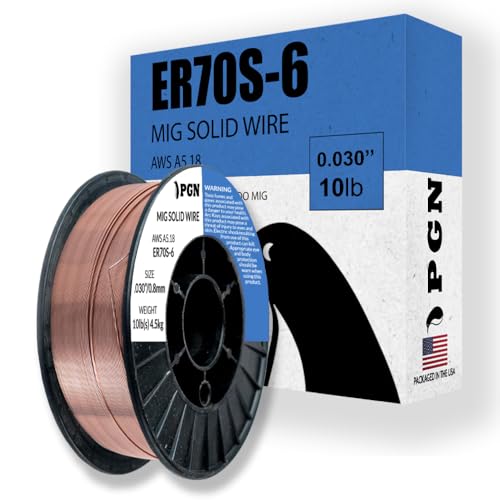 PGN Bearings WW-ER70S6-030-10LBBest for hobby welders
 PGN Bearings WW-ER70S6-035-33LBBest mid-size spool
The short version: ER70S-6 solid wire
If you only remember one thing, remember ER70S-6. It is the wire most welders reach for when they MIG weld mild steel, and it is just as common on other carbon steel such as structural shapes, brackets, and tubing. That is why it is also the answer to "what MIG wire for carbon steel."
The wire works with a standard MIG setup and a shielding gas. You do not need a special welder. You do need to match the wire diameter to your machine and the thickness of the steel, which we cover below.
If you want to see specific spools side by side, our best mig wire for mild steel page lists several ER70S-6 options with their diameters and spool weights.
What the name ER70S-6 means
The letters and numbers on the label are a code from the American Welding Society. Once you can read it, wire shopping gets much easier.
- ER: the wire can be used as an electrode (carried current) or as a filler rod.
- 70: the weld metal has a minimum tensile strength of 70,000 psi, which suits mild steel.
- S: the wire is solid, not hollow or flux filled.
- 6: the chemistry group. The 6 version carries more deoxidizers than the ER70S-3 version.
What mild steel MIG wire is made of
Solid MIG wire is mostly iron, with a low carbon content so the weld behaves like mild steel. Small amounts of other elements are added on purpose to make the arc and the weld pool behave well.
The two that matter most in ER70S-6 are manganese and silicon. They act as deoxidizers. During welding they bind with oxygen and other impurities in the molten pool and pull them out into a thin glassy crust on the bead, often called slag islands. That helps prevent porosity (tiny gas holes) and helps the metal flow and wet out smoothly at the edges of the weld.
Because ER70S-6 has more of these deoxidizers than ER70S-3, it is more forgiving on steel that is not perfectly clean. Several listings in our data describe this as "high levels of silicon and manganese deoxidizers" and a smoother bead.
Most solid wire also has a thin copper coating. The coating helps the wire feed smoothly through the liner and contact tip, helps with electrical contact, and protects the wire from surface rust while it sits on the spool.
ER70S-6 compared with other wire choices
ER70S-6 is not the only wire that works on mild steel. Here is how the common options stack up for a typical home or small shop welder.
| Wire | Needs shielding gas? | Best for | Watch out for |
|---|---|---|---|
| ER70S-6 solid | Yes | General mild and carbon steel, light rust or mill scale | Needs a gas cylinder and calm air |
| ER70S-3 solid | Yes | Clean, bare steel with good surface prep | Less forgiving on dirty metal |
| Gas-shielded flux core | Yes | Thicker steel and heavier work | More smoke and slag to clean |
| Self-shielded flux core | No | Outdoor or windy jobs | More spatter and slag, rougher bead |
Choosing diameter and spool size
Diameter is the choice that changes how the welding feels. Thinner wire runs cooler and suits thin sheet and smaller welders. Thicker wire carries more current and suits heavier steel. On our comparison page the diameters run from 0.023 to 0.035 in.
The most common sizes in our data are 0.030 in and 0.035 in. For example, several 0.030 in wires come on 10 lb spools, while 0.035 in wires come on 33 lb and 44 lb rolls. The 0.030 in size is a popular all-round pick for hobby and garage work, and 0.035 in is a good step up when you are welding thicker steel and your machine can handle it.
Spool size is mostly about convenience. A big roll means fewer wire changes, but only if your welder can hold it. Check your spool holder before you order a large roll, because many small machines are built for smaller spools. Our best mig wire for mild steel picks show both small spools and larger rolls so you can match the size to your machine.
- Thin sheet and small welders: lean toward the thinner wire.
- General garage and fabrication work: 0.030 in is a common middle ground.
- Thicker plate and a stronger machine: consider 0.035 in.
- Occasional use: a smaller spool is less likely to sit around and rust.
Shielding gas, setup and storage
Solid wire needs shielding gas to protect the weld pool from the air. Many welders use a mix of argon and carbon dioxide for mild steel, and pure carbon dioxide is also used. Your welding supplier can tell you what regulator and settings suit your machine. Always check the wire maker's recommended settings and your welder's chart.
Set the wire feed speed and voltage to match the wire diameter and metal thickness. Check that the drive roll groove and contact tip match the wire size. A mismatch is a common cause of poor feeding and wire jams.
Keep spools dry and covered when you are not welding. Moisture and rust on the wire can cause porosity and erratic feeding. Some wires ship vacuum sealed, which helps keep moisture out until you open the pack.
Safety notes
MIG welding involves electricity, heat, bright light, and fumes, so set up carefully.
Wear an auto-darkening welding helmet with the right shade, dry welding gloves, and flame-resistant clothing that covers your skin. Wear safety glasses under the helmet and hearing protection when grinding or chipping. Weld in a space with good ventilation and keep flammable materials well away.
Make sure your welder is properly grounded, the cables are not damaged, and your work area is dry. Secure gas cylinders upright with a chain or strap, and close the valve when you are finished. Remove any paint, galvanizing, or coatings before welding, because they can release harmful fumes.
Frequently asked questions
Is ER70S-6 the same as copper-coated wire?
Not exactly. ER70S-6 describes the wire's classification and chemistry. Most ER70S-6 solid wire is also copper coated, but the copper is a surface layer for feeding and corrosion protection, not part of the class name.
Can I use ER70S-6 without shielding gas?
No. Solid wire needs shielding gas to protect the weld. If you cannot use a gas cylinder, self-shielded flux core wire is the usual alternative for mild steel.
Is ER70S-3 or ER70S-6 better for clean steel?
ER70S-3 works well on clean, bare steel. ER70S-6 does the same job and also copes better with light rust or mill scale, which is why it is the more common all-round choice.
Does a bigger spool make a better weld?
No. Spool size affects how often you change wire, not weld quality. Choose the size your welder's spool holder accepts and that you will use before the wire gets damp or rusty.