What Materials Can Go Through a Jointer?
A jointer is built for solid wood, both hardwoods and softwoods, with the grain running along the length of the board. Plywood, MDF, end grain, painted or nail-filled reclaimed boards, plastics and metal are poor fits, and some are unsafe. If you are unsure about a piece, use a different tool for it.
 CUTECH 401120HI-IFBest overall
 Jet JJ-6HHDXLongest 6 in tables
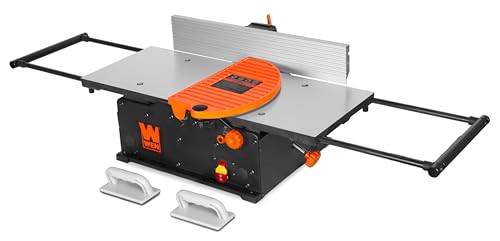 WEN JT1224HBest wide benchtop value
The short list: what a jointer is made to cut
A jointer flattens one face of a board and squares one edge to that face. Its cutterhead spins knives or inserts that shave thin layers from solid lumber, so it works best on stock where the grain runs the length of the board. Oak, maple, cherry, walnut, poplar, pine and similar species are all fine.
Product listings back this up. The JET JJ-6HHDX is described as built for wood, and its listing gives a minimum stock size of 8 in long, 3/4 in wide and 1/4 in thick. Pieces smaller than that are better shaped with another tool, because short or thin stock is hard to hold flat and keep your hands clear of the cutterhead.
For a quick view of the common materials, see the table below.
Material by material guide
Here is how the most common materials behave on a jointer. The ratings are general woodworking guidance, not a promise for every machine.
| Material | Jointer use | Why |
|---|---|---|
| Solid hardwood | Yes | Cuts cleanly, especially with a sharp or carbide cutterhead |
| Solid softwood | Yes | Cuts easily, but soft grain can dent and tear if knives are dull |
| Plywood | Edges only, with caution | Glue layers dull cutters and the face veneer is thin |
| MDF and particleboard | Avoid | Abrasive, very dusty and rough on cutting edges |
| Reclaimed lumber | Only after checking | Hidden nails, screws and grit can damage cutters |
| End grain | No | High tear-out and kickback risk |
| Plastic and metal | No | Not what the machine is designed to cut |
Can you use a jointer on plywood?
You can technically run a plywood edge over a jointer, but most woodworkers choose not to. The glue between plies is hard on cutting edges, and the thin outer veneer can chip as the knives exit the cut. A face pass is pointless anyway, since plywood is made flat and removing the veneer ruins the sheet.
If you must clean up a plywood edge, take a very light pass and use a carbide cutterhead. A table saw with a good blade or a router with a straight bit is usually the better choice for plywood edges.
MDF and particleboard are even harder on cutters, and they create fine dust that you should not breathe. Skip them on the jointer.
Why end grain is off limits
End grain means the cut surface at the end of a board, where the wood fibers point straight at you. Pushing it across a jointer makes the knives lift and break the fibers instead of slicing them. The result is heavy tear-out and chipped corners, and it can grab the workpiece and throw it.
A jointer cuts along the grain, so feed the board with the grain running with the cutterhead rotation. If you need a square end, use a miter saw, table saw with a crosscut sled, or a hand plane with a shooting board.
Spiral and helical heads reduce tear-out on tricky grain, but they do not make end grain safe. Our best jointer page explains how those cutterheads differ.
Can a jointer do all four sides, or both faces?
No. A jointer prepares two surfaces that meet at a right angle: one face and one edge. It cannot make the second face parallel to the first, because the board rides on the table with nothing to set a thickness.
The usual order of work is:
- Joint one face until it is flat.
- Joint one edge square to that face, with the fence set at 90 degrees.
- Run the board through a planer with the jointed face down to make the opposite face flat and parallel.
- Rip the other edge on a table saw, with the jointed edge against the fence.
- Cut to final length with a saw.
Check the board and the machine before you cut
Material matters, but so does condition. Check every board for nails, staples, screws, grit and embedded stones, especially reclaimed lumber. A metal detector helps, and so does a careful look at the end grain and surfaces. Very wet wood, loose knots and bark can also damage cutters or cause rough cuts.
Cutter type matters too. The WEN JT1224H listing describes 24 staggered HSS blades, while the CUTECH 401120HI-IF uses tungsten carbide inserts. Carbide generally holds an edge longer, which helps with abrasive or glued material, though the wrong material can still nick any cutter.
Also match the job to the machine. Most models in our lineup remove up to 1/8 in per pass, while the Powermatic 60HH lists a 1/2 in maximum depth of cut. Cutterhead width limits the board width: the models run from 6 in to 12 in. If you are deciding between sizes, our best jointer comparison lays out width, tables and weight side by side.
Safety notes
A jointer has an exposed rotating cutterhead, so these habits matter every time:
- Wear safety glasses and hearing protection, and keep long sleeves, jewelry and loose hair away from the machine.
- Use push blocks to feed the board, and never pass your hands over the cutterhead.
- Unplug the machine before changing or rotating inserts or knives.
- Use dust collection. The JET JJ-6HHDX listing calls for a collector rated at least 350 CFM, and fine dust from MDF and sanding is a health risk.
- Never joint pieces shorter or thinner than the manufacturer's stated minimum.
- Stop and reassess if a board rocks, chatters or feels like it may catch.
Frequently asked questions
Can a jointer handle painted or finished wood?
It is best to avoid it. Paint, stain and finish can hide metal fasteners and leave residue on the cutters. Strip or cut off the finished surface first, and check for hardware.
Is a jointer the same as a planer?
No. A jointer flattens one face and squares one edge. A planer makes the opposite face parallel to the first and brings the board to a set thickness.
Can I joint very short or thin pieces?
Usually not safely. The JET JJ-6HHDX listing states a minimum of 8 in long, 3/4 in wide and 1/4 in thick. For smaller parts, joint a longer board first and cut the pieces afterward.
Does a spiral cutterhead let me cut more kinds of material?
Not really. It gives a smoother finish in figured grain and runs quieter, but the material list stays the same. Solid wood is still the right choice.