What Kind of Outlet Should You Use in a Garage?
Use GFCI-protected, grounded 120-volt outlets, ideally on a 20-amp circuit, and keep them above the floor. Heavy tools like compressors or welders may need their own dedicated circuit, and some need 240 volts. For extra reach on a bench, a heavy-duty power strip with a resettable breaker is a good add-on, but it never replaces proper wiring.
 GE 54638Best overall
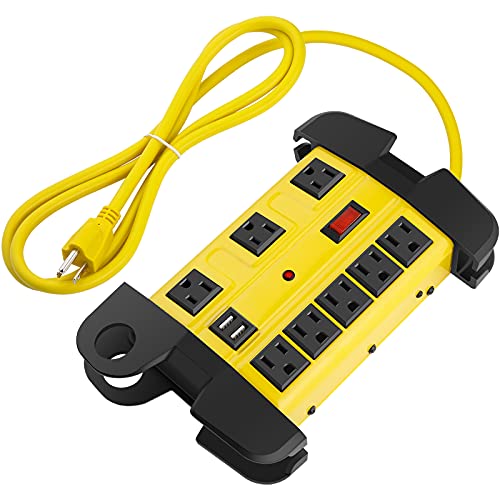 CCCEI CC-02-8U-03Metal strip with 2700 J
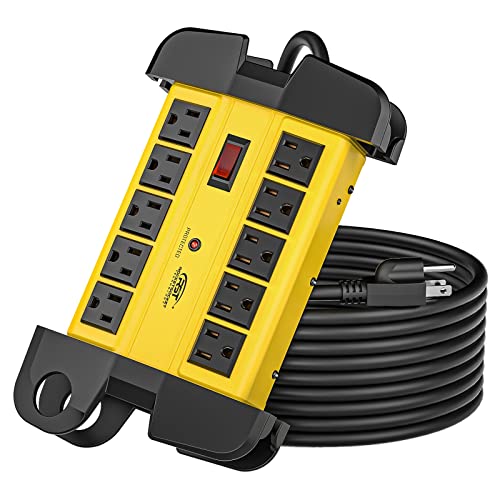 CRST LTS-10TSTied for longest cord
The short version: GFCI, grounded, and on the right circuit
Garages are damp, dusty and often cold, and the floor is concrete. That is a poor mix with electricity, which is why garage outlets are held to stricter rules than outlets in a bedroom. The baseline is a grounded three-prong outlet with ground fault circuit interrupter (GFCI) protection.
A GFCI outlet watches the current going out and coming back. If some of it leaks, for example through a person or a wet tool, it shuts off power in a fraction of a second. Electrical codes in the US generally require GFCI protection for garage receptacles, and local rules can differ, so check what applies where you live.
Many garages are wired with at least one 20-amp circuit. That matters because tools such as table saws, shop vacuums and compressors can draw a lot of current when they start up.
Match the outlet to the job
Not every garage needs the same setup. A garage that only stores bikes and a freezer has different needs than a workshop with a table saw and an air compressor. The table below shows common choices and where each fits.
Treat it as a planning aid. Wiring changes inside walls should be done or checked by a licensed electrician.
| Outlet type | Best for | Notes |
|---|---|---|
| Standard GFCI duplex (120 V) | Hand tools, chargers, lights, radios | The everyday choice. Look for a grounded, three-prong outlet. |
| 20-amp GFCI outlet on a 20-amp circuit | Saws, vacuums, heavier portable tools | Accepts both 15-amp and 20-amp plugs. Needs the matching breaker and wire size. |
| Dedicated circuit | Freezer, compressor, a major stationary tool | Only one load on the circuit, so nothing else trips it. |
| 240-volt outlet | Large compressors, welders, EV chargers, some big shop machines | Needs a different outlet, breaker and wiring. Always use a licensed electrician. |
| Weatherproof in-use cover | Outlets near the door or on the outside wall | Keeps rain and splashes out even while a cord is plugged in. |
Where to place outlets
Put more outlets than you think you need. Running long cords across the floor creates trip hazards and wear points, and daisy-chained cords are a common cause of overloaded circuits.
Mount receptacles above floor level, where they stay clear of puddles, snow melt and spilled fluids. Bench areas do well with a row of outlets just above the work surface. For large machines, locate the outlet close to where the machine will actually sit, so you do not need an extension cord at all.
- Place a few outlets along each wall so a short cord reaches anywhere.
- Put a pair above the workbench for chargers and hand tools.
- Give a freezer or fridge its own outlet so a tripped tool does not thaw your food.
- Add an outlet near the garage door opener, or a ceiling outlet for the opener itself.
- Plan for the future, such as an EV charger or a larger compressor.
What to do when you need more outlets fast
Adding new wiring takes planning and sometimes a permit. In the meantime, or for a bench that just needs more sockets, a heavy-duty power strip is the practical fix. Our best power strip for garage page compares models on the points that matter in a workshop.
Look for a resettable circuit breaker, a thick cord and a sturdy housing. Each strip on that page is rated for 1875 W, which is 15 amps at 125 volts. Add up the wattage of what you plan to run at once and stay under that number. Adding outlets does not raise the limit.
Cord gauge is also worth checking. AWG describes wire thickness, and a lower number means thicker wire. Among the models that list a gauge, 12 AWG is the thickest and 14 AWG is the most common. Cord length goes up to 15 ft on the longest, but reach is less important than gauge.
Surge protection, mounting and certification
Surge protection is rated in joules. On our comparison, ratings run from 800 J to 4800 J. Higher numbers suit valuable electronics like chargers and shop radios. Power tools lean more on the breaker and cord than on the joule rating, so look at both.
Mounting matters in a garage. Every strip ranked on our garage power strip comparison lists wall mounting, which keeps it off a damp floor and out of the way of foot traffic. Metal housings resist knocks better than thin plastic.
Finally, check for a safety certification such as ETL. One metal strip on the page lists none, so it is worth reading the spec sheet before you decide. Keep in mind that a power strip is not a permanent wiring solution, and you should plug it directly into a wall outlet, never into another strip.
Safety notes before you start
Electrical work can injure or kill, and garages add water, metal tools and concrete floors to the mix. Keep these rules in mind.
- Turn off the breaker and confirm the power is off with a tester before touching any wiring.
- Use a licensed electrician for new circuits, 240-volt outlets, panel work and any wiring you are unsure about.
- Press the TEST and RESET buttons on GFCI outlets regularly, following the maker's directions.
- Do not use an indoor strip or cord outside or in standing water. Use gear rated for the conditions.
- Never run a tool that draws more than the strip or cord is rated for. A warm cord or a tripping breaker is a warning.
- Wear eye and hearing protection when using power tools, and use a stable ladder or step stool when working on ceiling or high outlets.
A simple way to decide
Start with what you plan to plug in. If it is chargers, lights and hand tools, GFCI-protected standard outlets on a 20-amp circuit are enough. If you run large stationary tools, plan dedicated circuits, and consider 240 volts for the biggest machines.
If you cannot add outlets right now, choose a rated, breaker-equipped strip, mount it, and keep your total load below its limit. Then bring in an electrician when you are ready for permanent changes.
Frequently asked questions
Do I need a weatherproof outlet in my garage?
Only for outlets that can get wet, such as ones on an exterior wall or near an open door. Use an in-use cover that closes over a plugged-in cord. Inside a dry garage, a standard GFCI outlet is usually enough.
Can I use a regular household outlet instead of GFCI?
Codes in most places call for GFCI protection in garages, so a regular outlet alone is generally not acceptable for new work. A GFCI breaker at the panel can also protect a circuit. Ask a licensed electrician what your local rules require.
Can I plug a freezer into a garage power strip?
It is better to use a wall outlet. A strip adds a failure point, and a breaker trip on the strip can go unnoticed while food thaws. A dedicated outlet is the safer arrangement.
How do I know if a tool needs 240 volts?
Check the label or manual on the tool. The nameplate lists the voltage and amperage. If it says 240 V, it needs a matching outlet and circuit, and a standard 120-volt outlet will not work.