G Clamp vs F Clamp: What Is the Difference?
A G clamp (also called a C clamp) has a closed, curved frame with a threaded screw, so it is compact and holds very firmly on small pieces. An F clamp has a long straight bar with a sliding head, so it adjusts quickly and opens wide enough for boards and panels. Pick a G clamp for small, tight, high-pressure holds and an F clamp for larger or wider work.
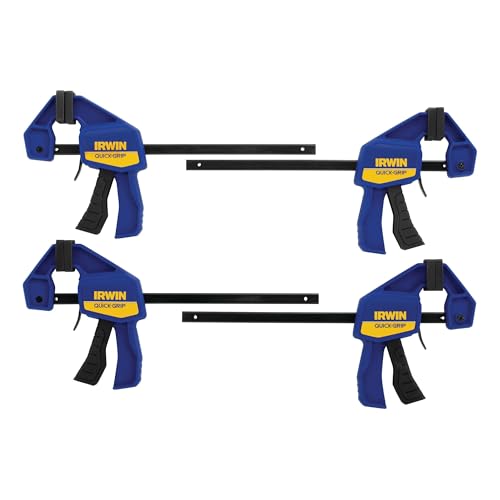 IRWIN 1964758Lightest listed clamp
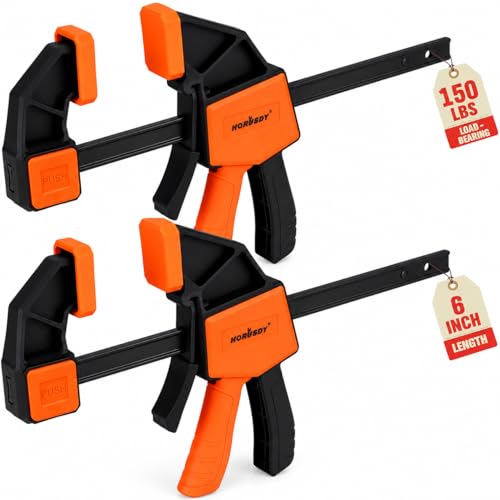 HORUSDY 88026Spreader in a two-pack
 Jorgensen 93424ALong reach, 24 in opening
How the two clamps are built
A G clamp is a single curved frame shaped like the letter G or C. One jaw is fixed to the frame. The other jaw sits on a threaded screw that you turn by hand with a handle or tommy bar. The frame sets the maximum opening, so the clamp can only open as wide as its frame allows.
An F clamp is built around a long straight bar. A fixed jaw sits at one end, and a sliding head moves along the bar. Many models lock the head with a screw, a ratchet, or a trigger. Because the bar can be long, the opening can be much wider than most G clamps offer.
Both tools do the same basic job: they press two surfaces together. The difference is in how they reach, how fast they adjust, and how they spread pressure.
Where each one works best
G clamps suit small jobs where you need a firm, steady hold. Think of metal brackets, small welding or fabrication work, holding a part to a bench, or pinning a small workpiece while you drill. The closed frame is stiff, and the screw lets you add pressure gradually.
F clamps suit woodworking and anything wide. Glue-ups, cabinet frames, drawers, shelves, and panels are typical jobs. You slide the head to roughly the right spot, then tighten. That saves time when you have many clamps to set while glue is still wet.
F clamps can often do one more thing. Some models can be converted into spreaders, which push parts apart instead of pulling them together. That helps when you are fitting frames or separating panels. A standard G clamp cannot do this.
Side-by-side comparison
The table below summarizes the general differences. Exact limits vary by model, so always check the maker's spec sheet.
| Feature | G clamp (C clamp) | F clamp (bar clamp) |
|---|---|---|
| Frame shape | Closed, curved G or C frame | Straight bar with sliding head |
| Opening range | Limited by the frame size | Set by bar length, often much wider |
| Adjustment speed | Slower, you turn the screw the whole way | Faster, slide the head then tighten |
| Typical use | Metalwork, small parts, benches | Woodworking, panels, frames, glue-ups |
| Reach from the edge | Fixed by the frame depth | Set by the throat depth of the head |
| Spreader use | No | Available on some models |
| Bulk and storage | Compact | Long bars take more space |
What to check on an F clamp
If you decide an F clamp fits your work, a few numbers matter. Our best f clamps page puts these on one spec sheet so you can compare products side by side. Some makers leave a figure out, so a blank means the maker did not publish it.
Jaw opening is the widest piece the clamp can hold. Clamping force shows how hard the jaws press. Throat depth is how far the clamp can reach in from an edge.
- Jaw opening: the listed clamps range from 12 in up to 36 in. The CRAFTZONE 36in F Bar Parallel Clamp lists the widest opening, with parallel jaw faces.
- Clamping force: light trigger clamps such as the IRWIN Quick-Grip 1964758 list 140 lb, while the Wilton GSM30 heavy-duty F-clamp lists 2660 lb.
- Throat depth: values on our page run from 1.1875 in to 5.5 in. The Wilton GSM30 lists 5.5 in, and the Jorgensen E-Z Hold 24in lists 3.375 in.
- Extras: quick release, soft jaw pads, and a spreader function make repeated adjustments easier and protect finished wood.
How to choose between them
Start with the size and shape of the job. If the piece is wider than a typical G clamp frame, an F clamp is the practical choice. If you are holding a small part firmly and the frame easily reaches around it, a G clamp is simple and compact.
Next, think about speed. Gluing up a panel means setting several clamps before the glue starts to set. Sliding an F clamp head into position with one hand is far quicker than winding a G clamp screw across a wide gap.
Then think about the surface. Many F clamps ship with soft, non-marring pads, such as those listed on the IRWIN and Jorgensen models on our F clamp comparison. Bare steel jaws can dent wood, so with any clamp, add a scrap block between the jaw and the finished surface.
Many workshops end up with both types. A few G clamps handle small, rigid holds, and a set of F clamps handles the wider work.
- Choose a G clamp for small parts, metal, and tight, firm holds.
- Choose an F clamp for wide boards, glue-ups, frames, and cabinet work.
- Choose an F clamp with spreader function if you also need to push parts apart.
- Pick a longer bar than you think you need, or look for clamps that link together for extra reach.
Using clamps safely
Clamps store a lot of force, so treat them with care. Keep fingers clear of the jaws and the sliding head, because pinch points are easy to miss when you are focused on alignment.
Do not over-tighten. Extra force can bend a bar, crack a handle, or crush the workpiece. Heavy pressure is only needed for some hardwood glue-ups, and even then it should be steady and even.
Wear safety glasses when tightening or releasing a clamp under heavy load, since a slipping jaw or a snapping workpiece can throw fragments. If you are clamping something you will then cut, drill, or weld, add the eye, ear, and hand protection that job needs, and make sure the clamp is clear of the tool path.
Never use a clamp as a lifting aid or to hold a ladder or load in place. Clamps are made to press things together, not to carry weight.
Frequently asked questions
Is a G clamp the same as a C clamp?
Yes. Both names describe the same tool. The closed frame can look like a G or a C depending on the angle.
Can an F clamp replace a G clamp?
Often, yes, for woodworking and wide pieces. For small metal parts or tight spaces where you want a compact, stiff frame, a G clamp can still be the better fit.
Why do woodworkers prefer F clamps?
The sliding head adjusts quickly, the bar opens wide for panels, and many models have soft pads and a spreader function. These features suit glue-ups and frame work.
Do F clamps need pads?
They are not required, but soft pads protect finished wood from dents and scratches. If your clamp has bare jaws, use scrap wood as a buffer.