What Is the Correct Way to Use a Staple Remover?
Slide the tip of the remover under the crown of the staple (the flat bar on top), tilt the handle so the staple lifts, then pull it out in line with its legs. For paper, use a jaw-style remover from the back of the page. For upholstery and wood, use a thin-tipped lifter, and wear eye protection while you work.
 meillyocean ME-QDQ4PS-100Best overall
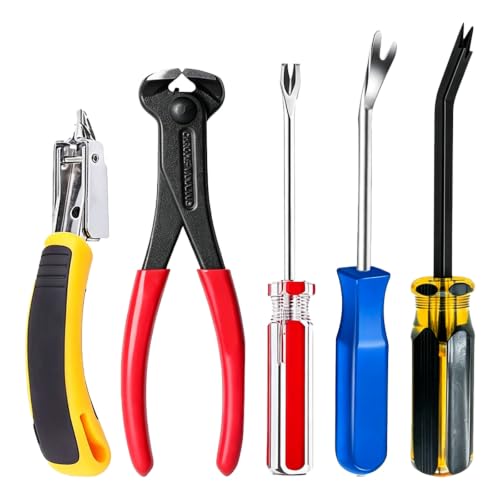 GOROBU Staple-remover-5pcTies for most pieces
 Fifatopo QDQ-StyleRust resistant hardened set
Match the remover to the job
Staple removers come in a few shapes, and each one works best on a certain kind of staple. Using the wrong shape is the most common reason staples bend, snap or tear the material around them.
A jaw-style office remover is made for thin staples in paper. A flat lifter with a V or U tip is made for heavier staples in wood and fabric. Pliers handle the staples that break off and leave only the legs behind. Our best upholstery staple remover page compares single lifters and multi-piece sets if you need heavier gear.
| Job | Best tool | Why it fits |
|---|---|---|
| Paper and card stacks | Jaw-style office remover | Two small teeth grip under the staple legs from the back of the page |
| Upholstery staples in wood frames | Flat lifter with a V or U tip | A thin hardened tip slides under the crown and pries upward |
| Broken or flush staples | End cutting pliers | Grip the stub and pull it straight out |
| Tacks and small nails | Tack puller | The curved base slips under the head and loosens it |
How to use an office staple remover on paper
Most jaw-style removers work the same way. The goal is to lift both legs of the staple at once instead of pulling on one side.
Turn the stack over first. The bent legs on the back are easier to reach than the flat crown on the front.
- Flip the paper so the bent legs face up.
- Open the jaws and place one tooth under each leg, just outside the bend.
- Squeeze the handles together so the teeth lift the legs straight out of the paper.
- Turn the paper back over and pull the staple free from the front.
- Drop the staple into a bin right away so it does not end up on the floor or in a drawer.
How to use an upholstery staple remover on wood
Upholstery staples are set deeper and held by dense wood, so the method changes. You pry instead of squeeze, and the angle of the tool matters more than force.
Start by securing the piece so it will not shift. Place the tip against the wood next to the staple, with the flat side of the tip facing down. Work the tip under one end of the crown until it catches, then rock the handle so the staple rises. Switch to the other end and repeat until the staple stands proud, then pull it out along the line of its legs.
- Keep the tool at a low angle to the wood. A steep angle digs a gouge next to the staple.
- Lift a little at one end, then a little at the other. Pulling one end all the way up tends to snap the staple.
- If the crown is buried, tap the tip gently under it with a mallet instead of forcing the handle.
- Use pliers to grip any staple that breaks, and pull it straight out.
- Work in a steady line across the frame so you do not miss any staples that would tear the new fabric.
Pick a tool with the right tip and handle
A hardened tip makes the job much easier because it slides under the crown without bending. The DneyLerf Heavy Duty Staple Remover, for example, lists chrome vanadium steel, a 30-degree angled rod and a rubber handle at 8.46 in long. That extra length gives leverage for stubborn staples.
If you also have broken staples and tacks to deal with, a set may suit you better. The meillyocean 4-piece set lists a nail remover, end cutting pliers, a V-nail puller and a U-nail puller, at 7.9 in overall length. The GOROBU 5-piece upholstery set lists chrome vanadium steel with pliers and tack pullers. Our upholstery staple remover comparison lays out the specs side by side, including where makers leave out details like weight or steel type.
Safety steps before you start
Staples are small, sharp and often spring free under pressure. A few simple habits prevent most injuries.
Wear safety glasses every time you pry out a staple. Staples can fly off at speed, and a bent leg can snap back toward your face. Work gloves protect your fingers from the sharp legs left in the wood. Keep your free hand behind the tip and never in front of it, because the tool can slip sideways when a staple lets go.
If you are working on an old chair or sofa, check for loose fabric and dust before you start. Wear a dust mask if the filling is crumbling. Pick up every staple you remove, since stray ones are a hazard for bare feet and pets.
Never use a staple remover on skin
Some people search for how to use a staple remover on skin. Office and upholstery removers are not made for that, and they are not sterile. If you have a staple in your skin, such as after an accident with a stapler, see a doctor or urgent care clinic.
Surgical staples are different. They need a special medical remover, and a healthcare professional should take them out. Do not try to remove them at home, and do not use a hardware tool on a wound.
A quick word on using an upholstery stapler
Many readers who need to remove staples are also about to add new ones. An upholstery stapler is held flat against the wood with the fabric under the nose. Press down firmly and squeeze the trigger so the staple is driven in fully.
Keep your fingers clear of the nose and the area in front of it. Point the stapler away from yourself and others. Disconnect power if yours is electric or pneumatic before you clear a jam. Test on a scrap of the same wood first, so you can check that the staples sit flush and do not sit proud.
Frequently asked questions
Why does the staple keep bending when I lift it?
The tip is probably too thick, or you are lifting only one end. Use a thinner lifter, work both ends in turn and keep the tool low against the surface.
Can I reuse staples after I remove them?
It is better not to. Removed staples are usually bent or weakened, so they hold poorly the second time. Use new ones for the repair.
What do I do with a staple that breaks off flush with the wood?
Grip any stub with pliers and pull it straight out. If there is nothing to grip, tap a thin lifter gently under the broken edge to raise it first.
Will pulling staples damage the wood?
It can leave small marks, but a low angle and a thin tip keep them small. A curved base or fulcrum under the tool helps protect the surface.