What Is the 3/4 Rule for Floor Jacks?
The 3/4 rule says your floor jack should be rated to lift at least three-quarters (75%) of your vehicle's Gross Vehicle Weight Rating (GVWR). That is the maximum weight the manufacturer says the vehicle can safely carry, not its empty curb weight. Treat the result as a minimum, then round up to the next jack size.
 SATA 3T AluminumBest overall
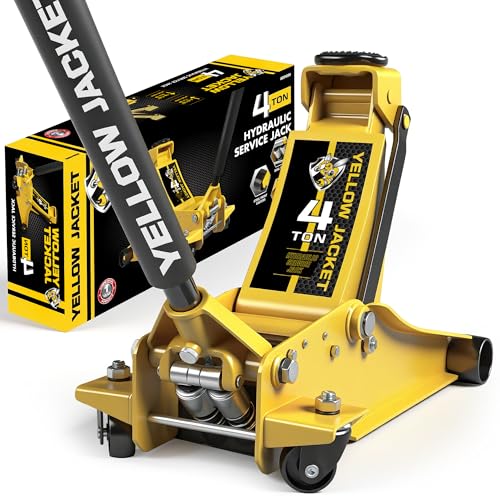 YELLOW JACKET AS840094-ton capacity
 VEVOR Aluminum and Steel Racing JackThree safety standards listed
What the 3/4 rule means
The rule is a quick way to pick a safe jack rating. Take your vehicle's GVWR, multiply it by 0.75, and buy a jack rated at or above that number.
GVWR is the maximum loaded weight set by the manufacturer. It includes the vehicle, fuel, passengers and cargo. You can find it on the sticker inside the driver's door jamb or in the owner's manual.
Many people use curb weight instead, because it is easier to look up. That can leave you short. A loaded truck or SUV can weigh well above its curb weight, and the rule is meant to cover that case.
Why the rule works
When you lift one corner or one end, the jack does not carry the whole vehicle. It carries only part of it. So why use 75% of the full weight? Because the rule builds in a safety margin for uneven loads, heavy cargo and a front or rear end that carries more than half the weight.
A jack that works near its limit is also under more stress. Staying below the rated capacity helps the seals, the pump and the frame last longer. A rated overload valve is a backup, not a target to aim for.
How to apply it step by step
The math takes about a minute. Follow these steps.
- Find the GVWR on the door jamb sticker or in the owner's manual.
- Multiply the GVWR by 0.75 to get the minimum jack capacity in pounds.
- Divide by 2,000 to convert pounds to tons.
- Round up to the next common jack rating.
- Check that the jack's minimum saddle height fits under your vehicle and its maximum lift height gives you enough room.
| Vehicle GVWR | 75% of GVWR | Minimum jack rating |
|---|---|---|
| 4,000 lb | 3,000 lb | 1.5 tons |
| 5,000 lb | 3,750 lb | 1.9 tons |
| 6,000 lb | 4,500 lb | 2.25 tons |
| 8,000 lb | 6,000 lb | 3 tons |
| 10,000 lb | 7,500 lb | 3.75 tons |
Matching the result to a real jack
Most floor jacks are sold in 2-ton, 3-ton and 4-ton ratings. Among the jacks on our low profile floor jack comparison, ratings run from 2 tons to 4 tons.
A 2-ton jack handles 4,000 lb, so under the rule it fits vehicles up to a GVWR of about 5,300 lb. The Sunex 6602LP is a 2-ton example with a 2.75 in minimum saddle height and a 24 in maximum lift. A 3-ton jack covers 6,000 lb, which suits a GVWR up to 8,000 lb. The SATA 3T Aluminum is a 3-ton example, with a 3.75 in minimum and a 19.125 in maximum.
A 4-ton jack covers 8,000 lb, which suits a GVWR up to about 10,600 lb. The Yellow Jacket AS84009 is rated for 4 tons, but its saddle starts at 4.3125 in, so check your clearance first. Listings for these jacks give capacity in pounds too, such as 6,600 lb for the 3-ton models and 8,800 lb for the 4-ton Yellow Jacket.
Height matters as much as capacity
Capacity is only half of the choice. A jack that cannot slide under your car, or cannot lift high enough, is no use even if it meets the 3/4 rule.
Measure the gap under your lift point. Then compare it with the jack's minimum saddle height. Lowered cars and sports cars often need a saddle near the low end of the range. Trucks and SUVs usually need a taller maximum lift. Our best low profile floor jack page lists these numbers side by side so you can check both.
Safety notes
A floor jack is for lifting, not for holding. Never work under a vehicle that is supported only by a jack. Hydraulic seals can fail without warning.
Use these habits every time:
- Work on firm, level ground. Avoid soft dirt, gravel and slopes.
- Set the parking brake and chock the wheels that stay on the ground.
- Lift only at the manufacturer's jack points.
- Place jack stands under solid support points and lower the vehicle onto them.
- Choose jack stands with a rating that also meets or beats the 3/4 rule.
- Wear safety glasses, and keep hands and feet clear of pinch points.
When to go higher than the rule
The 3/4 rule is a floor, not a ceiling. If you tow, haul heavy loads or work on a vehicle near its GVWR, a higher rating gives you more margin. A bigger jack can also be easier to use, since it runs further from its limit.
The trade-off is size and weight. Higher-capacity jacks tend to be larger, and some sit higher off the ground. Weigh the extra margin against the clearance you have.
Frequently asked questions
Is the 3/4 rule based on curb weight or GVWR?
It is based on GVWR. Curb weight is the empty vehicle, so using it can understate what the jack may need to handle.
Does a jack with a higher rating work for a lighter car?
Yes, as long as it fits under the car. The risk is not the rating but the height, since higher-capacity jacks often have a taller minimum saddle.
Do jack stands follow the same rule?
Use the same approach. Pick a pair of stands rated for at least 75% of the GVWR, and make sure the stand's height range suits your work.
Can I use the rule for a trailer or RV?
You can use the same math with the trailer's GVWR. Lift only at the points the manufacturer names, and use stands made for that weight.