What Is Sand Blasting and How Does a Sand Blaster Work?
Sand blasting is a surface treatment that uses compressed air to shoot abrasive particles at a surface, stripping rust, paint and scale or giving the surface a fresh texture. A sand blaster is the gun or machine that mixes the abrasive into the air stream and aims it through a nozzle. Most home setups pair a handheld gun with an air compressor and a supply of dry abrasive media.
 LE LEMATEC AS118-2Best overall
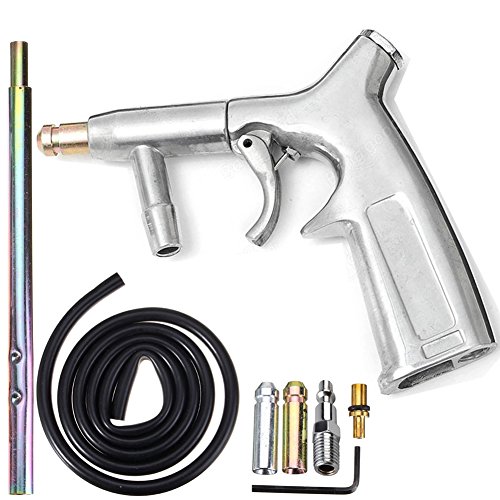 Jewboer Best for blast cabinets
 HOLDWIN SAFD45Best for small detail work
What sand blasting is
Sand blasting, also called abrasive blasting, is a way to clean or shape a surface by hitting it with small, hard particles at high speed. The particles knock off whatever sits on top: rust, old paint, scale, grime or a thin layer of the material itself.
The name comes from the original abrasive, sand. Today many people use other media, such as aluminum oxide, glass beads or silicon carbide, because they can be chosen to suit the job. The process is still often called sand blasting, and the tool is still called a sand blaster, whatever goes in it.
The result is a clean, slightly roughened surface. That roughness helps new paint or coatings grip, which is why blasting is a common step in surface preparation.
How a sand blaster works
A sand blaster does not make power on its own. It borrows power from compressed air and uses that air to pick up abrasive and throw it. The basic sequence is the same on nearly every handheld gun.
- Your air compressor sends a steady stream of air through a hose to the gun.
- Inside the gun, the air speeds up as it passes through a small passage. Fast-moving air creates suction, the same effect that lets a spray bottle draw liquid upward.
- That suction pulls abrasive into the air stream, either up a hose from a container or down from a cup on top of the gun.
- The air and abrasive travel together through the nozzle, which narrows and shapes the stream.
- The particles hit the surface at speed and chip away rust, paint or other coatings.
Siphon, gravity and pressure feed
The way abrasive reaches the air stream is the biggest difference between blasters. Each style suits a different kind of work.
| Feed type | How it works | Best suited to |
|---|---|---|
| Siphon | Air flow creates suction that pulls media up a hose from a container | Larger, flatter surfaces |
| Gravity | Media sits in a cup on top of the gun and drops into the air stream | Small parts and detail work |
| Pressure pot | Media sits in a sealed, pressurized tank and is pushed out with the air | Large surfaces and longer jobs |
Why your compressor matters
Blasting uses air continuously, so air volume matters more than peak pressure. Volume is measured in CFM (cubic feet per minute), and pressure in PSI. A compressor that reaches the right PSI but cannot supply enough CFM will give weak, pulsing flow.
The published requirements show how demanding this can be. LE LEMATEC says its AS118-2 gun needs at least 4 CFM at 90 PSI, lists a 150 PSI maximum, and says it is not meant for pancake compressors under 6 gallons. It notes that small 1 to 3 gallon compressors lead to sputtering and low performance. Check the CFM rating on any gun before you buy, and compare it with your compressor's rating at the same pressure.
Air quality counts too. Wet air makes abrasive clump and clog the gun, so an inline air filter or water trap is a sensible addition. Keep the media itself dry in a sealed container.
What sand blasting is used for
People reach for a sand blaster when sanding or wire brushing would take too long or cannot reach into the surface. Common jobs include:
- Removing rust from tools, fences and automotive parts
- Stripping paint from metal and other hard surfaces
- Cleaning car wheels and rims
- Etching glass for decoration
- Refurbishing outdoor tiles and brickwork
- Preparing metal so paint or coatings stick better
Choosing media and kit
The abrasive you pick changes how aggressively the blaster cuts. Coarser, harder media removes heavy rust faster, while finer or softer media is gentler on delicate surfaces. Always use the media the gun maker says it supports. For example, LE LEMATEC says to use clean, dry media between 46 and 220 grit.
Nozzles wear out because abrasive passes through them constantly. Ceramic nozzles resist wear far better than steel, and many kits include several sizes so you can match the nozzle to the job. A blast cabinet is another option for small parts, since it contains the dust and lets you reuse the media.
If you are ready to shop, our best sand blaster comparison puts nozzles, feed type, hose, weight and fittings on one spec sheet. It is also worth reading it alongside your compressor's specs, since a good kit is only useful if your compressor can keep up.
Safety before you start
Sand blasting throws hard particles and fine dust into the air, so protection is not optional. Treat the gun like a tool that can injure someone.
- Wear sealed eye protection or a full face shield. Ordinary glasses are not enough.
- Use a respirator rated for fine dust. Dust from blasting, and especially from silica sand, can harm your lungs.
- Wear hearing protection, since compressors and blasting are loud.
- Wear gloves and thick clothing to protect your skin from rebounding abrasive.
- Never point the gun at people or animals, and keep bystanders well away.
- Work outdoors or in a well-ventilated space, and check that your hose and fittings are secure before turning on the air.
- Check your compressor's power requirements and plug it into a properly rated outlet.
Frequently asked questions
Is sand blasting the same as shot blasting?
They are related but not identical. Both fire abrasive with force. Sand blasting usually refers to air-driven abrasive such as sand, glass beads or aluminum oxide, while shot blasting often means throwing metal shot with a wheel in industrial equipment.
Can I use regular sand in a sand blaster?
Many guns are built for specific media, so follow the manufacturer's list. Fine dust from silica sand is a serious breathing hazard, which is one reason many people choose other abrasives such as glass beads or aluminum oxide.
Will sand blasting damage the surface?
It can. Blasting removes material, so hard media at high pressure on thin metal, glass or soft materials can pit or warp the surface. Start with finer media and lower pressure, and test on a hidden spot first.
Why does my sand blaster sputter?
The usual causes are a compressor that cannot supply enough CFM, damp media or wet air, or a clogged nozzle. Check the gun's air requirements, dry the media and add a water trap if needed.