What Is Pliers Used For? Common Uses Explained
Pliers are hand tools with two handles, a pivot and a pair of jaws. They grip, hold, bend, twist and cut things your fingers can't handle alone. Five common uses are gripping nuts and pipes, holding small parts, cutting wire, bending and shaping wire, and clamping work in place. Yes, you can strip wire with pliers, but a dedicated wire stripper does it more cleanly.
 DISEN 21DGNQBest overall
 WORKPRO W006012AEBest with storage racks
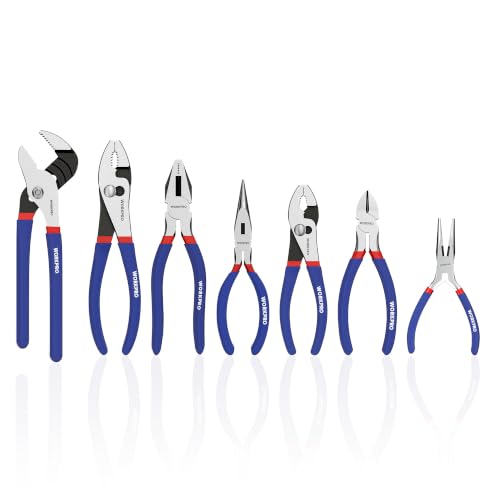 WORKPRO W001306ABest basic set
What pliers are and how they work
Pliers are a hand tool built from two handles, two jaws and a pivot point. When you squeeze the handles, the pivot multiplies your hand strength at the jaws. That extra force lets you hold, turn or cut things you could not manage with bare fingers.
Different jaw shapes handle different jobs. Flat, serrated jaws bite into metal. Long, narrow jaws reach into tight spaces. Sharp angled edges shear through wire. That is why most toolboxes hold several pliers instead of just one.
Five common uses for pliers
If you only remember a handful of jobs, these are the ones that come up most around the house, garage and car.
- Gripping and turning: Slip joint and groove joint pliers grab nuts, bolts, pipes and fittings when you don't have the right wrench.
- Holding small parts: Needle nose (long nose) pliers pick up and position tiny screws, washers, clips and wires in tight spots.
- Cutting wire: Diagonal cutters snip wire, zip ties and small pins flush to a surface.
- Bending and shaping: Needle nose and linesman pliers bend wire into loops, hooks and gentle curves.
- Clamping and holding: Locking pliers clamp onto a part and stay shut, so both hands are free to work.
Which type of pliers does which job
The names can be confusing, so here is a quick map. It matches the plier types that a well-rounded set usually includes, as covered on our best pliers page.
Snap ring (circlip) pliers are a specialty type. They spread or squeeze the small metal rings that hold shafts and pins in place, which is why they show up in car work.
| Plier type | Best for | Typical job |
|---|---|---|
| Slip joint | Light gripping with two jaw positions | Holding a nut, pulling a small nail |
| Groove joint | Gripping larger, rounder objects | Turning pipe fittings and big nuts |
| Needle nose | Reaching and precise holding | Bending wire, retrieving dropped screws |
| Diagonal cutters | Cutting wire close to a surface | Trimming wire ends and zip ties |
| Linesman | Gripping, bending and cutting together | General electrical and wire work |
| Locking | Clamping and holding without squeezing | Holding a part steady, stuck fasteners |
| Snap ring | Installing and removing retaining rings | Automotive and equipment repair |
Can you use pliers to strip wire?
Yes, but it depends on the pliers. A wire stripper has graduated notches that match wire sizes, so it removes the insulation without nicking the copper underneath. Some pliers sets include one. The DISEN 21-piece set and the WORKPRO 20-piece set on our comparison page both list a wire stripper among their pieces.
You can strip thin wire with diagonal cutters or the cutting edge of linesman pliers. Squeeze just enough to cut the insulation, rotate the tool a little, then pull the insulation off. This takes practice, and it is easy to cut into the metal strands. Nicked conductors are weaker and can overheat later.
For anything beyond a quick, low-stakes job, use a proper stripper. It gives a cleaner result and protects the wire.
Common uses by project
Here is how pliers show up in everyday projects.
In the garage and on the car, groove joint pliers grip stubborn fittings and snap ring pliers handle retaining rings. Locking pliers clamp a hose or hold a part while you work. Some sets also include oil filter pliers, which grip a filter so you can turn it free.
Around the house, slip joint and groove joint pliers help with plumbing fittings, while needle nose pliers help with picture hanging wire, small hardware and craft projects. Diagonal cutters tidy up cable ties and trim wire.
For electronics and light electrical work, needle nose pliers position small leads and diagonal cutters trim them. Linesman pliers bend and twist heavier wire.
Safety notes and choosing a set
Pliers are simple, but a few habits prevent injuries. Wear safety glasses whenever you cut wire, because snipped ends can fly off. Never use pliers on live electrical wiring unless they are rated and insulated for that job, and switch off and verify power is off before you work on any circuit. Don't use pliers on gas fittings or as a hammer. Keep your fingers clear of the pivot and the jaws, and check that the grip is dry and clean so the tool does not slip.
When you are ready to buy, look for hardened steel jaws, cutting edges that stay sharp, and handles that stay secure in oily hands. Sets on our page range from 3 to 21 pieces, so you can start small or cover many jobs at once. You can see them side by side on our best pliers comparison.
Frequently asked questions
Are pliers the same as wrenches?
No. Wrenches fit a specific nut or bolt size and turn it cleanly. Pliers grip many shapes and sizes, but they can round off a fastener, so use a wrench when you have the right one.
What is the difference between slip joint and groove joint pliers?
Slip joint pliers have two pivot positions for a small and a large opening. Groove joint pliers have several adjustment positions and longer handles, so they handle larger pipes and nuts with more leverage.
Why are locking pliers useful?
They lock onto an object and hold it without you squeezing. This frees both hands and gives a firm grip on rounded or stuck parts.
Can I cut hard steel wire with any pliers?
No. Cutting hard wire with the wrong tool can damage the cutting edge. Use cutters made for the job, and check the tool's published specifications before trying.