What Is a Transmission Jack and What Is It Used For?
A transmission jack, often called a trans jack, is a hydraulic lifting stand with a tilting saddle that holds a heavy transmission while you lower it out of a vehicle or raise it back into place. It also lets you adjust the angle so the gearbox lines up with the engine. Telescoping models are made for cars on a lift, and low-profile floor models are made for cars on jack stands.
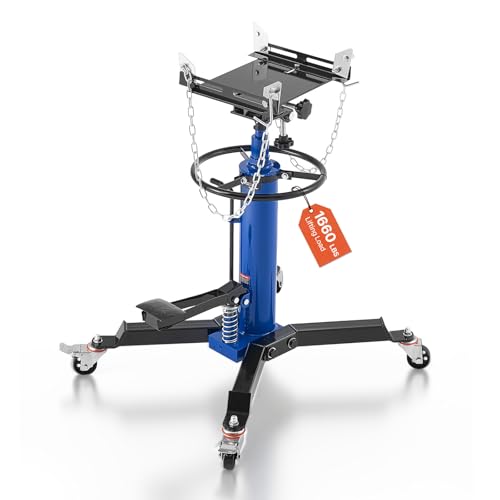 VEVOR GW-0.8Best overall
 VEVOR HTJ-1322Best for steady saddles
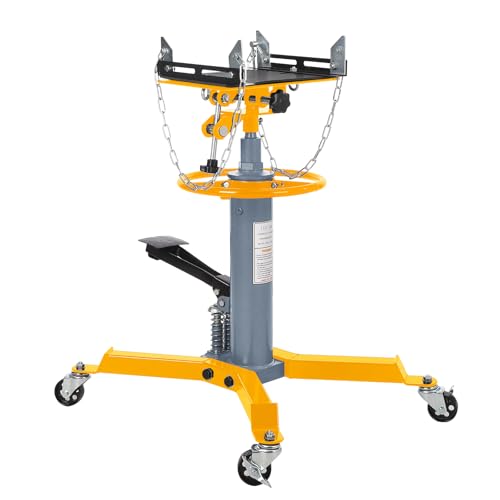 JustSmart LL-jackshuang-YELLOWIos3Le2Best dual plunger
How a transmission jack works
A transmission jack is built around a hydraulic ram. When you press a foot pedal (or work a pump handle on some models), fluid pressure pushes the ram upward and raises a platform called a saddle or tray. Turning a release valve lets the fluid return slowly, so the load comes down in a controlled way instead of dropping.
Most jacks sit on a wide base with swivel casters, so you can roll the jack under the vehicle and then roll the transmission away once it is free. Many have a center ring or handle to help you push and pull the jack across the floor.
The saddle is what sets a transmission jack apart from an ordinary floor jack. It can tilt and often rotate, and some saddles adjust in width to cradle different transmission shapes. A tie-down chain or strap goes over the transmission so it cannot slide off while it moves.
What a transmission jack is used for
The main job is removing and installing a transmission, or a transfer case, on a car or light truck. A transmission is awkward and heavy, and it has to come out and go back in at a precise angle. Trying to do that with a winch or pure muscle is risky, and a trans jack gives you a stable platform instead.
The same tool helps with other heavy, hard-to-hold parts. Some listings also mention drive shafts and axles as suitable loads. Check the jack's rated capacity and your part's weight before you try anything beyond a transmission.
- Lowering a transmission out of the vehicle after the mounts and bolts are removed
- Raising a transmission back up and fine-tuning its angle for reinstallation
- Supporting the gearbox in place while you swap a clutch or other parts nearby
- Rolling a removed transmission across the shop floor
What a transmission jack looks like
Picture a tall, narrow column on a wide, flat base. The base is often X-shaped or square so it stays steady, and it sits on four casters. On our top-ranked VEVOR model, for example, the base footprint is listed as 28.94 by 24.61 inches, and two of the four casters have brakes.
At the top is the saddle, a flat tray with adjustable plates or arms to grip the transmission. On that same VEVOR model, the tray rotates 360 degrees and tilts up to 30 degrees. A foot pedal near the base raises the jack, and a release handle controls the descent.
A telescoping jack has a column that extends in stages, like a nested tube, which is how it reaches high enough to serve a vehicle raised on a lift. A low-profile floor jack looks shorter and flatter, because it is meant to slide under a car that sits on jack stands.
Telescoping vs. low-profile floor jacks
The right style depends mostly on how the vehicle is supported. Our best transmission jack page covers both styles, with lift ranges from 7 to 76 inches and capacities from 450 to 2000 pounds across the models we compare.
| Feature | Telescoping jack | Low-profile floor jack |
|---|---|---|
| Best for | Vehicles raised on a lift | Vehicles on jack stands |
| Reach | High, with multi-stage columns | Short, close to the floor |
| Example from our page | VEVOR 1660 lb, 34.6 to 69.3 in | MAXSA 450 lb |
| Typical capacity trend | Higher | Lower |
| Footprint | Larger, wider base | Smaller, easier to store |
A basic overview of how a job goes
Every vehicle and transmission is different, so follow the service manual for your car. In general, the process looks like this:
- Raise and support the vehicle securely, either on a lift or on properly rated jack stands.
- Disconnect the battery, drain fluids as needed, and remove the driveshaft, linkage and any parts in the way.
- Roll the jack under the transmission and raise the saddle until it touches the case.
- Strap or chain the transmission to the saddle before removing any mounts.
- Remove the mounts and bell housing bolts, then slide the transmission back and lower it slowly using the release valve.
- For reinstallation, reverse the process, using the saddle tilt to match the engine angle before sliding the gearbox forward.
Safety notes before you lift anything
A transmission is heavy and can shift suddenly, so treat the work seriously. Never rely on a jack alone to hold a vehicle. Use a lift or jack stands rated for the load, and keep your body out from under a raised, unsecured load whenever you can.
Lock the caster brakes before you raise the transmission, and always fasten the tie-down chain or strap. One listing for our top pick notes that vehicles must be supported by a car lift, and that parts should be chained to avoid falling.
Wear safety glasses, because fluid, rust and debris can fall as you work. Gloves and steel-toe boots protect your hands and feet. Turn the release valve gently, since a sudden drop can damage parts or injure you. Use the jack on flat, hard floor, not on soft ground or a slope.
What to check when choosing one
Start with capacity. Look up your transmission's weight and pick a jack rated well above it. Then match the lift range to your setup. A jack that fits a lift may be too tall to be useful under a car on stands, and a low-profile jack may not reach a vehicle on a lift.
Next, look at saddle adjustment and stability. Tilt and rotation make alignment easier, while locking casters, a wide base and a tie-down chain keep the load steady. For a side-by-side look at these specs, see our transmission jack comparison.
Weight matters too, since you have to move the jack around. Our lightest telescoping pick here has a 1660 lb capacity at 86 lb, while the Sunex 7796 air/hydraulic model weighs 160 lb and reaches 73.5 inches.
Frequently asked questions
Can I use a regular floor jack instead?
It is not a good idea. A standard floor jack has a small, flat pad and no tilt or tie-down, so a transmission can slip or tip. A transmission jack is designed to cradle the load and let you adjust its angle.
Do I need a car lift to use one?
Not always. Telescoping jacks are meant for vehicles on a lift, while low-profile floor models are made for cars on jack stands. Pick the style that matches how you will support the vehicle.
What is the saddle tilt for?
Tilt lets you match the transmission's angle to the engine's angle when you slide it back in. Without it, lining up the input shaft and bolt holes can be very hard.
What is the difference between a foot-pedal and an air/hydraulic jack?
A foot-pedal jack raises the load with your foot and needs no air supply. An air/hydraulic model such as the Sunex 7796 uses air for the first stage and a hand pump for the second, so you need an air source.