What Is a Refrigerant Scale and How Does It Work?
A refrigerant scale is a digital weighing platform made to hold a refrigerant cylinder while you charge or recover an HVAC system. It shows how much weight leaves or enters the cylinder, so you can add or remove refrigerant by exact weight instead of by guesswork. It works by sensing the load on the platform and showing the change on an LCD, often on a remote display you can read from a distance.
 YELLOW JACKET ASRCS-220LBest overall
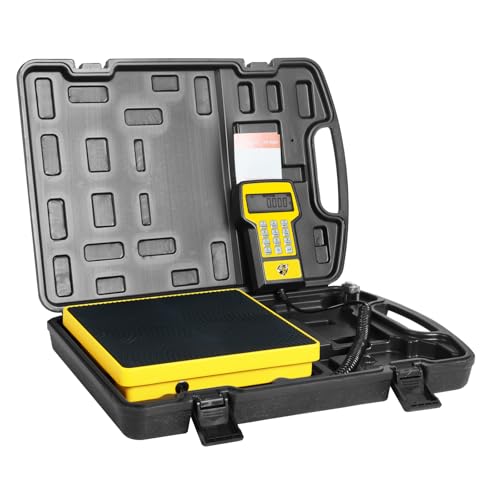 YELLOW JACKET ASRCS-220CProgrammable target weight
 Elitech LMC-100ALight 220 lb option
What a refrigerant scale is used for
A refrigerant scale has one job: it weighs a cylinder accurately while refrigerant moves in or out of a system. That sounds simple, but it matters. Many systems need a charge measured in ounces or grams, and a gauge alone cannot tell you exactly how much refrigerant went in.
People also call it a refrigerant charging scale, an HVAC scale or a freon scale. An electronic refrigerant scale is the same thing, and most scales sold today are electronic. They are different from a kitchen or bathroom scale because they are built for heavy cylinders, rough job sites and small weight changes.
The two main uses are charging and recovery. When you charge, you watch the cylinder get lighter as refrigerant leaves it. When you recover, you watch the recovery cylinder get heavier, which helps you avoid overfilling it.
How a refrigerant scale works
Inside the platform are sensors that measure force, often called load cells. When you set a cylinder on the platform, the sensors flex a tiny amount. The scale's electronics turn that flex into a weight reading and send it to the display.
The reading is only useful if you zero it first. Most scales have a zero or tare button. You place the full cylinder on the platform, press the button, and the display starts at zero. From then on, you read only the change in weight. If the cylinder loses 2 lb, the display shows that change.
Many scales have a remote display on a cable, which lets you read the weight while you stand at the gauges. A backlight helps in dark attics and crawl spaces. Some models also let you set a target weight and beep when you reach it. For example, the Yellow Jacket programmable 220 lb scale on our refrigerant scale comparison has 12 buttons for setting a charging value and sounds an alert when it is reached.
How to use one to charge a system
The exact steps depend on the system and the manufacturer's charging instructions, so treat this as a general outline. Always follow the nameplate and service manual for the correct refrigerant type and charge amount.
The basic flow looks like this:
- Place the scale on a flat, stable surface, away from edges and loose footing.
- Set the cylinder on the platform and connect your hoses.
- Turn the scale on and choose your units, such as pounds and ounces or kilograms and grams.
- Press zero once the cylinder is in place and hoses are attached, so the weight of the cylinder is not counted.
- Open the valve and watch the display. Stop when the weight change matches the charge you need.
- Close the valve, then note the final reading before you remove hoses.
Using a scale for recovery
Recovery works in reverse. You put the empty or partly filled recovery cylinder on the platform and zero the display. As the recovery machine pulls refrigerant out of the system, the cylinder gets heavier and the display shows the amount recovered.
Capacity matters most here. The scale has to carry the cylinder plus the refrigerant inside it. Recovery cylinders can be large, and the scales on our page list 110 lb, 155 lb, 220 lb or 252 lb. A higher rating leaves more margin.
An overload warning helps if you handle heavy cylinders. On the Yellow Jacket 220 lb scale, the remote shows FULL if the weight goes past the maximum, which protects the platform and sensor.
Specs that matter when you compare scales
Most scales look alike, so the spec sheet is where they differ. The table below shows the main specs and the range listed on our comparison page.
Resolution and accuracy are easy to mix up. Resolution is the smallest step the display shows. Accuracy is how close the reading is to the true weight, often given as a percent of reading. Charging to a target weight needs both to be tight.
| Spec | What it tells you | Range on our page |
|---|---|---|
| Capacity | Heaviest load the platform is rated for | 110 lb to 252 lb |
| Resolution | Smallest step on the display | 2 g to 10 g |
| Accuracy | How close the reading is to true weight | 0.03% to 0.5% of reading |
| Battery life | How long it runs between battery changes | 20 hr to 200 hr, where listed |
| Overload warning | Alerts you when the load is beyond the rating | Not listed on every model |
Safety notes
Refrigerant work carries real hazards. Wear safety glasses and gloves, because liquid refrigerant can cause frostbite and eye injury if it escapes. Work in a ventilated space, and keep cylinders upright and secure on the platform.
Never exceed the scale's capacity, and never fill a recovery cylinder past the limit marked on it. Overfilling a cylinder is dangerous because heat can raise the pressure inside. If you work on live equipment, shut off power and follow lockout procedures before connecting hoses.
In the US, handling refrigerants generally requires certification, so make sure you are qualified for the work you do. A scale does not replace the manufacturer's charging instructions. It only helps you follow them.
Picking one that fits your work
Start with capacity. Match it to the cylinders you use, then check resolution and accuracy. If you want the tightest figures on our page, the Fieldpiece SR47 lists 252 lb capacity and 0.03% accuracy, though its listed resolution is 10 g. The VIVOHOME VH104 lists 5 g resolution and also saves the last entered weight if it shuts off or loses power, which helps on long charging jobs.
Then look at power and comfort features: battery type, auto shut-off, a backlight and a remote display. A hard case protects the scale between jobs. You can see these details side by side on our best refrigerant scale page.
Frequently asked questions
Can I use any scale with refrigerants?
A household scale is a poor choice. It is not built for heavy cylinders or small weight changes, and it may not show fine enough steps. A scale made for refrigerant work is a safer fit.
Does the scale work with every refrigerant type?
It weighs the cylinder, not the gas, so the type does not change how it works. The Yellow Jacket 220 lb scale listing says it can be used with all refrigerants. You still need the right cylinder and hoses for each refrigerant.
Why do I zero the scale after placing the cylinder?
Zeroing removes the weight of the cylinder and hoses from the reading. The display then shows only the refrigerant added or removed.
What does a FULL message mean?
It means the load is above the scale's rated capacity. Remove weight right away to protect the platform and sensor.
Do I need a remote display?
It is not required, but it is handy. A remote lets you read the weight while you work at the gauges, and a backlight helps in dark spaces.