What Is a Knee Kicker and How Does It Work?
A knee kicker, also called a carpet kicker, is a hand tool with a toothed head on one end and a padded pad on the other. You grip the teeth into the carpet backing and strike the pad with your knee, which pushes the carpet a short distance onto the tack strip. It is meant for positioning carpet, working corners and smoothing wrinkles, not for stretching a whole room.
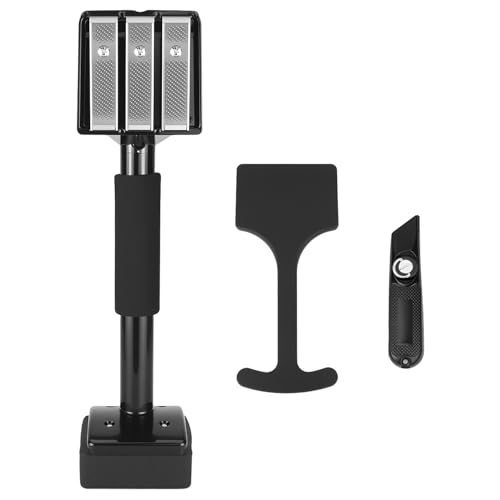 QWORK DG16521Best overall
 NATGAI NTJ-0915-01Simplest fixed-length kicker
 ROBERTS 10-410Adjustable basic option
What a knee kicker is
A knee kicker is a manual carpet installation tool. It has three main parts: a head with small teeth, a shaft or body, and a padded end that your knee strikes. Some models add a foam grip, and some let you change the length of the shaft.
Most of the kickers on our comparison page are listed as light-duty DIY tools. Their bodies are aluminum, often paired with a steel head. Because the teeth are forward-angled, they bite into the carpet backing when you push forward and let go when you pull back.
How a knee kicker works
The tool turns a short knee strike into a small, controlled push on the carpet. The teeth grip the backing, the shaft carries the force, and the carpet slides toward the wall until it catches on the pins of the tack strip.
Tack strips are thin wood strips with angled pins that run around the edge of a room. The carpet hooks onto those pins and stays in place. The kicker only has to move the carpet a short distance for this to happen.
How to use one, step by step
The basic motion is the same for every model. Go slowly the first few times, because a misplaced strike is the most common way to go wrong.
- Fasten the carpet along one wall first, so it has an anchor point.
- Set the kicker head a few inches away from the wall, with the teeth resting on the carpet.
- If your model has a depth dial, set the teeth so they grip the backing without going through to the pad or floor.
- Strike the padded end with the fleshy part of your knee just above the kneecap, not the kneecap itself.
- Check that the carpet has caught on the tack strip, then move along the wall and repeat.
- Finish the edge by tucking the carpet into the gap along the wall with a suitable tucking tool.
What it is used for
A kicker is best at small jobs. It works well in closets, on stair edges, in hallways and in corners where a larger tool will not fit. It also helps with loose carpet or a wrinkle that shows up after the main stretch is done.
Several listings on our comparison page say plainly that their tool is for positioning and wrinkle removal, not for stretching a full room. For a whole room, a power stretcher is the usual tool, and the kicker finishes the edges. If you are still deciding which tool fits your job, our best knee kicker page lines up the published specs side by side.
Features that differ between models
Most knee kickers look alike at first glance. The differences are in length, adjustability, padding and the kind of carpet each is meant for.
Pile rating matters most. Many of the light-duty models are listed for low to medium pile, and one is listed for low pile only. Thick or high-pile carpet needs a heavier tool, and a maker that does not publish a pile rating is worth asking before you buy.
| Model | Listed length | Adjustable | Listed weight | Listed pile |
|---|---|---|---|---|
| QWORK DG16521 | 16.625 in | Not stated | Not listed | Low to medium |
| NATGAI NTJ-0915-01 | 16.625 in | No | Not listed | Low to medium |
| FLKQC G20251125931 | 16.625 in | No | Not listed | Low only |
| Roberts 10-422BK | 18.5 in | Yes | 4.92 lb | Not listed |
| Roberts 10-412-2 | 17 in (17 to 21 in range) | Yes | 4.3 lb | Not listed |
| Roberts 10-412BKK | 19.6 in | Yes | 5 lb | Not listed |
Choosing and comfort
Your knee takes every strike, so padding is worth a look. Some listings name a foam-filled or thicker bumper pad, while others say nothing. If you will be kneeling for long stretches, prefer a model that names its padding.
Fixed-length models are simpler and have nothing to set wrong, which suits small repeat jobs. Adjustable models, such as the Roberts kickers that list a 17 to 21 in range, let you change your reach from room to room. Weight is listed by only four of the eight models we compare, so check it if you care about arm fatigue. You can see all of these details in one place on our knee kicker comparison.
Safety notes
The teeth on a kicker are sharp, and tack strips are full of small angled pins. Treat both with care.
Wear knee protection even though the tool has its own pad, and wear gloves when you handle tack strips. Wear safety glasses if you are cutting carpet or pulling old staples nearby. Cover the teeth when you store the tool, as some listings note with a protective shell. Keep your hands out of the path between the head and the wall while you strike, and never strike with the kneecap.
Frequently asked questions
Is a carpet kicker the same as a knee kicker?
Yes. Carpet kicker, knee kicker and carpet knee kicker are different names for the same hand tool.
Can a knee kicker stretch a whole room of carpet?
Not well. It moves carpet a short distance per strike, so it suits corners, closets and touch-ups. A power stretcher is the usual choice for a full room.
Does a knee kicker work on thick carpet?
Often not. Many light-duty models are listed for low to medium pile, and one is listed for low pile only. Thick or high-pile carpet generally calls for a heavier tool.
Will the teeth damage my carpet?
They grip the backing rather than the surface. Set the teeth depth carefully if your model has a dial, and avoid repeated strikes in the same spot.