What Is a Jigsaw Used for in Woodworking?
A jigsaw is used in woodworking to cut curves, internal cutouts, rough shapes and quick crosscuts in boards and sheet goods like plywood. It is a good choice for wood when you need to follow a line that a straight-cutting saw can't, though it is not the tool for long, perfectly straight or very precise cuts.
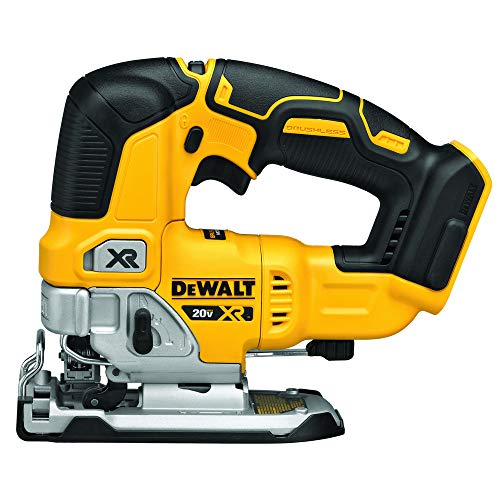 DEWALT DCS334BBest overall
 FLEX FX2231-ZFastest with long stroke
 DEKOPRO JigsawBest corded value
What a jigsaw does best
A jigsaw has a thin, narrow blade that moves up and down while the base plate rides on the workpiece. Because the blade is narrow, it can turn tightly. That is what makes the jigsaw the go-to saw for anything that is not a straight line.
In a woodshop it handles curves, cutouts, rough shaping and quick crosscuts in sheet goods. It will not replace a table saw or circular saw for long straight rips, but it reaches places those saws cannot.
- Curves and scrolls, such as rounded tabletops, shelf brackets and decorative edges
- Internal cutouts, such as a sink opening in a countertop or a hole for a speaker or vent
- Rough shaping of parts before sanding or trimming with a router
- Quick crosscuts in plywood and other sheet goods when a larger saw is not handy
- Notches and inside corners, such as fitting a board around a pipe or a wall corner
- Bevel cuts for angled edges when the base plate tilts
Is a jigsaw good for cutting wood?
Yes, with the right blade and settings. A jigsaw cuts softwood, hardwood and plywood well when you match the blade to the job and let the saw work at its own pace.
The trade-off is accuracy. The blade is thin, so it can bend slightly in thick stock and drift off square. Expect to sand or file the edge for a finished look, and use a different saw when you need a cut that is straight and square from the start.
Features that matter for wood
Our best jigsaw for woodworking page compares saws on the features that affect wood cuts most. A longer stroke uses more of the blade and clears thick stock faster. Saws on that page reach 2500 to 3500 strokes per minute (SPM), and stroke length runs up to 1 in.
Orbital action swings the blade forward on the upstroke to cut faster in wood. Use a high orbital setting for rough cuts in softwood and a low or zero setting for clean curves and plywood. Several saws we compare offer 4 orbital settings, including the DEWALT DCS334B and the RIDGID R86345B, while the FLEX FX2231-Z has 3.
A bevel shoe lets you tilt the base for angled edges. The DEWALT, RIDGID and DEKOPRO corded saws in our data tilt up to 45 degrees. Good line visibility also helps, so look for an LED light, a dust blower or a vacuum port.
Choosing between corded and cordless
Corded saws give steady power and suit bench work. Cordless saws are easier to carry around large panels, and they make sense if you already own compatible batteries.
Weight also affects control over a long cut. Here is how a few saws on our page compare, based on published specifications.
| Saw | Power source | Weight (lb) | Orbital settings |
|---|---|---|---|
| RIDGID R86345B | Cordless | 4.2 | 4 |
| DEKOPRO corded (B0DRF78461) | Corded | 4.89 | 4 |
| DEWALT DCS334B | Cordless (battery) | 5.07 | 4 |
| FLEX FX2231-Z | Cordless | 5.1 | 3 |
| Bosch JS470E | Corded | 5.6 | 4 |
How to make a clean cut
Technique matters as much as the saw. These steps give good results on most wood projects.
- Choose a blade for the job: fine teeth for clean cuts and plywood, coarser teeth for fast cuts in thick softwood.
- Set the orbital action: low for smooth curves, higher for fast rough cuts.
- Mark your line clearly and clamp the workpiece so it cannot move.
- Rest the base plate flat on the wood before you pull the trigger, and let the blade reach full speed.
- Guide the saw gently without forcing it. Let the blade do the cutting and slow down on tight curves.
- For an inside cutout, drill a starter hole in the waste area, or use a saw with a plunging system if you are comfortable with that technique.
- Wait for the blade to stop before lifting the saw out of the cut.
Safety notes
Wear safety glasses, since chips and dust are thrown up toward your face. A jigsaw is loud enough over long sessions that hearing protection is a good idea, and a dust mask helps when cutting sheet goods like plywood and MDF.
Clamp the work and keep both hands clear of the blade path. Remove the battery or unplug a corded saw before changing blades, and remember a used blade can be hot. Some saws, like the Bosch JS470E, have a blade ejection lever so you do not need to touch it.
Keep the cord out of the cutting path, and never cut with the saw held above the workpiece or while standing on an unstable surface.
Frequently asked questions
Can a jigsaw cut a straight line?
It can, especially with a guide fence or a clamped straightedge. Some kits include a parallel guide for this. For long, very accurate straight cuts, a circular saw or table saw is usually the better pick.
Can a jigsaw cut materials other than wood?
Yes. With the right blade it can cut metal, plastic, laminate and similar materials. Check the saw's rated capacity first and use a slower speed for harder materials.
Why does my jigsaw blade wander or splinter the wood?
The usual causes are a dull or wrong blade, too much feed pressure or an orbital setting that is too high. Switch to a fine-tooth blade, lower the orbit and slow your feed. Cutting with the good face down also reduces splintering on many saws.
Do I need a variable speed jigsaw?
It is very helpful. Slower speeds give more control on tight curves and harder materials, while higher speeds remove wood faster on straight and rough cuts.