What Is a Hex Key Set and How Does It Work?
A hex key set is a collection of small keys, each made to fit a screw or bolt with a six-sided socket in its head. You insert the short or long end into the socket and turn the key, and the flat sides grip the fastener so it tightens or loosens. Sets bundle many sizes, often in both SAE (inch) and metric, so one case covers furniture, bikes and general repairs.
 ELEAD 70084Best overall
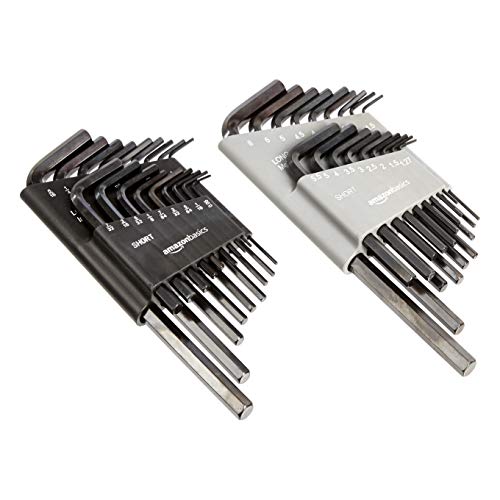 Amazon Basics DS-AMZ030Long-arm keys in two cases
 HORUSDY 94262Color-coded ball-end set
What a hex key set is
A hex key is a simple driver with a six-sided shaft. It fits into a matching hexagonal recess in a screw or bolt head. You may also hear it called an Allen key, Allen wrench or hex wrench. They all mean the same tool.
A set groups several keys of different sizes, usually in a case, holder or folding handle. Because each fastener needs a snug fit, a single key rarely does the whole job. A set lets you match the key to the screw in front of you.
How a hex key works
The idea is simple. The six flat sides of the key press against the six flat walls inside the socket. When you turn the key, force spreads across those contact points rather than a single edge. That is why hex sockets hold up well in small, tight spaces.
The classic L shape gives you two ends with different jobs. The long arm reaches into deep or awkward spots. The short arm gives you more leverage for breaking a tight fastener loose. Many people switch ends as the job changes: short end for the first stubborn turn, long end for quick spinning once it moves.
Fit matters more than force. A key that is too small will wobble and can round off the socket. A key that is too large will not go in at all. The right key slides in fully with very little play.
What you will find in a set
Contents vary, but most sets share a few features. Reading the product details before you buy tells you which ones you are getting.
- Two size systems. SAE keys are measured in fractions or decimals of an inch, and metric keys are measured in millimeters. Many sets include both because products from different makers use either one.
- A size range. The ELEAD 70084, for example, covers 0.7 to 10 mm and 0.028 to 0.375 in across its 41 pieces.
- Extra key types. Some sets add Torx keys, which fit star-shaped sockets rather than hex ones. The ELEAD set lists Torx sizes from T9 to T50.
- Special tips. Ball-end tips let the key enter a socket at an angle. The HORUSDY set describes entry at up to 25 degrees.
- Storage. Cases with marked slots, color-coded keys and etched sizes all help you find the right key fast.
Common styles compared
Hex key sets come in a few main layouts. The best one depends on where you work and how often you reach for it.
Keep in mind that folding sets trade range for convenience. The Amazon Basics folding set lists metric keys from 1.5 to 8 mm and SAE keys from 0.078125 to 0.25 in. That is enough for many household tasks, but larger bolts may call for a full-length set.
| Style | How it works | Good for | Watch out for |
|---|---|---|---|
| L-shaped keys in a case | Long and short arms on each key, stored by size | General repair and assembly, wide size range | Takes more space than a folding set |
| Folding keys | Keys fold into a handle like a pocketknife | Toolboxes, bike bags, quick fixes | Narrower size range, shorter reach |
| T-handle keys | A handle across the top for a comfortable grip | Repeated tightening and loosening | Handles can be bulky in tight spaces |
| Ball-end keys | Rounded tip lets you turn at an angle | Hard-to-reach screws | Hex end is usually still better for final tightening |
How to use a hex key correctly
Good technique protects both the key and the fastener. These steps work for nearly any hex socket.
- Clear dirt or paint out of the socket so the key can seat all the way.
- Pick the key that fits with almost no wobble. If you are unsure, try the next size down and the next size up.
- Push the key fully into the socket before you turn it.
- Turn smoothly and keep the key in line with the screw. Avoid sudden jerks.
- Use the short arm for the first tight turn and the long arm for fast spinning.
- Stop if the key starts to slip. Re-check the size and clean the socket again.
Safety and care
Never slide a pipe over a hex key to get extra leverage. The key can snap or the fastener can fail suddenly, and a slipping hand can hit nearby edges. If a bolt will not move, use penetrating oil and a stronger tool made for the job.
Wear safety glasses when working on anything that could spring, flake or spray debris. Disconnect power before opening any plugged-in appliance, and do not use a metal key near exposed live parts. When working overhead or on a ladder, keep your balance first and your tool second.
Wipe keys clean after use and store them in their slots. Rust and grime make the fit looser, and worn tips round off sockets.
How to choose a set
Start with the sizes you actually meet. If you work on furniture, bikes and small machines, you will likely want both SAE and metric. Then check the range at each end, since a set that stops at 8 mm or 0.25 in can miss larger bolts.
Next, look at the steel. Chrome vanadium is a common choice for hex keys, and a listed material line is a good sign. A softer key can twist under load and damage the socket. Easy size identification is the other big factor, because loose keys are slow to sort.
If you want to see how specific sets line up on piece count, size range, steel and storage, our best hex key set page puts them on one spec sheet. You can also use that page to check whether a set includes Torx keys, ball-end tips or a torque handle before you decide what fits your work.
Frequently asked questions
Is a hex key the same as an Allen key?
Yes. Allen key and Allen wrench are common names for the same tool. Hex key and hex wrench describe its six-sided shape.
How do I know which size to use?
Try a key that slides in fully with almost no play. If it rattles, go one size up. If it will not enter, go one size down. Mixing up inch and metric sizes is a common cause of rounded sockets.
What is the difference between a hex key and a Torx key?
A hex key has six flat sides and fits hexagonal sockets. A Torx key has a six-point star shape and fits star-shaped sockets. They are not interchangeable.
When is a folding set a good idea?
A folding set suits a toolbox, glove box or bike bag where space is tight. It usually covers fewer sizes than a full case, so check the range against the screws you plan to turn.