What Is a Grease Gun Coupler and How Does It Work?
A grease gun coupler is the head on the end of a grease gun that clamps onto a zerk fitting and seals against it, so grease goes into the joint instead of onto the floor. Inside, a set of jaws grips the fitting's ball-shaped head while a seal keeps pressure in. Locking versions stay attached on their own, which lets you pump with both hands and release with a lever.
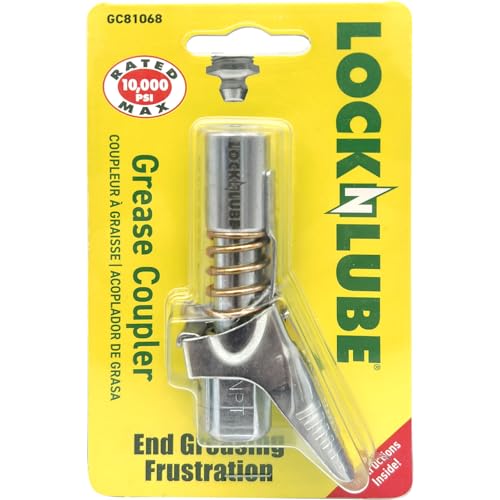 LockNLube GC81011Best overall
 LockNLube GXCLBest for recessed fittings
 Akeoil XUC-05Best 6-jaw grip
What a grease gun coupler does
Most moving parts on cars, tractors, trailers and mowers have a small metal nipple called a zerk fitting, also known as a grease fitting. It is the only door into a bearing or joint that needs fresh grease. The grease gun makes the pressure, and the coupler is the connection between the gun and that tiny door.
Its job is simple to state: grip the fitting, seal against it, and let grease pass through. If any of those three things fails, you get slipping, leaks or a joint that never gets filled.
You may also hear it called a grease coupler, grease gun tip or quick-release coupler. They all mean the same part, the one that screws onto the gun's outlet or the end of its hose.
How a coupler works inside
A zerk fitting has a rounded head with a groove under it. The coupler's jaws close around that groove, and a rubber or similar seal presses against the face of the fitting. A small valve in the fitting lets grease in when pressure is applied and closes again when you stop.
When you pump the gun, grease is pushed through the coupler, past the seal and through the fitting's valve into the joint. The jaws are what keep the coupler from being pushed off by that pressure.
- Jaws: grip the groove under the fitting head so the coupler does not pop off.
- Seal: presses on the fitting face so grease does not leak sideways.
- Spring: pushes the jaws closed and keeps them gripping.
- Lever or handle: opens the jaws to attach or release the coupler.
- Threaded base: screws onto the gun. Almost all grease guns use 1/8 in NPT threads.
Basic and locking couplers compared
A basic coupler is a plain, spring-loaded head that you push onto the fitting and hold in place by hand. It works fine on easy fittings, but a worn one tends to leak and can slip off when pressure builds.
A locking coupler clamps on and stays there. That frees your second hand to steady the gun or pump the handle, and you release it with a lever. Our best grease gun coupler page covers locking designs for this reason.
Within locking couplers, there are a few variations worth knowing.
| Type | What it does | Good for |
|---|---|---|
| Basic push-on | Held on by hand, simple jaws | Easy, open fittings |
| Locking | Clamps and stays attached, lever release | Hands-free pumping, fewer leaks |
| Extra reach | Longer body that reaches into shielded areas | Recessed fittings on axles, U-joints and PTO shafts |
| 90 degree adapter | Turns the angle of the connection | Fittings tucked against a frame or housing |
How to use a coupler, step by step
The steps are quick once you have done them a couple of times. Wipe the fitting first. Dirt on the zerk goes straight into the bearing along with the grease.
Following these steps keeps the seal clean and the joint properly filled.
- Wipe the zerk fitting clean with a rag.
- Open the lever or jaws and push the coupler straight onto the fitting.
- Lock it in place and check that it sits square, not at an angle.
- Pump the gun slowly and watch for fresh grease at the joint seals or for the joint to stop taking grease.
- Release the lever, pull the coupler straight off and wipe away any extra grease.
- Clean the coupler face before moving to the next fitting.
What to check when choosing one
Start with thread size. Almost all grease guns use 1/8 in NPT, and every coupler on our comparison page fits that size. Next, look at the pressure rating. The couplers we compare range from 5000 to 12000 psi, and higher ratings suit stubborn or partly blocked fittings.
Reach matters if you work on equipment with buried fittings. Then check whether the coupler can be rebuilt, since replacing the seal and jaws is a way to extend its life. If you also need a gun, our best grease gun for the money page is the place to compare those.
Here is how a few of the couplers on our page line up, based on published specifications.
| Coupler | Max pressure | Rebuildable | Notes |
|---|---|---|---|
| LockNLube GC81011 | 10000 psi | Yes, kit not included | 3.5 in length, SAE and metric zerks |
| LockNLube GXCL XL | 10000 psi | Yes, kit included | 5.5 in length, extra reach |
| Akeoil XUC-05 | 12000 psi | Not listed | 6-jaw locking, carbon steel |
| luckywagon LW-GGC-1 | 12000 psi | Not listed | 6-jaw locking, alloy steel, 3.5 in length |
| THINKWORK W6301 | 12000 psi | Not listed | 5-piece kit with 90 degree adapter and needle tips |
Safety and care
Grease guns build serious pressure, and the numbers above show how much a coupler is designed to hold. Never point the gun at your skin. Grease injected through the skin is a medical emergency and needs prompt treatment, even if the wound looks tiny.
Wear safety glasses, because a coupler that releases suddenly can spray grease. Make sure equipment is turned off, supported and cannot move before you reach under it. Never rely on a jack alone, and keep your hands clear of pinch points and moving shafts.
For care, wipe the coupler after use and store it capped or covered. Replace or rebuild it when it leaks, will not grip, or the jaws look worn.
Frequently asked questions
Can I use one coupler on every grease fitting?
Not always. Most standard zerk fittings work with a typical coupler, but some couplers list specific compatibility such as SAE and metric zerks or DIN fittings. Check the listing before buying.
Why does my coupler leak around the fitting?
The usual causes are a worn seal, worn jaws, a dirty or damaged zerk, or a coupler that is not seated square. Clean the fitting and try again. If it still leaks, replace or rebuild the coupler.
Will a higher pressure rating make greasing faster?
No. The rating is the pressure the coupler can safely handle, not how much grease it delivers. It only matters when a fitting is stiff or partly blocked.
What if the grease will not go in at all?
Stop pumping hard. The zerk may be clogged, damaged or seized. Try cleaning or replacing the fitting rather than raising pressure further.