What Is a Forstner Bit and What Is It Used For?
A Forstner bit is a wood-boring drill bit that cuts a clean, flat-bottomed hole with a small center point and a sharp rim. Use it when the hole must be neat, precise, or only part way through the material, such as for hinge cups, dowels, and shelf pins. For rough through-holes, a twist bit or spade bit is usually enough.
 Fisch FSA-367208Best overall
 Freud PB-100Lifetime guarantee included
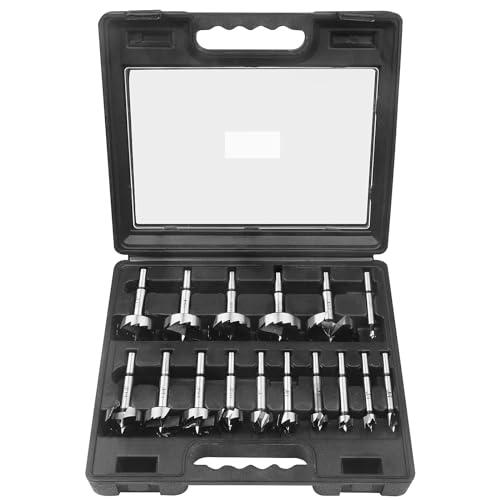 BAIDETS BD210035Every size named
How a Forstner bit works
A Forstner bit looks different from a standard twist bit. It has a short center point, a round rim, and two cutting edges that sweep across the bottom of the hole. The center point locates the hole and keeps the bit from wandering. The rim scores the outline of the hole, and the cutting edges lift the wood out in chips.
Because the rim guides the cut, the hole wall stays smooth and the bottom stays flat. A twist bit leaves a cone-shaped bottom, and the tip can poke through the back of your workpiece. A Forstner bit lets you stop at a set depth and get a level floor.
Rim designs vary. A plain rim gives a smooth wall. A wave or serrated rim clears chips faster and tends to run cooler. Some bits have a sawtooth rim for the same reason. Our best forstner bit set page notes which listings name a wave rim and a center point, so you can compare them without guessing.
What Forstner bits are used for
The common thread is a hole that needs a flat bottom or a tidy edge. These are the jobs people reach for a Forstner bit to do:
- Hinge cup holes for concealed cabinet hinges, which need a flat floor and a set depth.
- Shallow recesses for hardware, such as a magnet, a knob base, or a small electronic part.
- Plug holes that hide screw heads, followed by a wood plug glued in flush.
- Dowel and shelf-pin holes where the fit must be snug and square.
- Large, clean holes in boards, such as handles, finger pulls, or round openings in furniture.
- Clearing waste for joinery, by drilling out most of a mortise or a recess before you pare it with a chisel.
- Drilling into plywood, MDF, and composite panels where tear-out would show.
When to use a Forstner bit (and when not to)
Pick a Forstner bit when the finish of the hole matters or when the hole should not go all the way through. It is also a good choice for overlapping holes and for holes that start on a slightly curved or angled surface, since the rim helps hold the line. For quick holes that will be hidden, a cheaper bit may do the job.
This table compares it with other common wood bits in general terms.
| Bit type | Hole bottom | Best for | Watch out for |
|---|---|---|---|
| Forstner | Flat | Hinge cups, recesses, clean large holes | Needs steady pressure and a slow speed |
| Twist | Cone-shaped | Small through-holes in many materials | Can wander on wood and tear out the exit side |
| Spade | Slightly pointed | Fast, rough holes in framing | Rough walls and edge tear-out |
| Brad point | Pointed | Accurate small holes and dowels | Not made for large, flat-bottomed recesses |
How to drill with one safely
Forstner bits remove a lot of material in each turn, so they can grab and twist the workpiece. Treat that as a real hazard and set up the job before you pull the trigger. Wear safety glasses, because chips fly. Add hearing protection if you are drilling many large holes. Avoid loose sleeves, gloves, and dangling cords near the spinning bit.
Clamp the work down. Never hold it with your hand while you drill, and keep your fingers clear of the bit. If you use a corded drill press or drill, unplug it before you change bits or adjust the chuck.
- Mark the hole center and, if you like, make a small dent with an awl so the point sits in the right spot.
- Clamp the workpiece to the bench or the drill press table.
- Set a slow speed, especially for the largest bits in the set.
- Start the drill, then lower the bit with steady, light pressure and let the cutting edges do the work.
- Back the bit out often to clear chips and let it cool.
- Stop at your depth mark, or drill from both sides if you want a clean through-hole.
Drill press or handheld drill?
A drill press gives the steadiest cut and the most accurate depth, and it is the safest way to use large bits. A handheld drill can work for small and medium holes if you keep it square to the surface and the work is clamped. Large bits can twist a handheld drill out of your grip, so hold it with both hands and be ready for torque.
Shank shape matters here. The best forstner bit set page says hex and flatted shanks resist slipping better than plain round ones, which matters on large bits. For example, one set in our data lists a 0.375 in hex shank, and another lists a reduced shank with flats. Both are meant to hold better in the chuck than a plain round shank.
What to look for in a Forstner bit set
A set saves you from buying single bits as you go. The sets we compare run from 0.25 in up to 2.125 in at the top, while smaller sets stop at 1 in or 1.375 in. Pick a range that covers the holes you drill most, such as hinge, dowel, and shelf-pin sizes, so you do not have to buy twice.
Check what the maker states about the steel. High-speed steel resists heat and tends to stay sharp longer in dense woods. Carbon steel works for wood but may dull sooner. Then look for a named center point and a wave or serrated rim, since those two features help most with accuracy and clean walls. A case is a practical extra because it keeps sizes in order and protects the cutting edges.
Our best forstner bit set page lines these specs up on one sheet. The top pick lists 16 bits from 0.25 to 2.125 in, high-speed steel, a wave rim, a center point, a flatted shank, and a case, all stated by the maker. We compare published specifications, so check each listing for the details that matter most to you.
Keeping your bits sharp
Forstner bits dull faster when they run hot. Slow speed, steady pressure, and regular chip clearing all help. Brush off resin and pitch after use, and store each bit in its slot so the rims do not knock together. If a bit burns the wood or needs a lot of force, stop and check it rather than pushing harder.
Frequently asked questions
Can a Forstner bit drill through metal?
No. These bits are made for wood and wood products, and some listings also mention plastic and PVC. Metal needs a bit designed for metal and a different speed.
Can you drill overlapping or edge holes with one?
Yes, that is one of its strengths. The rim guides the cut, so you can drill overlapping holes or a hole near an edge. Clamp the work well, because the bit has less material to support it.
Why does my Forstner bit burn the wood?
Too much speed, too little chip clearing, or a dull edge is the usual cause. Slow the drill, back the bit out often, and check that the rim is clean and sharp.
Do I need a center point on every bit?
A center point helps you locate the hole and keeps the bit from wandering, so it is worth having. Confirm the listing names it, since not every set does.