What Is a Drywall Knife Set Used For?
A drywall knife set is used to apply, spread and smooth joint compound (also called mud) over seams, screw holes, patches and whole wall surfaces. The narrow knives handle small fills and scraping, the wider ones feather out seams, and very wide skimming blades smooth large areas. Most blades are stainless steel, though some are coated carbon steel, and the handles are usually plastic or rubber-like grips.
 suokoun CCGTDTZBest overall
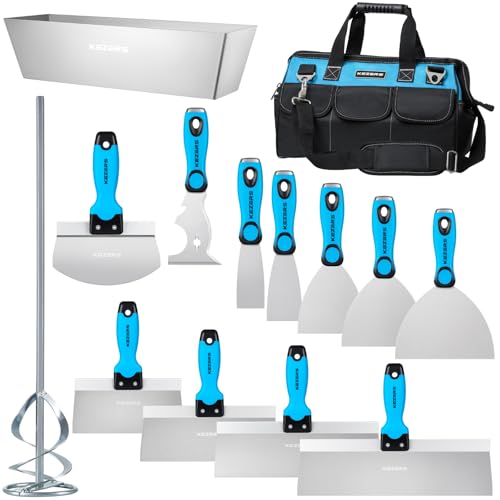 KEZERS F106Most complete taping kit
 Airless SJG DNS001Narrow knives plus pan
The short version: what the knives actually do
Hanging drywall is only half of the job. Once the panels are screwed up, you still have seams, screw dimples, corners and dents to hide. A drywall knife set gives you the blade sizes needed to do that in layers, so the wall ends up flat and ready for primer and paint.
The same knives also work for repairs. A small putty knife can fill a nail hole, while a wide taping knife can smooth a patch so it blends into the surrounding wall. Many people also use the narrow blades for scraping loose paint or lifting old wallpaper.
- Spreading joint compound over seams between panels
- Pressing paper or mesh tape into wet compound
- Filling screw and nail holes
- Patching small holes and dents
- Feathering compound wide so the edges disappear
- Skim coating a whole wall or ceiling for a smooth finish
- Scraping paint, old compound or wallpaper
Which knife is which, and what is it called?
People use several names for the same tools, which can be confusing. A wide, thin blade for spreading compound is a taping knife, a joint knife or a mud knife. A narrower blade is usually called a putty knife or spackle knife. Very wide, flexible blades for covering large areas are called skimming blades or skim coat blades.
Product listings are not always consistent. One kit may call a 6 in blade a putty knife, while another calls it a joint knife. Go by the blade width and the job, not the label.
| Tool | Typical use | Example sizes from listed sets |
|---|---|---|
| Putty knife | Filling holes, scraping, small repairs | 1 in to 6 in |
| Taping knife | Spreading compound on seams, bedding tape, feathering | 8 in to 14 in |
| Skimming blade | Smoothing large wall or ceiling areas | 10 in to 32 in, up to 40 in in some sets |
| Mud pan | Holding compound within reach while you work | 14 in in several listed sets |
What is a drywall knife set made of?
The blades are most often stainless steel, because it resists rust and rinses clean. That matters since joint compound is water based and sits on the blade while you work. Listings name different grades. Among the products on our spec sheet, you will see 304 stainless, 3CR13 stainless and 201 stainless named.
Carbon steel is another option, and it shows up in some budget sets. Read the fine print. One set we list uses thickened carbon steel with a rust-resistant coating for its 10 in, 12 in and 14 in taping knives. If the coating gets scratched, those blades can rust, so they need to be dried before storage.
Some blades are hollow-ground, which means the steel is shaped to give controlled flex. That helps when you are smoothing a seam, because the blade follows the wall instead of digging in. The KEZERS 14-piece kit, for example, lists hollow-ground blades and a hammer end.
Handles vary too. One listed set describes handles made of PP and TPR, which are a hard plastic and a soft rubber-like material, with non-slip sides. Others mention soft grip or ergonomic handles. Mud pans in these kits are typically stainless steel, and carry bags can be fabric, such as the 600D water-resistant Oxford bag listed with the Airless SJG set.
Taping and filling sets versus skimming sets
The biggest decision is which job you are buying for. Taping and filling work needs a ladder of widths, from a small knife for holes up to a wide knife for the final pass on a seam. Skim coating needs far wider, thinner blades.
A set built for one job rarely covers the other. The suokoun skimming set, for instance, lists seven knives from 3 in to 32 in and adds a pole and paint rollers. A taping kit such as the KEZERS one tops out at 14 in but includes nine knives starting at 1.5 in. If you need both, check the narrowest and widest blade in each set before choosing.
Our best drywall knife set page lays out piece count, blade sizes, pan size and weight side by side, which makes it easier to see which sets lean toward taping and which lean toward skimming.
Extras you may find in a set
Once you have the right blades, the extras are worth a look only if you will use them. A mud pan is handy because it keeps compound close and gives you a clean edge to wipe the knife on. A hammer end on a handle can tap a loose nail flush before you cover it.
Other kits add sanding sponges, a bucket scoop, a drill-driven mixer, paint brushes or a multi-tool. The KEZERS kit lists a 16 in mixer with a hex-drive end that fits a drill. Skimming sets may add an extension pole. The suokoun pole adjusts from 28 in to 61 in, and heavier skimming kits weigh more than simple knife sets. Among the products we list that show weight, that spans from 0.79 lb up to 25.35 lb.
You can browse those options on our drywall knife set comparison without opening each listing separately.
Basic use and safety
The method is simple, but it takes patience. Thin coats dry faster and sand more easily than one thick coat.
1. Load a little compound onto the pan or a small knife.
2. Press tape into a thin bed of compound over each seam.
3. Fill the screw holes with a small knife and scrape them flat.
4. Let it dry, then add a wider coat with a taping knife, feathering the edges.
5. Repeat with a still wider knife for the final pass, then sand lightly.
- Wear eye protection when sanding, scraping overhead or mixing. One listed set includes safety goggles.
- Wear a dust mask when sanding dry compound, since the dust is fine and easy to breathe in.
- Treat blade edges with care. Scraper and hollow-ground blades can cut, especially when removing tape.
- If you mix compound with a drill, keep the cord clear of the bucket and unplug the drill before changing attachments.
- Use a stable ladder when working high, and avoid overreaching. A pole can reduce how far you need to climb.
- Dry steel and coated carbon steel blades before storing them.
Frequently asked questions
Can I use a putty knife instead of a taping knife?
For small holes and quick repairs, yes. For seams and larger patches, a wider blade spreads compound more evenly and feathers the edges better, so you get a flatter finish.
Do I need a mud pan?
Not strictly, but it helps. It holds compound close to your work and gives you an edge to clean the knife. Some sets leave it out, such as the THINKWORK set, which lists no pan.
Are stainless steel blades always better than carbon steel?
Stainless resists rust and is easier to rinse, which suits water-based compound. Coated carbon steel can work, but a scratched coating can lead to rust, so it needs more care.
Are drywall knives only for drywall?
No. The narrower knives are also used to scrape paint, lift wallpaper, spread filler on other surfaces and tidy up patches around the house.