What Is a Crowbar Used For?
A crowbar is a long metal lever used to pry things apart, lift heavy objects a little, pull nails and help with demolition. It works because the long handle turns a small push from you into a much larger force at the tip. That is also why it counts as a simple machine: it is a lever.
 Titan 11509Lightest in the lineup
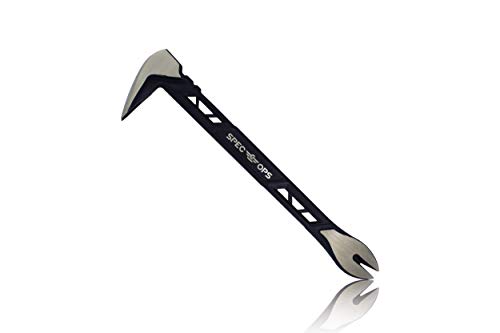 Spec Ops SPEC-D10CLAWBest for pulling nails
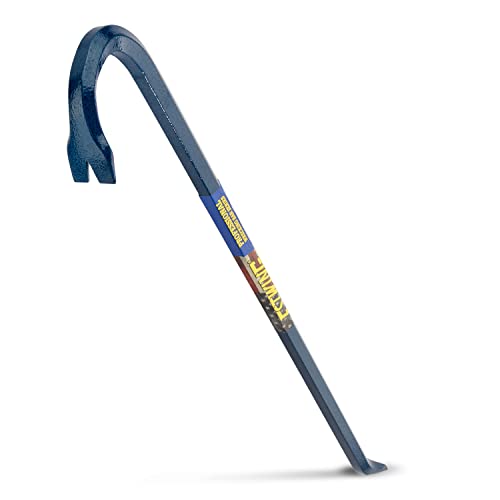 Estwing EWB-30Classic forged gooseneck
The main jobs a crowbar does
Most crowbar work falls into a few groups. The common thread is that something is stuck, nailed or fastened down, and you need more force than your hands can give.
Bars sold under the name crowbar come in several shapes, from long gooseneck wrecking bars to short flat pry bars. The right one depends on the job, so it helps to know what each task asks for.
- Prying boards, trim, baseboards and molding away from a wall or floor.
- Pulling nails, spikes and staples, usually with a slotted hook or claw end.
- Demolition, such as tearing out old framing, flooring or wood slats.
- Lifting or nudging heavy objects a short distance so you can slide a block or shim underneath.
- Opening wooden crates and pallets.
- Scraping off caulk, adhesive or paint, on bars that have a scraper edge.
How a crowbar works
A crowbar is a lever. You push down on one end, the bar pivots on a point called the fulcrum, and the other end pushes up or out against the load. The fulcrum is often the floor, a block of wood or the edge of the board you are working against.
The longer the distance from your hands to the fulcrum compared with the distance from the fulcrum to the tip, the more force you get at the tip. That is why a long bar feels so much stronger than a short one, even when you push just as hard.
The trade-off is distance. To move the tip a small amount, your hands have to travel farther. You gain force and give up motion, which is exactly what you want when a nail is holding tight.
Why a crowbar is a simple machine
A simple machine changes the size or direction of a force without needing power from a motor. The lever is one of the classic six, along with the wheel and axle, pulley, inclined plane, wedge and screw. A crowbar is a lever in everyday form.
Many crowbars also use a second simple machine at the tip. The chisel or beveled end acts as a wedge, slipping into a tight gap so the lever can then spread it open. A curved or gooseneck bend helps the bar roll against the surface, which adds leverage as you pull.
Matching the bar to the job
Length and weight are the two specs that change how a bar behaves. Longer bars give more leverage, and heavier bars add force but tire your arms. Our best crowbar comparison lists published lengths from 9.25 in to 58 in, so you can see the range at a glance.
The table below shows how a few bars from that page line up with different kinds of work.
| Job | Bar style | Example from our page |
|---|---|---|
| Heavy demolition and stuck framing | Gooseneck or demo wrecking bar | Estwing EWB-30, 30 in, forged one piece |
| Mid-size prying and nail pulling | Wrecking bar with slotted claw | Olympia Tools 18 in, 2 lb |
| Nail pulling and tight spots | Cat's paw | Spec Ops 10 in, 0.7 lb |
| Trim, scraping and cleanup | Small flat pry bar | Titan 9.25 in, 0.1 lb, stainless steel |
| Automotive and industrial prying | Long curved bar | Mayhew Dominator Pro, 58 in, 9.32 lb |
What to look for in a bar
Construction matters as much as size. A forged one-piece bar has no joints to loosen or break when you lean on it, which is why we favor that spec. If you plan to strike the bar with a hammer, a one-piece build is the safer choice.
A nail puller slot is worth checking for if you do any framing or cleanup. Features like a cushioned grip, a strike cap or a scraper edge add comfort or versatility, but steel and build come first.
One caution: many products labeled crowbars are really small flat pry bars. That is fine for trim work, but it will not do the job of a 30 in wrecking bar. You can compare shapes and specs on our crowbar spec sheet before you choose.
Using a crowbar safely
Prying stores a lot of force, and a bar that slips can hit your hand or face. A few habits lower the risk.
Wear safety glasses, since nails, splinters and chips can fly when material gives way. Work gloves protect your hands and improve grip. If you strike the bar with a hammer, hearing protection is wise too.
- Set the tip firmly and push in a controlled way. Avoid jerking the bar.
- Keep your face and body out of the line the bar will travel if it slips.
- Check behind walls and under floors for wiring, pipes and gas lines before prying or demolishing. Turn off power to the area if you are unsure.
- Stand on stable ground, and use a ladder only when it is secure. Do not pry from a position where a slip could throw you off balance.
- Bend or hammer down pulled nails so nobody steps on them.
- Use the bar only for prying and pulling. Do not use it as a hammer unless it is built for striking.
Frequently asked questions
Is a crowbar the same as a pry bar?
The terms overlap. Crowbar usually means a longer, heavier bar for demolition and heavy prying, while pry bar often means a smaller, flatter tool for finer work like trim.
What type of lever is a crowbar?
It depends on how you use it. With the fulcrum at the tip and the load in the middle, it is a second-class lever. With the fulcrum between your hands and the load, as when you pry a board up over a block, it is a first-class lever.
Can a crowbar pull nails?
Yes, if it has a slot, hook or claw at the end. Slip the nail into the slot and rock the bar back to draw it out. Setting a small block under the bar protects the surface and adds leverage.
Why is it called a crowbar?
The name most likely comes from the bent, beak-like end of the tool, which resembles a crow's foot or bill. The exact origin is not certain.