What Is a Crimping Tool Used For?
A crimping tool joins a wire to a connector, such as a terminal, ferrule or lug, by squeezing the metal barrel tightly around the conductor. The result is a secure electrical and mechanical connection without solder. It is used in car and boat wiring, appliance repair, home electrical projects and network cabling.
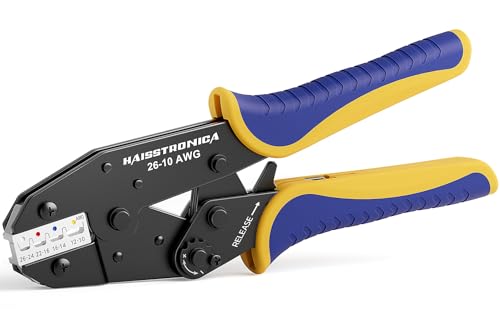 haisstronica HS-1073Best overall
 Plustool K-BM-104-USFull-featured heat shrink runner-up
 KLEIN TOOLS 3005CRColor-coded insulated terminal slots
What a crimping tool does
A crimping tool deforms a metal connector so it grips a wire. You strip the insulation, slide the bare conductor into the connector's barrel, and squeeze the tool. The jaws press the barrel around the strands, and the metal and wire are forced together into one tight joint.
A good crimp holds the wire firmly and keeps resistance low where the two meet. It also resists vibration, which is why crimped connections are common in vehicles, boats and machinery. Many people also like that a crimp needs no heat, flux or open flame.
Common jobs for a crimper
Most crimping falls into a few everyday tasks. The tool you need depends on which one you do most.
If you mainly repair vehicle or appliance wiring, a hand crimper with dies for common terminals will cover most of it. If you work with large battery cables, you need something very different, which we cover below.
- Attaching ring, spade or butt connectors to wires in cars, boats and trailers
- Splicing two wires together with a butt connector, including heat shrink versions that seal against moisture
- Putting ferrules on the ends of stranded wire so it sits neatly in a terminal block
- Fitting lugs on heavy battery or power cables
- Repairing appliance leads and home wiring connections
- Terminating network or phone cable with modular plugs, which uses a different style of crimper
How a crimping tool works
Most hand crimpers are lever tools. Squeezing the handles multiplies your grip force through a pivot, and that force closes two shaped jaws, called dies, around the connector. The die shape decides how the metal is formed. Some make a rounded or hex shape, some a square shape, and some a simple indent.
Better tools add a ratchet. The ratchet locks the jaws as you squeeze, so you cannot release halfway and leave a weak crimp. With a full-cycle design, the handle only lets go once the crimp is complete. That is why our best crimping tool comparison puts full-cycle ratcheting near the top of the checklist: it makes every crimp the same.
Hydraulic crimpers work on the same idea but use a pump to build far more force. They are meant for thick cable that a hand tool cannot close on.
Types of crimpers and what they suit
Crimpers are built for one connector family, so matching the tool to the terminal matters more than any extra feature. The table below sums up the main kinds and some examples from our spec sheets.
Keep in mind the AWG scale runs backward: a lower number means thicker wire.
| Crimper type | Typical use | Example from our data |
|---|---|---|
| Heat shrink connector crimper | Sealed splices and terminals on car, boat and appliance wiring | haisstronica HS-1073: 10 to 26 AWG, ratcheting, 1.2 lb |
| Insulated terminal crimper | Color-coded red, blue and yellow terminals | Klein Tools 3005CR: three cavities covering 10 to 22 AWG |
| Swappable die set | Mixed work with several terminal styles | Vesmikit set: six die options, listed 6 to 24 AWG |
| Hex or square ferrule crimper | Wire ends going into terminal blocks | Hex and square ferrule tools listed at 10 to 22 AWG |
| Hydraulic lug crimper | Heavy battery cable | Brileine: 12 AWG to 2/0 AWG, 5.95 lb, 12.2 in long |
What to look for before you buy
Start with the connector type. A tool built for heat shrink connectors will not make a good crimp on hex ferrules or battery lugs, because the dies are shaped differently. Then confirm the AWG range covers both your thickest and thinnest wire.
Next, look at control and comfort. Ratcheting, adjustable force and a quick-release lever all help you get repeatable results. A cushioned or non-slip grip eases hand fatigue when you have many crimps to make. Size matters too, since the hydraulic Brileine suits heavy cable work but is not a small toolbox item.
Not every tool lists a ratchet. The Klein 1005, for example, does not, so crimp pressure depends on your grip. That can work for occasional light jobs, but a ratchet is the safer route to consistent results. You can compare all of these points side by side on our crimping tool comparison page.
How to make a good crimp
The steps are simple, but small mistakes cause most bad crimps. Take your time on the first few until you can judge a good one by feel and by eye.
- Disconnect the power source first. For vehicles, disconnect the battery before touching the wiring.
- Strip only as much insulation as the connector barrel needs, and avoid cutting any strands.
- Choose a connector sized for your wire gauge, and place the wire fully into the barrel.
- Seat the connector in the matching die or cavity, with the barrel's seam facing the right way for your tool.
- Squeeze the handles through the full cycle until the tool releases.
- Give the wire a firm tug. If it slips, cut the connector off and redo it with a fresh one.
- Add heat shrink or tape where the connector needs sealing.
Safety notes
Always work on dead circuits. Live wiring can shock you, and a battery can deliver a dangerous current even at low voltage if a tool bridges its terminals.
Wear safety glasses. Wire strands and small pieces of metal can fly off when you cut or strip, and a bad crimp can fail under tension. Keep your fingers clear of the jaws, and be especially careful with hydraulic tools, which can crush a hand. Use only the dies and connectors the tool maker lists for that tool.
Frequently asked questions
Can I use pliers instead of a crimping tool?
It is not a good idea. Ordinary pliers squeeze unevenly and can cut the strands or leave a loose joint. A crimper with matching dies forms the connector evenly, which gives a stronger and safer connection.
Is a crimp as good as solder?
A correct crimp is a standard, accepted way to make a connection, and it handles vibration well. Solder can make wire stiff and brittle near the joint. The right choice depends on the job and any rules that apply to your project.
Do I need a different crimper for network cables?
Yes. Modular plugs for network and phone cable use a different crimper designed for those plugs. A wire terminal crimper will not make a proper connection on them.
Can one crimper handle every wire size?
Rarely. Each tool lists an AWG range, and most hand tools stop at about 10 AWG on the thick end. Heavy battery cable needs a larger tool, such as a hydraulic crimper.