What Is a Box Cutter and What Is It Used For?
A box cutter is a compact knife with a replaceable, razor-style blade, made mainly for opening cartons and slicing cardboard, tape and packaging. Its proper name is a utility knife, and you will also hear razor knife or box knife. Most designs keep the blade covered when you are not cutting, which is what makes them safe to carry in a pocket or apron.
 WORKPRO W013053Best overall
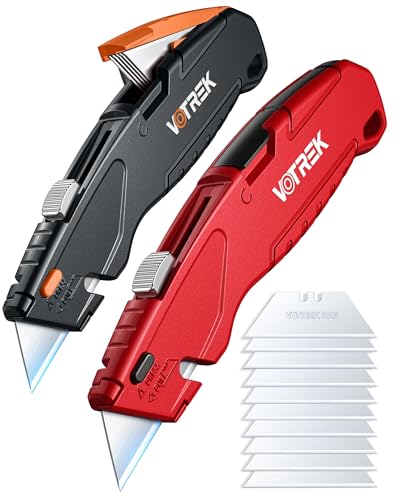 VOTREK UK003Best for one-handed use
 WORKPRO W011047Most blades included
What a box cutter is
A box cutter is a hand tool built around a thin, sharp blade that you can extend for a cut and cover again afterward. The blade is usually a flat, trapezoid-shaped piece of steel with two cutting edges, and you replace it when it dulls instead of sharpening it.
The body holds the blade and gives you something to grip. On a retractable model, the blade slides out of a closed body and locks in place. On a folding model, the blade swings out of the handle, much like a pocketknife.
The goal is simple: make quick, controlled cuts through everyday materials, and keep the edge protected the rest of the time.
The real name and other names
The most accurate name is utility knife. Box cutter is the casual name people use because opening boxes is the most common job. In everyday speech and on product listings, the terms are often used interchangeably.
Some people draw a line between the two. A box cutter is the simple, lighter tool for cartons and thin packaging. A utility knife is sometimes used for the heavier, general-purpose versions with sturdier bodies. In practice, a lot of products carry both labels.
- Utility knife: the standard, formal name
- Box knife or boxcutter: common everyday names
- Razor knife: a name that points to the razor-style blade
- Stanley knife: a brand name that people in some countries use for any utility knife
What a box cutter is used for
Cardboard and packaging are the classic jobs, but the same blade handles many thin or soft materials. The product listings we compare mention a wide range of uses, from shipping work to crafts.
Match the cut to the tool. A box cutter is a good fit for light to medium cutting. It is not a replacement for a saw, shears or a chisel.
- Opening cartons and slicing packing tape
- Cutting cardboard down to size for shipping or recycling
- Trimming plastic packaging and straps
- Scoring and trimming drywall, vinyl and flooring
- Cutting carpet, rope and leather
- Precision cuts for arts, crafts and hobby projects
Retractable vs. folding designs
The two main designs suit different habits. A retractable cutter is quick to use again and again, which helps if you open many boxes in a row. A folding knife tucks the edge into the handle, which suits a toolbox or pocket.
Either way, check that the blade locks firmly before you press on a hard cut. A blade that shifts under pressure is a safety risk.
| Feature | Retractable | Folding |
|---|---|---|
| How the blade is stored | Slides back into a closed body | Folds into the handle |
| Best for | Repeated carton opening | Pocket or toolbox carry |
| Typical extras | Multiple blade depth settings, internal blade storage | Belt clip, dual lock, scraper edge |
| Check before use | That the slider locks in place | That the blade lock engages fully |
What to look for in a box cutter
Three features matter more than most others: an edge that stays covered between cuts, blade changes without tools, and an easy one-handed opening. These make daily use faster and safer. Our best box cutter comparison puts retractable and folding designs on one spec sheet so you can see these points line by line.
Weight and size also matter if you hold the tool for long stretches. Among the models on that page that list weight, the range runs from 3.17 oz to 9.44 oz. For example, the WORKPRO W013053 retractable model is listed at 3.2 oz and 6.3 in long, with 10 blades included. A folder such as the WORKPRO red folding knife closes to 4.5 in and comes with 13 blades.
Blade depth control is handy too. The VOTREK UK003 lists three blade lengths, 3 mm, 8 mm and 15 mm, so you can use a shallow setting for opening boxes and a deeper one for carpet or flooring. A shallow cut also lowers the chance of slicing the contents of a box.
If you want a tool that does a second job, look at combination designs. The Klein Tools FLICKBLADE lists a dual lock and works as both a utility knife and a scraper.
Using a box cutter safely
A box cutter is simple, but the blade is very sharp. Most injuries come from a dull blade, a rushed cut or a hand placed in the path of the blade. A few habits prevent most of them.
Dull blades need more force, and force is what makes a blade slip. Swap in a fresh one as soon as the cut starts to tear instead of slice. Tool-free release buttons make this quick, which is one reason we weigh that spec in our comparisons.
- Cut away from your body and keep your free hand out of the cutting line.
- Extend only as much blade as the job needs.
- Retract or fold the blade every time you set the tool down.
- Cut on a stable surface, not on your lap or in the air.
- Wear cut-resistant gloves for long runs of cardboard, and eye protection when cutting strapping or under tension, since a snapped blade or strap can fly.
- Dispose of used blades in a rigid, sealed container, never loose in a bin.
- Keep the tool and spare blades away from children.
Choosing the right one for your tasks
If you open boxes all day, a retractable body with built-in blade storage keeps spares close and the edge covered. If you carry a tool in a pocket or bag, a folding model with a belt clip may fit better. If you only open a few packages a month, one blade and a basic body are enough.
To compare specific models by weight, length, blade count and blade change method, see the best box cutter page. It lists which products note tool-free blade changes and which do not publish that spec, so you can check before you decide.
Frequently asked questions
Is a box cutter the same as a utility knife?
Mostly yes. Utility knife is the formal name, and box cutter is the common name for the version used on cartons. Some people use box cutter for lighter tools and utility knife for heavier ones.
Can a box cutter be used on materials other than cardboard?
Yes. Product listings mention uses such as vinyl, carpet, drywall, rope, leather and craft materials. Use a fresh blade and a stable surface, and do not force thick or hard materials.
How often should I change the blade?
Change it when cuts start to drag, tear or need extra pressure. Dull blades slip more easily, so do not wait until the edge is clearly worn out.
Are blades interchangeable between brands?
Often, but not always. The Klein Tools FLICKBLADE listing says it is compatible with universal utility blades. Check the product details for your model before you buy spares.