What Is a Benchtop Jointer and What Is It Used For?
A benchtop jointer is a compact woodworking machine that flattens one face of a board and then straightens and squares one edge. It gives you a true reference surface so later cuts on the table saw and planer come out accurate. It is sized to sit on a sturdy bench, which makes it a good fit for small shops, though its short tables and narrow cutterhead limit the boards it handles best.
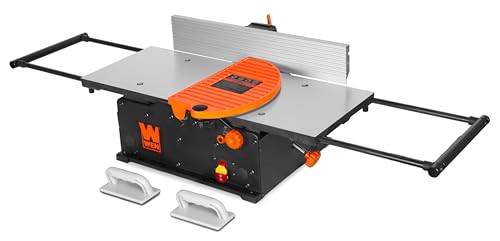 WEN JT1224HBest overall
 CUTECH 401120HI-IF#1 on our Best Score
 CUTECH 40180HBMid-size 8 in spiral
What a benchtop jointer does
A jointer has two flat tables with a rotating cutterhead between them. The infeed table sits slightly lower than the outfeed table, and the difference is how much wood the cutters remove in one pass. As you push a board across, the cutterhead shaves the high spots until the surface is flat.
A benchtop jointer does the same job as a full-size floor model, just in a smaller package. It is built to be lifted onto a workbench or a stand, and it usually plugs into a standard household outlet. The tradeoff is shorter tables and a narrower cut, which affects how well it handles long or wide boards.
If you are new to the machine, think of it as the first step in milling rough lumber. It creates the flat face and square edge that everything else is measured from.
What it is used for
The main job is flattening one face of a board. Rough or air-dried lumber often arrives cupped, bowed or twisted. A planer on its own tends to follow those shapes, so the jointer is used first to create one truly flat side.
The second job is making an edge straight and square to that flat face. With a flat face and a straight edge, you can run the board through a table saw or planer and get parallel, consistent parts.
- Flattening the face of cupped or bowed boards
- Squaring an edge at 90 degrees to the face
- Cutting bevels or chamfers when the fence tilts
- Preparing glue-ready edges for panels and tabletops
- Removing small amounts of twist or warp from short stock
How the process works
The usual order is face first, edge second, then thickness and width with other machines. Following that order keeps each step referenced to a surface you already trust.
Here is the basic sequence for a typical board:
- Check the board for loose knots, nails or embedded grit, and remove them.
- Set the infeed table for a light cut and make sure the fence is square to the tables.
- Place the cupped or concave side down and feed the board with steady, even pressure.
- Repeat until the whole face is flat, then hold that face against the fence and joint one edge.
- Move on to the planer to bring the opposite face parallel, and the table saw to cut the width.
Benchtop vs. full-size jointers
The biggest differences are table length, cutting width and weight. Longer tables support long boards and help you get a straighter result. Benchtop tables are shorter, so you need to take more care to keep long boards supported and not rock them as they pass over the cutterhead.
Space matters too. A jointer needs clear room on both ends of the machine, often more than the machine itself. A long board needs open floor space in front of and behind the bench, so plan your layout before you buy. If you are weighing a floor-standing machine against a compact one, our best jointer comparison covers the wider field.
| Feature | Benchtop jointer | Full-size jointer |
|---|---|---|
| Table length | Shorter | Longer |
| Typical cut width | Narrower | Wider |
| Setup | Sits on a bench or stand | Floor standing |
| Best for | Small shops, short boards, smaller projects | Long boards, wide stock, frequent milling |
| Portability | Easier to move and store | Heavy, usually stays in one place |
Straight knives vs. spiral cutterheads
You will see the term spiral benchtop jointer in many listings. A spiral cutterhead uses many small square inserts arranged in a spiral pattern around the cylinder, instead of two or three long straight knives. Each insert takes a small shearing cut.
In general, that shearing action tends to leave a smoother surface on figured or interlocked grain and is often quieter. When an insert gets a nick, you can rotate it to a fresh edge rather than replacing a whole knife. Straight knives can still produce excellent results when they are sharp and set correctly, and they are simple to sharpen.
To see how specific models with each cutterhead type compare on published specifications, check our best benchtop jointer page.
Safety essentials
A jointer has an exposed rotating cutterhead, so treat it with respect. Unplug the machine before you change knives, rotate inserts or adjust anything near the cutterhead. Never reach over the cutterhead, and keep your hands on the top of the board, using push blocks or push pads to move it across.
Wear safety glasses and hearing protection, since jointing is loud and throws chips. Use dust collection where you can, because the machine produces a lot of fine dust and chips. Avoid loose sleeves, jewelry and long hair near the machine.
Do not joint very short pieces by hand. If a board is too short to hold safely with push blocks, use a different method or a longer blank that you cut down later.
Frequently asked questions
Can a benchtop jointer replace a planer?
No. A jointer flattens one face and squares an edge, but it does not make the second face parallel to the first. A planer handles thickness, so most workshops use both.
Can I joint wide boards on a benchtop jointer?
Only up to the cutting width of the machine. Boards wider than the cutterhead need to be ripped narrower first or flattened with another method, such as a planer sled.
Do I need to bolt a benchtop jointer down?
Mount it firmly to a solid bench or stand so it cannot shift while you feed lumber. A machine that moves during a cut is a safety risk and gives uneven results.
Why does my jointed board still rock on the table?
The tables may be out of alignment, or the board may be too long for the table length. Check that the outfeed table is level with the cutterhead at its top point and support long stock at both ends.