What Happens If You Don't Pull a Vacuum on Car AC?
If you skip the vacuum, air and moisture stay trapped in the system. That means weak cooling, high pressures, possible ice blockages, and over time acid, corrosion and a damaged compressor. A vacuum pump does not remove freon. It is used on an empty system after the refrigerant has been properly recovered, so it clears out air and boils off moisture before you recharge.
 VIVOHOME VH1803Best overall
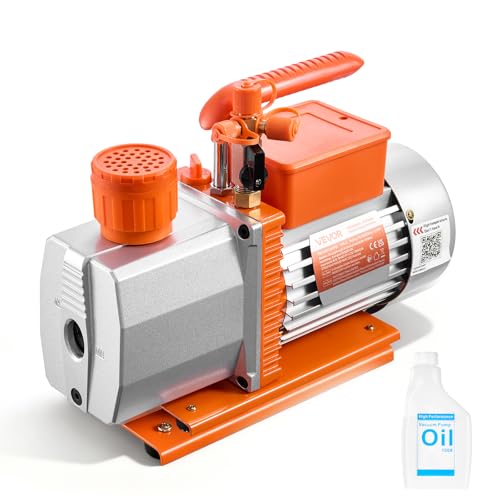 VEVOR 2RS-2Oil included, A2L listed
 SPECSTAR VH1694Lightest in the lineup
What happens when you skip the vacuum
Every time an AC system is opened, such as for a new compressor, condenser or hose, air gets in. That air carries water vapor. A vacuum pump lowers the pressure inside the system so the moisture boils off and gets pulled out with the air.
If you skip that step and just add refrigerant, the air and moisture are sealed in with it. The results build up in stages, and some are slow enough that you may not connect them to the missed step.
- Weaker cooling, because air does not condense like refrigerant and takes up space in the condenser.
- Higher than normal pressures on the gauges, which makes the compressor work harder.
- Ice forming at the orifice tube or expansion valve, which can cause cooling that comes and goes.
- Acid forming inside the system as moisture reacts with refrigerant and oil.
- Corrosion, sludge and early failure of the compressor, drier and other parts.
Why air and moisture are a problem
Air is a non-condensable gas. Once it sits in the high side, it keeps pressure up without helping to move heat. The system runs hotter and the vents never get as cold as they should.
Moisture is the quieter problem. The oil used in many car AC systems absorbs water from the air easily. Water in the loop can freeze where the refrigerant expands and cools, which blocks flow for a while. Water can also react with refrigerant and oil to form corrosive acids, and those attack metal from the inside.
This is why the damage can show up months later. The AC may cool fine on day one and then lose performance or fail once the internal wear has built up.
Quick view of the consequences
Here is how the main problems line up with what you would notice behind the wheel.
| Problem | Cause | What you may notice |
|---|---|---|
| Air in the system | Skipped or short vacuum | Warm vents, high gauge pressures |
| Moisture freezing | Water at the expansion point | Cooling that fades, then returns |
| Acid formation | Water mixing with oil and refrigerant | Hidden damage, shorter part life |
| Oil breakdown | Contamination | Poor lubrication, noisy compressor |
| Compressor wear | Heat, pressure and contamination together | Failure, often after the repair |
Does pulling a vacuum remove freon?
No. A vacuum pump is not a way to empty a system. The refrigerant has to be recovered first with a recovery machine, and in the US it is illegal to knowingly vent it to the air. Shops use recovery equipment for this, and the rules for handling it are set by federal law.
If you connect a pump to a system that still holds refrigerant, you would pull that refrigerant into the pump and exhaust it. That wastes it, pollutes the pump oil and can create a safety problem. Pull a vacuum only on a system that is already empty.
The same applies if your system just has a small leak and some pressure left. Fix the leak and recover what remains before you evacuate.
What about lines left open overnight?
Many DIYers ask whether a short open period lets them skip the vacuum. Open lines can take in humid air, and that moisture is exactly what you are trying to remove. Capping the lines quickly helps, but it does not make the water go away once it is inside.
Replace the drier or accumulator whenever the system is opened, since it holds moisture. Even then, pull a vacuum before recharging. The vacuum is cheap insurance compared with the parts it protects.
How to pull a vacuum the right way
The steps below are a general outline. Follow the service manual for your vehicle for exact refrigerant type, oil and charge amounts.
- Confirm the system is empty and the refrigerant has been recovered.
- Connect a manifold gauge set to the service ports and the center hose to the pump.
- Open both gauge valves and start the pump.
- Run the pump long enough for the gauge to reach a deep vacuum. Many service guides suggest at least 30 minutes, longer if the system was open for a while.
- Close the valves, turn off the pump and watch the gauge for 10 to 15 minutes. If the reading climbs, there is a leak or moisture still boiling off.
- If it holds, charge the system with the correct refrigerant and oil.
Safety notes
Wear safety glasses and gloves. Liquid refrigerant can cause frostbite on skin and serious eye injury. Keep hands and hoses away from belts and fans if the engine is running during charging.
Many newer cars use R1234yf, which is mildly flammable. Use a pump with a sparkless motor and an A2L listing, and keep the work area ventilated and free of ignition sources. Do not run the pump in a closed garage with fuel vapors around.
Picking a pump for car AC
For a car, a compact pump around 5 CFM is usually enough, as covered on our best vacuum pump for auto ac page. Look for A2L compatibility if your car uses R1234yf. One option there, the VIVOHOME VH1803, lists 5 CFM, a 1.5 micron ultimate vacuum, A2L compatibility, a gauge set and a weight of 19.5 lb.
Ultimate vacuum matters because a deeper vacuum pulls out more moisture. On the same page, the deepest pumps reach 1.5 micron and the shallowest listed is 50 micron. Anti-backflow protection is also worth checking, since it helps keep oil out of the system after a power cut. You can compare all of these specs side by side in our auto AC pump comparison.
Frequently asked questions
Can a recharge can with a gauge replace a vacuum?
No. A can and hose do not remove air or moisture from the system. They only add refrigerant. Evacuating needs a vacuum pump.
Do I need a vacuum if I am only topping off a low system?
Usually not, if the system was never opened and still holds pressure. The vacuum is for systems that were opened or emptied.
How can I tell if my AC has moisture in it?
Signs include cooling that fades and returns, high pressures and a freeze-up at the evaporator or expansion point. A shop can confirm it with proper gauges.
Can I reuse the pump with different refrigerants?
Often yes, since the pump only removes air. Check the maker's listing for supported refrigerants and A2L compatibility, and keep the oil clean.