What Class Safety Vest Do I Need?
Most people who work near roads or moving equipment need an ANSI/ISEA 107 Class 2 vest, and many roadway jobs also call for Type R. Class 3 is for faster traffic, poor visibility or high-risk work, and Class 1 is for slow, low-risk areas. Your employer or site rules make the final call, so check them first.
 JKSafety 51112LBest overall
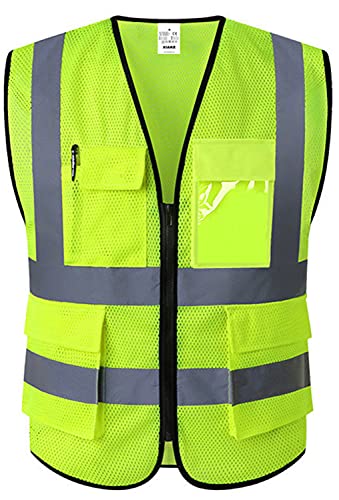 XIAKE 5MSVPlain breathable mesh
 HYCOPROT 162Most pockets listed
The short version: match the class to your risk
ANSI/ISEA 107 is the standard that sets how much bright background fabric and reflective material a high-visibility garment must have. The class tells you how much of that material you get. A higher class means more visible material and a better chance that a driver or equipment operator spots you in time.
Three classes cover most vests. Class 1 suits low-risk settings where traffic is slow. Class 2 is the common choice for work near moving traffic or equipment. Class 3 is for the most demanding conditions and usually comes as a garment with sleeves.
What is a Class 2 safety vest?
A Class 2 vest is built for moderate-risk work. Common guidance puts it at sites where traffic or machinery moves roughly between 25 and 50 mph, or where you need to stand out against a busy background. Think road crews, utility work, surveying, parking and airport ground work, and many warehouse and construction jobs.
It is also the level our best safety vest page sees most often. Nine of the ten vests we rank list Class 2. That fits its role as the standard choice for a wide range of jobs.
What is a Class 3 safety vest?
Class 3 gives the most visible material of the three. It is recommended or required for workers exposed to fast traffic (over about 50 mph), or where conditions are poor, such as heavy rain, fog or night work. Emergency incident response and some flagging work often land here.
Class 3 garments usually include sleeves, so you will often see jackets, long-sleeve shirts and coveralls rather than a plain sleeveless vest. If your site requires Class 3, a standard vest will not meet the rule, even if it looks bright.
What is Class 1, and what is ANSI?
ANSI stands for the American National Standards Institute. ISEA is the International Safety Equipment Association. Together they publish ANSI/ISEA 107, the American standard for high-visibility apparel. A vest that says it meets the standard has to carry a label showing its class and type.
Class 1 is for low-risk places where traffic moves slowly, commonly under 25 mph, and where you can give full attention to approaching vehicles. Examples are parking lots with slow cars or a quiet warehouse aisle. If a vehicle could reach you at speed, step up to Class 2.
Class and type: read both labels
The class is only half of the label. The performance type tells you where the garment is meant to be worn. Type R is for roadway work near traffic. Type O is for off-road work where traffic is not a concern. Type P is for public safety work, such as police or emergency crews.
This matters when you shop. On our comparison page, Type R is listed by several vests, while others publish no type at all. For example, the JKSafety JK150 lists Class 2 and Type R, with 9 pockets and a weight of 0.3 lb. The HYCOPROT 162 lists Class 2 and 16 pockets, but it publishes no type, so check the label if you work beside a road.
Be careful with any vest that shows no class. One black-collar vest on our page lists a padded neck, a zipper and 10 pockets, but no ANSI class. Do not assume it meets the standard.
Which class fits your job?
Use this table as a starting point. It is general guidance, and your employer, local rules or a traffic control plan can require more.
Safety note: if your work puts you near traffic, a vest does not replace other protection. Follow site rules for barriers, spotters and hard hats, and wear hearing and eye protection when the task calls for it.
| Class | Typical setting | Typical jobs | Common form |
|---|---|---|---|
| Class 1 | Slow traffic, low risk | Parking lot attendants, light warehouse work | Vest |
| Class 2 | Traffic or equipment up to about 50 mph, busy backgrounds | Road crews, surveyors, utility and construction workers | Vest |
| Class 3 | Fast traffic, bad weather or low light, high risk | Emergency response, highway flagging | Garment with sleeves |
Check these before you buy
Once you know the class, a few practical points help you pick a vest you will actually wear.
- Rules first: confirm the class and type your employer or site requires.
- Label: look for the class and type printed on the listing and on the garment.
- Fabric: mesh lets air through for hot work, while solid fabric holds pocket loads better.
- Weight: among the models that list it, weights run from 0.2 lb to 1.2 lb, so a heavier vest trades carry weight for build.
- Pockets: counts run from 7 to 16 among the models that list one. Pick an ID window if you carry a badge.
- Closure: a zipper front keeps the vest shut in wind or when you bend and climb.
Keep it working
A vest only helps if you can see the colors and reflective strips. Faded fabric, heavy dirt or peeling tape reduce visibility, so replace a vest that looks worn. Check the care label before washing, since some vests are machine washable and others are not.
Fit matters too. Check the size chart, and leave room for layers if you work in cold weather. A vest that rides up or hangs open can hide reflective strips.
For more side-by-side details on class, type, weight and pockets, see our safety vest comparison. Where a maker does not publish a spec, we say so rather than guess.
Frequently asked questions
Is a Class 2 vest enough for night work?
It can be, if your site allows it. Class 2 vests carry reflective strips that work with headlights. For fast traffic or poor visibility, some sites require Class 3, so ask before you buy.
Can I wear a Class 2 vest over a jacket?
Yes, if it fits over your layers without covering the reflective strips. Size up if needed, and make sure the vest stays closed and does not ride up.
Does a bright color alone make a vest compliant?
No. Compliance depends on the amount and placement of the fluorescent and reflective material, plus the label. Some bright vests do not list any ANSI class.
Do I need a safety vest for jogging or cycling?
There is no job rule for that, but many sellers list their vests for such use. A vest with reflective strips helps drivers see you in low light.
Are mesh vests as visible as solid ones?
Visibility depends on the class and the amount of material, not on mesh versus solid. Mesh mainly improves airflow, so check the class label on either type.