What Ceiling Light Should Go in a Living Room?
For most living rooms, a dimmable LED flush mount or slim panel with a warm to neutral color range is the safest choice. Match its brightness to your room size, make sure it dims, and add lamps so the ceiling light is not your only source. Ceiling height decides whether a slim fixture or a taller ring or semi-flush design fits.
 LUTEC XDD-7Best overall
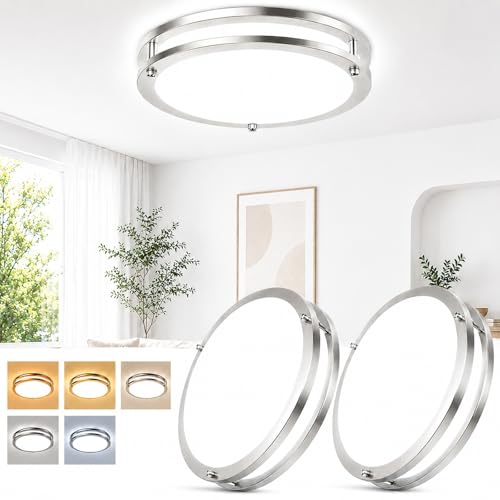 weddeg 63633008-03CRI 90 two-pack
 Brightever XD300-09Most efficient on the page
Start with the job the light has to do
A living room is used for TV, reading, guests, games and sometimes work. One fixed brightness cannot suit all of that, so the ceiling light is best treated as the base layer. It fills the room with even, comfortable light, and other lights handle the details.
That is why dimming and color temperature matter more here than in a closet or hallway. If you pick a fixture that does both, one ceiling light can cover a movie night and a Saturday cleanup.
Pick the fixture type by ceiling height
Height is the first filter. Measure from floor to ceiling, then check how far each fixture hangs down. Anyone walking under it, or tall furniture nearby, should never feel crowded.
Our best lighting for living room page lists the thickness of several fixtures. The Brightever panel is 0.67 in thin, and the weddeg is 2.6 in tall. Ring designs on that page measure 6 in or 10.2 in tall, so they need more headroom.
| Fixture type | Best for | Watch out for |
|---|---|---|
| Slim LED panel | Low ceilings and modern rooms | Can look plain; light may feel flat without lamps |
| Flush mount with diffuser | Standard ceilings, even light | Check the diameter against the room |
| Ring or multi-ring fixture | Larger rooms and open plans | Needs more height; often higher output |
| Semi-flush or pendant | Higher ceilings, decorative look | Hangs lower, so it is a poor fit under low ceilings |
Match brightness to the room size
Brightness is measured in lumens. A common planning rule is to aim for roughly 10 to 20 lumens per square foot in a living room, then adjust for dark walls, big windows and how you use the space. Treat that as a starting point, not a hard rule.
When a maker lists a coverage area, use it. The LUTEC is rated for up to 250 sq ft at 4200 lumens from 37 W, and the weddeg two-pack is also rated for up to 250 sq ft at 3600 lumens per fixture. For larger or open-plan rooms, our page points to higher-output designs such as the 8000 lm and 10400 lm ring fixtures.
If your room is larger than one fixture can cover, consider two lights spaced evenly rather than one very bright light. It avoids a hot spot in the middle and dim corners.
Choose color temperature and CRI
Color temperature is measured in kelvin. Around 2700K to 3000K looks warm and relaxed, which suits evenings in a living room. Cooler settings such as 5000K to 6500K look crisp and bluish, which can help for cleaning or detailed tasks but often feels harsh at night.
Look for a range that includes the warm end. The weddeg and Brightever list 2700K to 6500K, while the LUTEC starts at 3000K. The hykolity panel offers only 3000K, 4000K and 5000K.
CRI shows how true colors look. The weddeg lists CRI 90, which helps fabrics, wood and artwork look natural. Many fixtures do not list CRI at all, so if color accuracy matters to you, check the spec sheet before you buy.
Also note how the color is changed. Several fixtures use a switch inside the fixture that you must set before mounting. Remote models let you change it later, which is easier if you are not sure what you will like.
Make sure it dims
Dimming is the feature that turns a ceiling light into something you can live with. The LUTEC dims from 10% to 100% with standard triac dimmers, and the Brightever dims from 5% to 100%. In both cases the wall dimmer is not included, so budget time to buy a compatible one.
Skip non-dimmable panels for the main living room light. The hykolity works only with a regular on/off switch, and it is damp-rated, which makes it a better fit for a bathroom or basement.
Plan the whole room, not just the ceiling
A single ceiling fixture lights the room evenly but flattens it. Layering fixes that. Use the ceiling light for general light, then add lamps for reading and soft corners, and accent lights for shelves or art.
A simple approach to follow:
- Center the main fixture in the room, or over the seating area if the room is long and narrow.
- Put the ceiling light on a dimmer so it can drop low for the evening.
- Add a floor or table lamp beside each main seat.
- Use warm bulbs in lamps to match the ceiling light's warm setting.
- Place any accent light so it does not shine into the TV screen.
Install it safely
Ceiling work involves electricity and heights, so take it slowly.
Turn off the power at the breaker, not just the wall switch, and confirm with a voltage tester before touching any wires. Use a sturdy stepladder on a level floor and have a helper hold the fixture while you connect it. Wear safety glasses, since dust and debris fall as you work.
If the ceiling box looks damaged, there is no ground wire, or you need new wiring, hire a licensed electrician. Do not stare into a bright LED when testing it, and follow the maker's instructions for dimmer compatibility.
Frequently asked questions
Is one ceiling light enough for a living room?
In a small room it can be, if it dims and gives enough light. In most rooms, adding lamps gives better reading light and a more comfortable look in the evening.
How big should the fixture be?
Pick a diameter that looks balanced in the room and check the maker's rated coverage area. The 13 in LUTEC and weddeg fixtures are each rated for up to 250 sq ft.
Can I put a bathroom or utility panel in the living room?
You can, but a non-dimmable panel gives one brightness only. A dimmable fixture suits a living room better.
What color temperature is best for relaxing?
Warm white around 2700K to 3000K is the usual choice for relaxing, and a tunable fixture lets you go cooler when you need more focus.