The Two Types of Air Compressor Fittings: Couplers and Plugs
The two types of air compressor fittings are couplers (the female side with a sleeve and locking balls) and plugs (the male side, also called nipples or plugs). A coupler only works with a plug, and the two must share the same profile. The most common thread size is 1/4 in NPT, and the most common profile is Industrial (M/D).
 Ailbiuko aircoupler_plug-iron-45pcsBest overall
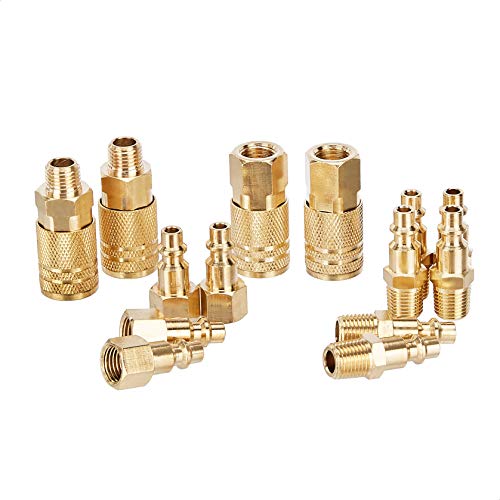 Amazon Basics A140001Brass starter set
 SOKOSEY 20SMmutou2packsReplacement M/D couplers
The two types: couplers and plugs
Every quick-connect air connection has two halves. The coupler is the female half. It has a spring-loaded sleeve and small locking balls inside that grip the plug. The plug is the male half, a short stem with a groove that the locking balls settle into.
Couplers usually go on the end of your air hose or on the compressor outlet. Plugs go on the tools, blow guns and accessories you attach. That way you can swap tools quickly without shutting off the compressor. Because each connection needs one of each, you need both types, not just a pile of one.
Some shops use "two types" to mean something slightly different: the thread end and the quick-connect end. Each fitting has both. The thread end screws into your hose, tool or tank. The quick-connect end is where the coupler and plug meet. We cover each below.
How couplers and plugs work together
When you push a plug into a coupler, the locking balls drop into the plug's groove and the sleeve holds them in place. Pull the sleeve back and the balls release, so the plug slides out. Push-to-connect couplers skip the sleeve pull when you connect. You simply push the plug in and it locks. Our listed push-in kits have 4 or 6 locking balls, depending on the model.
Fittings also come with male or female threads on the back end. A coupler can have male threads or female threads. So can a plug. Pick the threaded side based on what it screws into.
- Coupler: female quick-connect end, with a sleeve and locking balls.
- Plug: male quick-connect end, with a grooved stem.
- Threaded end: male or female pipe threads that attach to a hose, tank, regulator or tool.
- Rule of thumb: one coupler on the supply side, one plug on each tool.
| Part | Role | Usually found on |
|---|---|---|
| Coupler | Female half, locks the plug in place | Air hose end, compressor outlet |
| Plug | Male half, slides into the coupler | Air tools, blow guns, accessories |
| Thread end | Seals into the hose or tool | Both fittings, on the back side |
What size fittings are standard?
The standard thread size for compressor fittings is 1/4 in NPT. NPT stands for National Pipe Taper. The threads are tapered, so they tighten into a seal. Every top-ranked kit on our best air compressor fittings page lists 1/4 in NPT.
Check the threads on your compressor outlet and your hose before you buy anything. If yours use a different thread, a 1/4 in NPT fitting will not seal properly. Wrap the male threads with thread seal tape, then snug the fitting by hand before using a wrench.
Match the profile, not just the size
Thread size tells you what screws into what. Profile tells you which coupler fits which plug. A plug only locks into a coupler with the same profile. If the profiles differ, the plug may seem to fit but will leak or pop out.
Most kits we compare list Industrial (M/D), a common profile meant to interchange across brands. A few listings do not state the profile. If yours does not, look at your current plugs or tools before ordering a new coupler. Mixing profiles is one of the most common causes of leaks that people blame on bad parts.
Brass vs steel: which is better?
Neither wins in every case. Brass resists corrosion and wears smoothly, which suits damp garages and long-term use. Steel is strong and hard, but plain steel can rust unless it is plated. Plated steel and aluminum both appear in our fittings group.
One example is the 45-piece Ailbiuko kit, listed as brass and plated steel with a 300 psi rating. Several brass kits, such as the WORKPRO 16-piece set, also list 300 psi. Some makers publish no pressure rating at all. A missing rating does not prove a weak fitting, but it leaves a gap you should weigh.
| Material | Strengths | Watch for |
|---|---|---|
| Solid brass | Corrosion and wear resistance | Check the stated rating |
| Plated steel | Strong and hard | Plating can wear, exposing steel to rust |
| Aluminum | Light weight | Softer, so threads and sockets may wear sooner |
Choosing a kit
Count what you actually need. Large sets help if you run many tools. The Ailbiuko kit lists 45 pieces, with 8 couplers and 28 plugs, and includes thread tape. A small shop may do fine with the Amazon Basics 14-piece brass set, which lists 4 couplers and 10 plugs but no tape.
If you only need to replace a worn part, a small pack makes sense. SOKOSEY lists a pack of 2 couplers at 300 psi, and T TANYA HARDWARE lists 10 plugs with no couplers. For a tidy setup, the WORKPRO 16-piece set comes with a storage case and tape and weighs 0.97 lb.
If you are still picking a compressor, our guides to the best air compressor for home garage and best air compressor for home shop show what outlet and hose setup each one expects.
Safety and installation tips
Compressed air stores a lot of energy. Treat every fitting as part of a pressurized system.
Before you swap or tighten anything, follow these steps:
- Turn off the compressor and unplug it, or switch off power at the source.
- Open a valve or bleed the tank until the gauge reads zero.
- Wear safety glasses, since a stuck fitting can release suddenly.
- Use hearing protection when running the compressor or blowing air.
- Never exceed the lowest pressure rating in your system, including hose and tools.
- Replace fittings that leak, stick or show cracks or heavy wear.
Frequently asked questions
Do I need thread tape on air fittings?
Yes, on tapered NPT threads it helps seal small gaps. Wrap it in the direction of the threads and keep tape out of the air path.
Can I mix brands of couplers and plugs?
Often yes, if both use the same profile, such as Industrial (M/D). Always confirm the profile on both sides first.
How do I know a fitting is leaking?
Listen for a hiss, then brush soapy water on the joint. Bubbles show where air escapes.
Do automotive shops use different fittings?
Many use the same 1/4 in NPT Industrial setup, but check your tools. Our best air compressor for automotive shop page shows what to match.