What Are the Main Types of Pliers?
The main types of pliers are gripping pliers (slip joint, groove joint and locking), needle nose pliers for reaching small parts, and diagonal cutters for snipping wire. If you want a simple split into two types, think fixed-joint pliers, which have one set opening, and adjustable pliers, which can open to several widths. Most homes and garages are well covered by one of each main kind.
 DISEN 21DGNQBest overall
 WORKPRO W006012AEBest with storage racks
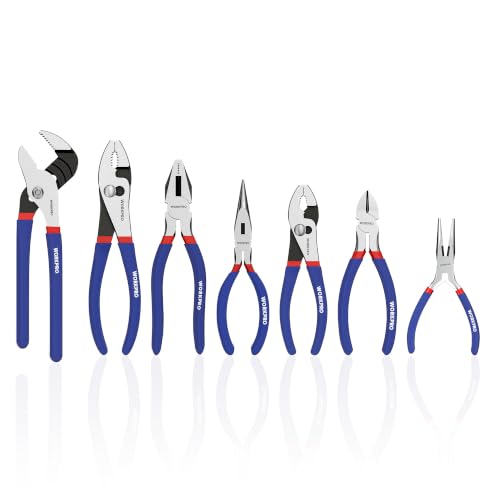 WORKPRO W001306ABest basic set
The main types at a glance
Pliers all work the same way: two handles act as levers and multiply the force of your hand at the jaws. What changes from type to type is the jaw shape, whether the pivot adjusts, and whether the tool can cut or lock.
Here are the types you will see most often. If someone asks for three types, the usual answer is slip joint, needle nose and diagonal cutters. Locking pliers are a close fourth.
- Slip joint pliers: general gripping with two jaw openings
- Groove joint pliers: wide, adjustable jaws for pipes and large nuts
- Locking pliers: clamp onto a part and stay shut without hand pressure
- Needle nose (long nose) pliers: reach into tight spots and hold small parts
- Diagonal cutters: cut wire and small fasteners flush
- Linesman pliers: grip, bend and cut electrical wire
- Snap ring (circlip) pliers: install and remove retaining rings
Two types: fixed-joint and adjustable
When people ask for just two types, they often mean how the pivot works. Fixed-joint pliers, such as most needle nose pliers and diagonal cutters, have a single rivet or bolt. The jaws open and close in one arc, which keeps them strong and precise.
Adjustable pliers let you move the pivot to a second or third position. Slip joint and groove joint pliers fall in this group. The wider opening lets one tool handle different thicknesses, though the pivot is a little less rigid than a fixed joint.
Another common two-way split is by job: gripping pliers versus cutting pliers. Both ways of sorting are valid. They just answer different questions.
Gripping pliers: slip joint, groove joint and locking
Slip joint pliers are the classic household pair of pliers. A pivot with two positions gives a narrow and a wide opening. They suit light gripping, pulling and holding jobs, and many sets include a 6 inch and an 8 inch size.
Groove joint pliers (often called water pump pliers) use a series of channels so the jaws open much wider and stay parallel to the work. That makes them a good fit for pipe fittings, large nuts and hose clamps. Sizes matter here: one mechanic-style set on our comparison page includes three groove joint sizes at 8, 10 and 12 inches, so you can match the tool to the job.
Locking pliers add a clamping mechanism. You set the jaw width, squeeze, and the jaws lock tight. They free up your hands for welding, sanding, or holding a rounded bolt head that a wrench would slip on. Some sets also include variants such as a long nose locking plier or a locking C-clamp.
Reaching and cutting pliers
Needle nose pliers have long, tapered jaws. They pick up small screws, bend thin wire into loops, and reach behind panels where fingers cannot go. Many have a short cutting edge near the pivot.
Diagonal cutters have angled blades that meet at the tip. Use them for trimming zip ties, cutting wire and snipping small nails or pins. Look for hardened cutting edges, which stay sharp longer.
Linesman pliers are a sturdier option for electrical work. The flat jaws grip and twist wire, and a cutter sits at the base. A wire stripper handles insulation so you do not nick the conductor underneath.
Specialty pliers and which job they fit
Specialty pliers are worth having when the job comes up regularly. Snap ring pliers have fine tips that fit into the holes of retaining rings, which show up in car and equipment repair. An oil filter plier has a wide, adjustable grip for filters that are stuck. Screw extraction pliers help with damaged fasteners.
The table below matches common tasks with the type that usually handles them best.
| Task | Best type | Why |
|---|---|---|
| Turning a pipe fitting | Groove joint | Wide jaws, strong grip |
| Picking up a small screw | Needle nose | Slim tips reach tight spots |
| Trimming wire or zip ties | Diagonal cutters | Angled blades cut close |
| Holding a rounded bolt | Locking | Clamps without hand pressure |
| Removing a retaining ring | Snap ring | Tips fit the ring holes |
| Light household gripping | Slip joint | Simple, two openings |
Safety notes before you start
Pliers are simple tools, but a few habits prevent most injuries. Wear safety glasses whenever you cut wire or snap rings, because small pieces can fly off at speed. Wear work gloves if you are handling sharp metal.
- Unplug a device or switch off the circuit at the breaker before cutting or stripping any wire. Never cut a live wire.
- Do not assume the grips insulate you. Only tools rated and marked for electrical work protect against shock.
- Do not use pliers as a hammer, and do not add a pipe to the handle for extra leverage. That can break the tool.
- Keep fingers clear of the pinch point between the handles, especially on locking pliers.
- Use the right size. An undersized tool slips and can round off a fastener.
How to choose and build a set
Start with the jobs you do most. A basic home kit needs slip joint or groove joint pliers, needle nose pliers, diagonal cutters and one locking plier. If you do car work, add snap ring pliers.
Sets are a convenient way to get the right mix. Our best pliers page compares sets from 3 to 21 pieces on a single spec sheet. For example, the DISEN 21-piece set lists locking, groove joint and snap ring pliers with Cr-V steel jaws, while the WORKPRO 7-piece set sticks to drop-forged steel pliers with dipped grips.
Check the materials and storage too. Cr-V or drop-forged steel jaws tend to last longer, and cushioned or dipped grips help when your hands are oily. A rack, tray or bag keeps everything in one place. The WORKPRO 20-piece set, for instance, includes two 10-slot racks. You can see how each option stacks up on our pliers comparison before you decide.
Frequently asked questions
What is the difference between slip joint and groove joint pliers?
Slip joint pliers have a pivot with two positions, so they offer two jaw openings. Groove joint pliers have several channels, which allows a much wider range of openings and a stronger hold on large pipes and nuts.
Can I use locking pliers instead of a wrench?
Sometimes, such as on a rounded bolt head. A wrench or socket is still the better choice on a healthy fastener because locking pliers can mar the surface.
Do I need different pliers for electrical work?
Linesman pliers and a wire stripper make the work easier. For live-circuit work, use tools that are specifically rated for it, and turn off power whenever you can.
How should I store pliers?
Keep them dry and separated so the jaws do not knock together. A rack, tray or roll-up pouch works well, and a light wipe after use helps protect against rust.