Types of Light Bulbs and How They Differ
The four main types of household light bulbs are incandescent, halogen, CFL (compact fluorescent) and LED. They differ in how they make light, how much electricity they use, how long they last and how much heat they give off. For most homes, LED is the best choice, because a 9 watt A19 LED can give about 800 lumens, the same brightness as an old 60W incandescent.
 TJOY QASN83+85Best overall
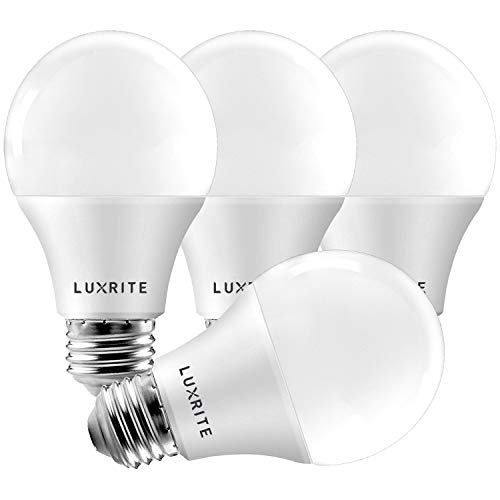 LUXRITE B07BHVRVPSLongest lasting
 GE 42977Best known brand
The four main types at a glance
Every bulb turns electricity into light, but the method changes almost everything else about it. Incandescent and halogen bulbs heat a thin wire until it glows. CFLs excite a gas inside a tube. LEDs pass current through a small semiconductor chip.
Heating a wire wastes most of the energy as heat. That is why older bulbs feel hot to touch and why they use more watts for the same brightness. The table below sums up the differences in general terms.
| Type | How it makes light | Light color | Energy use | Typical use |
|---|---|---|---|---|
| Incandescent | Glowing filament | Warm, yellowish | High | Older lamps and fixtures |
| Halogen | Glowing filament in halogen gas | Bright, white-leaning | High | Spotlights, track lights, some work lamps |
| CFL | Gas in a coiled tube | Warm to cool, varies | Lower | Fixtures where a swirl bulb fits |
| LED | Semiconductor chip | Warm to cool, many options | Lowest | Almost every fixture |
Incandescent bulbs: the classic
An incandescent bulb is the traditional glass bulb with a thin filament inside. Current heats the filament until it glows. The light is warm and soft, which many people still associate with a cozy room.
The downside is efficiency. Most of the power becomes heat, not light. Filaments also burn out sooner than the chips in LEDs. Many stores now stock few of them, since LEDs have replaced them in most fixtures.
Halogen bulbs: a brighter, hotter filament
A halogen bulb is a type of incandescent. The filament sits inside a small capsule of halogen gas, which lets it run hotter and give a whiter, crisper light. Halogens are common in spotlights, recessed cans and some desk and floor lamps.
They are still heat-based, so they use more power than LEDs and run very hot. Keep them away from curtains, paper and anything that can burn. Never touch the glass capsule with bare fingers if you can avoid it, since skin oils can shorten its life. Always let the bulb cool fully before you change it.
CFLs: the in-between step
Compact fluorescent lamps use a gas-filled tube, usually coiled into a spiral. An electrical current makes the gas glow, and a coating on the tube turns that into visible light. They use less power than incandescent bulbs and were a popular upgrade before LEDs improved.
CFLs can take a moment to reach full brightness, and not all of them work with dimmers. They also contain a small amount of mercury. If one breaks, open a window, leave the room for a while and clean up using your local guidance. Recycle old CFLs at a drop-off point instead of putting them in the trash.
LED bulbs: what they are and why they lead
LED stands for light-emitting diode. The chip makes light directly, so far less energy turns into heat. That is how a 9 watt bulb can match a 60W incandescent. In our best light bulbs comparison, the A19 LEDs list 8 to 10 watts for a 60W equivalent, with 750 to 850 lumens.
Rated lifespans on that page run from 10,000 to 25,000 hours. The TJOY 8-pack, for example, lists 15,000 hours, while the LUXRITE 4-pack lists 25,000 hours and a 2-year warranty. These are manufacturer ratings from published specifications, not results from our own use.
LEDs also come in many color temperatures. Warm 2700K looks like an incandescent bulb, 3000K is a little crisper, and higher numbers look cooler. If you care about how skin tones and food look, check the CRI. A rating of 85 or higher shows colors more naturally.
LED vs. regular and LED vs. halogen
When people say "regular" bulbs, they usually mean incandescent. Compared with those, an LED gives the same brightness with much less power and far less heat. Compared with halogen, the gap is similar: halogens are bright and crisp but run hot and use more watts.
The main thing to check when swapping is the base and shape. Most lamps use an E26 base and an A19 shape, which our listed LEDs match. Spotlights often use a different base, so match the old bulb before you buy.
Quick checklist before you swap:
- Compare lumens, not watts, to judge brightness. About 800 lumens replaces a 60W bulb.
- Pick a color temperature: 2700K for warm, 3000K for slightly crisper light.
- Check dimmability if the bulb goes on a dimmer. Some LEDs, like the TJOY 8-pack, are listed as not dimmable.
- Look for a safety listing such as UL or ETL.
- Confirm the base type and bulb shape match the fixture.
Choosing by room and location
Living rooms and bedrooms usually suit warm white, 2700K to 3000K, and a dimmable bulb. Kitchens, hallways and bathrooms work well with 3000K or a bit cooler, where clear light matters. For a work desk, a higher CRI helps you see colors accurately.
If comfort is your main concern, such as glare or flicker, see our best light bulbs for health guide. For porches, garages and lamp posts, you need bulbs rated for weather, so read best light bulbs for outdoor fixtures before you buy. Some indoor bulbs are only meant for dry spots.
Safety notes when changing bulbs
Turn the switch off and let the bulb cool before you touch it, especially halogen. Check the fixture label for its maximum wattage and do not exceed it. LEDs draw less power, so they are usually well within the limit, but check enclosed fixtures, since some bulbs are not made for them.
Use a stable ladder or step stool for ceiling fixtures, and keep one hand free to hold on. If a bulb breaks, wear gloves and sturdy shoes while you clean up the glass. For anything beyond a simple screw-in swap, such as damaged sockets or wiring, call a licensed electrician.
Frequently asked questions
Can I use an LED in an old lamp?
Usually yes, if the base matches. Most table and floor lamps use an E26 base. An LED draws less power than the bulb it replaces, so it will not exceed the lamp's wattage rating.
Why do some LED bulbs flicker on a dimmer?
The bulb and dimmer may not be compatible. Use a bulb listed as dimmable, and check whether it names the type of dimmer it supports, such as TRIAC. Some listings warn that smart dimmers are not supported.
Does a higher lumen number always mean a better bulb?
No. Lumens only measure brightness. A bulb that is too bright can cause glare, so match the number to the room and the fixture. For a standard lamp, about 800 lumens is a common target.
Are LED bulbs safe for enclosed fixtures?
Only if the package says so. Some LEDs list enclosed fixtures as fine, and others do not. Check the label before you install one in a closed glass globe.