What Are the Different Types of Wood Clamps?
The main types of wood clamps are bar clamps (parallel, F-style and pipe), one-handed trigger clamps, spring clamps, C-clamps, hand screws, band clamps and corner clamps. A woodworking clamp is simply a tool that holds pieces together or steady while glue dries or you cut, drill or assemble. For most home shops, a few bar clamps plus a handful of small trigger clamps cover the majority of jobs.
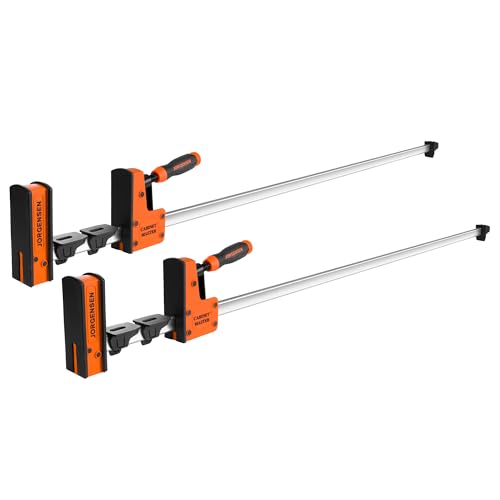 Jorgensen 99050Best overall
 VEVOR 50 inch 2packLong reach, simple spec
 WEN CLP502Deepest throat, soft pads
What a woodworking clamp does
A woodworking clamp holds wood in place by squeezing it between two jaws. You use it to press a glue joint tight while it cures, to pin a board to a bench while you cut or drill, or to hold parts square while you fasten them.
Clamps are sorted mostly by how they apply pressure and what shape of work they suit. Some reach across wide panels. Others grip a small trim piece with one hand. Knowing the families makes it much easier to see why a shop ends up owning several kinds rather than one.
Bar clamps: the workhorses
If you have heard the term "bar clamp" and wondered what it means, it is a clamp built on a long bar with one fixed jaw at one end and a sliding jaw you tighten with a screw or handle. The bar sets how wide a piece the clamp can hold. Three styles fill most shops.
Parallel bar clamps have thick jaw faces that stay flat and square to the bar as you tighten. That spreads pressure evenly and helps keep cabinet boxes, drawers and tabletops flat. The Jorgensen 50in Parallel Bar Clamp in our data opens to 50 in and lists 2200 lb of clamping force, and it also converts to a spreader by reversing the sliding jaw. Our best wood clamps page compares more models in this style.
F-clamps use a slimmer bar with a fixed jaw and a sliding jaw shaped roughly like the letter F. They are lighter and easier to handle, but the jaws can tilt under heavy load. That makes them a good fit for light assembly and holding work down, and less ideal for large glue-ups. If that sounds like what you need, see our best F-clamps comparison.
Pipe clamps are a third version. You buy clamp fittings and thread them onto a length of ordinary pipe, so you can pick the length you need. They are a flexible way to reach long distances, though the jaws are usually less precise than parallel clamps.
Small and quick clamps
Not every job needs a long bar. Smaller clamps are quicker to place and easier to store.
One-handed trigger clamps look like short bar clamps with a pistol grip. You squeeze the trigger to close the jaws, which frees your other hand to hold the work. The IRWIN Quick-Grip 1964758 in our data is a 6 in version at 0.25 lb per clamp with a listed 140 lb of force. That is plenty for trim and small assemblies and far too little for a hardwood tabletop.
Spring clamps work like oversized clothespins. They are fast and cheap in concept, but the pressure is light and fixed. They suit holding a template, a piece of scrap or a thin veneer, not a structural glue joint.
C-clamps have a C-shaped steel frame and a screw. They grip very tightly in a small space and are common for metal and for holding jigs. On wood, put scrap between the pad and the surface, since the small swivel pad can leave a dent.
Hand screws have two wooden jaws joined by two long screws. The wide wooden faces spread pressure across a large area and can angle to hold tapered pieces, which is handy for edge work and delicate surfaces.
Specialty clamps
Some clamps solve one shape problem very well.
Band clamps wrap a strap or cord around an object and tighten it, which suits chairs, round frames and other shapes that are not square. Corner clamps hold two pieces at a right angle for picture frames, boxes and carcases. Face clamps reach in from the edge to hold a trim or a face frame flush to a panel.
Clamp types at a glance
This table summarizes what each family does best. It is based on general clamp design, so check the specs on any particular model before you buy.
| Clamp type | Best for | Watch out for |
|---|---|---|
| Parallel bar | Panels, cabinets, tabletops, frames | Heavier and bulkier to store |
| F-clamp | Light assembly, holding work to a bench | Jaws can tilt under heavy load |
| Pipe clamp | Long glue-ups when you supply the pipe | Less precise jaw alignment |
| Trigger clamp | Trim, small parts, one-handed holding | Low clamping force |
| Spring clamp | Templates, scrap, thin veneer | Light, fixed pressure |
| C-clamp | Tight spaces, jigs, metal | Pad can dent soft wood |
| Hand screw | Edges, tapered pieces, delicate surfaces | Slower to adjust |
| Band clamp | Round or irregular frames | Not for flat panels |
| Corner clamp | Right-angle joints and boxes | Limited to specific joint sizes |
How to choose the right clamp
Start with the job, then check a few specs. Spec data on clamps is often incomplete, so a missing number is worth noting.
Here is a simple way to narrow it down:
- Measure your widest panel or longest board, then pick a clamp whose maximum opening is longer. Our data includes parallel clamps with openings of 24 in, 48 in and 50 in.
- Look at throat depth if you clamp wide panels. The WEN CLP502 lists a 4.125 in throat, and the POWERTEC 48in set lists 3.625 in.
- Check clamping force against your material. A 6 in trigger clamp rated at 150 lb is fine for trim. A hardwood glue-up calls for the higher ratings, such as the 1350 lb listed for the POWERTEC four-pack.
- Confirm soft jaw pads are included, or plan to add scrap wood between the jaws and the work.
- Decide whether you want a spreader function. Several clamps in our data, such as the VEVOR 24in 4-pack and the HORUSDY 6in pair, convert to a spreader by reversing the jaws.
Safety and good habits
Clamps store a lot of force. Tighten gradually and stop once glue squeezes out evenly, since overtightening can bow thin boards or crush the wood fibers.
Wear safety glasses when you tighten, release or work near a clamped piece. A jaw can slip, and a spring clamp can snap off a workpiece. Keep fingers clear of the jaws as they close.
When you clamp a workpiece that you will then cut or rout, make sure the clamp and its handle are out of the tool's path. Never clamp something in a position where a falling bar could hit your feet. Long bar clamps are heavy, so store them flat or in a rack.
Building a starter set
Most beginners do well with a small mix: a few 24 in parallel clamps for cabinet and panel work, a couple of longer ones for tabletops, and several 6 in or 12 in trigger clamps for trim and quick holding jobs.
Add specialty clamps such as band or corner clamps only when a project calls for them. You can compare many of the options side by side on our best wood clamps page, and look at lighter models on our F-clamp page.
Frequently asked questions
What are those long metal clamps with a screw handle called?
They are usually bar clamps. Depending on the jaw shape and bar thickness, they may be called parallel clamps, F-clamps or pipe clamps.
Do I need soft pads on my clamps?
Soft pads protect the surface and help spread pressure. If your clamps do not include them, place scrap wood between the jaw and your project.
Can I use an F-clamp instead of a parallel clamp?
For light assembly or holding work to a bench, yes. For flat, square glue-ups of cabinets or tabletops, parallel jaws are the steadier choice.
How many clamps do I need for a glue-up?
Use enough to apply even pressure along the whole joint. A common approach is to space clamps along the seam and alternate them above and below the panel to help keep it flat.