Common Types of Air Compressor Fittings Explained
Air compressor fittings fall into two groups: threaded fittings that join pipe-style connections, and quick-connect couplers and plugs that let you swap hoses and tools fast. In the US, 1/4 in NPT threads with an Industrial (M/D) quick-connect profile are the most common combination. Match the thread and the profile and your parts will seal and click together.
 Ailbiuko aircoupler_plug-iron-45pcsBest overall
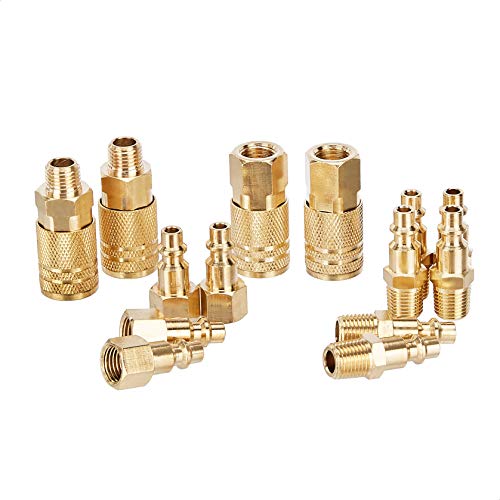 Amazon Basics A140001Brass starter set
 SOKOSEY 20SMmutou2packsReplacement M/D couplers
The two basic groups of fittings
When people ask about the two types of air compressor fittings, they usually mean threaded fittings and quick-connect fittings. They do different jobs, and most setups use both.
Threaded fittings are the permanent parts. They screw into the compressor outlet, the regulator, a hose end or a tool inlet. Think of nipples, adapters, elbows, tees and bushings. They have male threads (outside) or female threads (inside).
Quick-connect fittings come in pairs. A coupler is the body with a sleeve or push-in mechanism. A plug (also called a nipple or stem) is the part that locks into it. The coupler usually stays on the hose, and the plug threads into the tool or accessory. Both halves thread onto something, so you still need the right thread on each.
| Group | What it does | Typical parts |
|---|---|---|
| Threaded fittings | Joins components with a sealed thread | Adapters, nipples, elbows, tees, bushings |
| Quick-connect fittings | Connects and releases tools without threading | Couplers (male or female thread) and plugs |
Thread types: NPT and what to watch for
Most US compressors, regulators and hoses use NPT, short for National Pipe Taper. The threads are tapered, so they wedge tighter as you screw them in. That taper is why you wrap the threads with PTFE tape, since the threads alone do not fully seal.
Every top-ranked kit on our best air compressor fittings page lists 1/4 in NPT. If your hardware uses a different thread standard, such as a straight or metric thread, a 1/4 in NPT fitting will not seal properly even if it seems to start threading on.
Male and female also matter. A male NPT thread goes into a female NPT port. Check which one your compressor outlet and hose ends use before you order, so you do not end up with two male ends facing each other.
Quick-connect profiles: the part people mix up
Quick-connect plugs only work with couplers of the same profile. A plug can look almost identical to another profile and still not lock in or seal. The common profiles are:
- Industrial (M-style, also sold as D-type or I/M): the most widely used profile in North America, and the one most kits here list.
- Automotive (T-style): common on some auto shop and tire equipment, with a different plug shape.
- ARO (A-style): another distinct shape that does not mate with Industrial parts.
- V-style: a higher-flow design for demanding setups.
What size fittings are standard?
For most home and garage compressors, 1/4 in is the standard size. There are two numbers to keep apart. The thread size is the NPT thread, and the body size is the opening in the coupler and plug. Many kits list both as 1/4 in. Larger body sizes such as 3/8 in and 1/2 in exist for tools that need more airflow, but you must match them across the coupler and plug.
The kits on our comparison page show how this plays out. The 45-piece Ailbiuko kit lists 1/4 in NPT, a 1/4 in body size and an Industrial (M/D) profile, with 8 couplers and 28 plugs. The Amazon Basics kit is smaller at 14 pieces, with 4 couplers and 10 plugs, also 1/4 in NPT.
If you are choosing a compressor too, our guides to the best air compressor for home garage and the best air compressor for home shop help you see which outlet and hose setup comes with each.
Brass vs steel vs aluminum
Brass is a popular choice because it resists corrosion and wear, which matters in a damp garage where moisture collects in air lines. Several kits on our page are solid brass, including the 14-piece Amazon Basics and RNSXYAT sets and the 16-piece WORKPRO kit.
Steel is strong, but bare steel can rust. Plated steel adds a coating to slow that down. The 45-piece Ailbiuko kit is a mix: its listing describes iron-based plugs and couplers with copper plating, plus brass hex couplers and nipples. Aluminum is lighter and shows up in some push-in kits, though it is generally softer than brass.
So which is better? For general shop use, solid brass is the safer default because corrosion resistance and thread durability are easy to rely on. Plated steel can work well too, but check the plating if the fittings will see moisture or heavy use. Whichever you choose, look for a stated pressure rating. Several kits here list 300 psi, but some makers do not publish one.
How to pick and install the right fittings
Work through the choice in order and you will avoid most leaks and returns.
- Check the thread on your compressor outlet and hose ends, and note male or female.
- Choose a profile and stick with it. If you already own plugs, match their profile.
- Count couplers and plugs. Each tool needs a plug, and each hose end needs a coupler.
- Confirm the material and pressure rating are suitable for your compressor.
- Wrap male NPT threads with thread tape in the direction of the threads, then tighten by hand first and finish with a wrench. Do not overtighten.
Safety notes
Always shut off the compressor and release the pressure in the tank and hose before changing fittings. A coupler released under pressure can whip, and a loose plug can fly off.
Wear safety glasses whenever you connect, disconnect or test air lines, since a burst of air can carry debris into your eyes. Compressors are loud, so use hearing protection if you work near one for long periods.
Never exceed the lowest pressure rating in the system. If one part is rated lower than your compressor's output, use a regulator or replace that part. Inspect fittings for cracks, damaged threads and worn locking balls, and replace anything that leaks or looks damaged. For automotive work, see our best air compressor for automotive shop guide for setups that run tools often.
Frequently asked questions
Can I mix Industrial and Automotive plugs and couplers?
Not reliably. Different profiles are shaped differently, so they may not lock or seal. Use plugs and couplers from the same profile.
Do I need thread tape on quick-connect fittings?
You need it on the tapered NPT threads where the fitting screws in, not on the coupler and plug connection itself. Some kits include tape and some do not, so check the contents.
Why does my coupler leak when connected?
The usual causes are a mismatched profile, a worn plug, damaged internal seals or a poorly sealed thread. Check the profile first, then replace worn parts.
Are push-to-connect couplers different from sleeve-style ones?
Yes. Push-to-connect couplers lock when you insert the plug, while sleeve-style couplers need you to pull back the sleeve first. Both can use the same profile, so check the listing.