What Are Sawhorses Used For? Jobs, Setup and Safety
Sawhorses are sturdy stands that hold lumber, sheet goods and tools at a comfortable height so you can cut, sand, paint or assemble. Used as a pair, they can also turn a board or sheet of plywood into a temporary workbench. The right pair depends mainly on load rating, working height and how easily it folds away.
 BORA PM-4550TBest overall
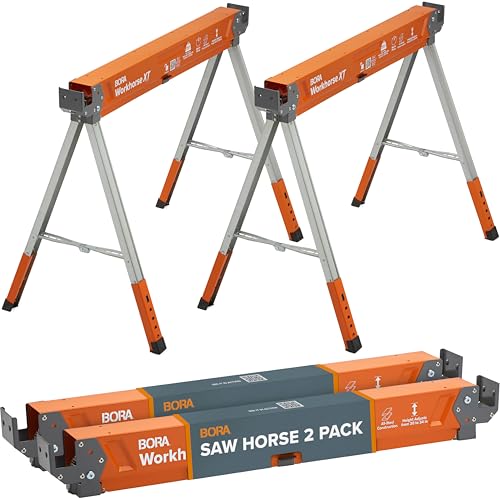 BORA PM-3360TQuick-latch adjustable pair
 KLEIN TOOLS 80178Lowest minimum working height
What a sawhorse is and how it works
A sawhorse is a simple stand with a horizontal top beam and four legs that angle outward, usually in an A-frame shape. You use two of them together, one near each end of the material, so the work rests on both. The name just describes a stand that holds work for sawing, and today it covers almost any trestle-style support.
The design works because of basic geometry. The top beam carries the load, and the angled legs pass that weight down to the floor. Because the feet sit wider apart than the top, the frame resists tipping and wobbling. Folding models add latches or levers that keep the legs open while you work and release them when you are done.
Many current models are made of steel, fold flat and have a carry handle. Some have adjustable legs, so the top sits at the height you pick rather than one fixed height.
Common jobs for sawhorses
The classic job is holding a board while you cut it. The sawhorses lift the board off the ground, so the offcut can drop away without pinching the blade. Beyond cutting, a pair is useful any time you want material at a comfortable height instead of on the floor.
Pairs also help when you work alone. They act like an extra set of hands, supporting one end of a long board while you handle the other.
- Cutting lumber with a hand saw or circular saw
- Supporting plywood and other sheet goods while you trim them
- Sanding, staining and painting boards, doors and furniture parts
- Assembling frames, shelves and small cabinets
- Holding tools and fasteners within reach on a temporary table
- Blocking off an area, such as a freshly finished floor, so people walk around it
Turning a pair into a workbench
Lay a sheet of plywood or a few boards across two sawhorses and you have a work surface that comes apart in minutes. That is why sawhorses are common in garages and on job sites where a permanent bench will not fit.
Some models make this easier. Pre-drilled tops and 2x4 brackets let you screw lumber across two sawhorses so the worktop stays put. Four of the five products on our best sawhorses page list 2x4 bracket support. The fifth, the Zyloquex pair, instead lists hooks that fit 4x2 timber.
Top length matters here too. A longer top gives more support to boards and sheet goods. Two models on our spec sheet list a 45 in top, the BORA Speedhorse XT and the BORA Speedhorse.
Matching height and capacity to the job
Working height decides how much you bend. A lower setting suits sanding and painting, while a taller setting suits cutting and assembly. Adjustable legs let you change the height, and legs that adjust independently can also level the top on uneven ground. A fixed height is simpler but cannot adapt.
Load rating is usually given per pair, so divide it by two to get the figure for each sawhorse. Add up the lumber, tools and any machine that will sit on top, and leave a margin. The table below shows the figures from the products we compare.
Listings can disagree with spec sheets, so confirm the load rating with the seller if a job is heavy. For a full side-by-side view, see our sawhorse comparison.
| Model | Load per pair | Working height | Bracket or hook support |
|---|---|---|---|
| BORA Speedhorse XT | 3600 lb | 30 to 36 in | 2x4 brackets |
| BORA Workhorse XT | 2700 lb | 30 to 34 in | 2x4 brackets |
| Klein Tools Folding Saw Horse | 3000 lb | 26 to 32 in | 2x4 brackets |
| BORA Speedhorse | 3600 lb | 30 in, fixed | 2x4 brackets |
| ZYLOQUEX Folding Saw Horses | 2650 lb | Starts at 30 in, maximum not recorded | Timber hooks for 4x2 |
Safety when you use sawhorses
A sawhorse is a support, not a step. Most accidents come from an unstable setup, so spend a minute checking the stand before you start work.
- Open the legs fully and engage every lock or latch before you load the sawhorse.
- Set the pair on firm, level ground, and adjust independent legs until the top does not rock.
- Stay under the load rating, and spread heavy items evenly across both sawhorses.
- Do not stand or sit on a sawhorse, and do not stack one on another.
- Clamp or hold the work, and keep your hands clear of the blade path.
- Wear eye protection when cutting or sanding, hearing protection around power saws, and a dust mask when sanding.
- Keep power cords off the floor path and away from the cut line, and use outlets with ground-fault protection outdoors.
Setting up a pair step by step
A good setup takes only a few minutes and prevents most problems. Here is a simple routine that works for any folding pair.
- Pick flat ground and clear loose debris from the area.
- Open both sawhorses and lock the legs. Quick-release models need only a lever or latch.
- Set the height, matching both sawhorses if the legs adjust.
- Place the sawhorses so the work rests near both ends, with the cut line between or just past them.
- Push down on the top to check for rocking, then add your material.
- When you finish, release the latches, fold the legs and store the pair flat.
Frequently asked questions
How many sawhorses do I need?
Most jobs use a pair, since two sawhorses support a board at both ends. All five products here come as a set of two. For long panels or heavy stock, a second pair or a middle support can keep the load from sagging.
Can I use one sawhorse by itself?
One alone only works as a prop for one end of a board while the other end rests on a bench, stair or second support. For stable cutting, use a pair so the work is supported at both ends, and clamp it when you can.
What height should a sawhorse be?
Pick the height that lets you work without bending much. Lower settings suit sanding and painting, taller ones suit cutting and assembly. Models here start between 26 and 30 in, and some adjust up to 32, 34 or 36 in.
Are adjustable sawhorses stable on uneven ground?
Models with independent leg adjustment let you set each leg separately to level the top. Check that all legs are locked and the top does not rock before loading it. Fixed-height models cannot compensate, so they need flat ground.