Taping Knife vs Putty Knife: What Is the Difference?
A taping knife is a wide, flexible blade made for spreading joint compound smoothly over drywall seams. A putty knife is narrower and usually stiffer, so it suits filling small holes, scraping and prying. Most drywall jobs need both, which is why they often come together in one set.
 suokoun CCGTDTZBest overall
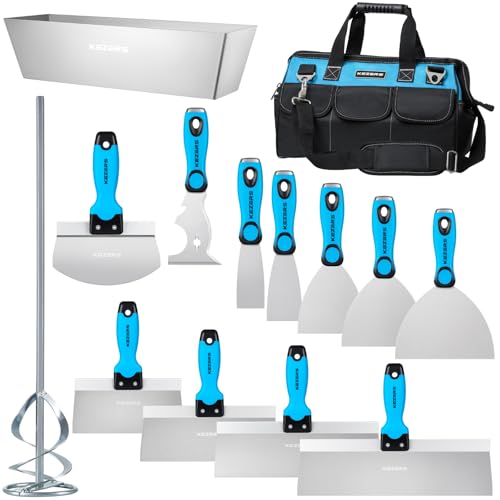 KEZERS F106Most complete taping kit
 Airless SJG DNS001Narrow knives plus pan
The short version
The main differences are blade width, stiffness and the job each one does best. A taping knife spreads and feathers compound over a long seam. A putty knife works in tight spots, pushes filler into holes and scrapes away loose material.
Makers and stores do not always use the names the same way. Some sets label every blade a putty knife, even the wide ones, and others call the narrow blades spackle knives. So look at the actual blade width and flex rather than the name on the package.
Taping knife: wide and flexible
Taping knives, also called joint knives, are the tools for finishing drywall seams. The wide blade rides across the wall surface and levels compound in one long pass. A little flex lets you press the edges down and feather them into the wall so the seam does not show.
Typical taping knife widths run from about 6 in up to 14 in. Some sets also include hollow-ground blades, which add controlled flex for smooth finishing. A wider blade covers more area per pass, but it also takes a steadier hand to keep the surface flat.
Putty knife: narrow and stiff
Putty knives are smaller and more rigid. That stiffness gives you leverage to scrape old paint, lift loose tape, pry trim gently or press filler firmly into a nail hole. The narrow blade also fits into corners and small repairs where a wide knife would be clumsy.
Common widths start at about 1 in and go up to around 6 in. A stiff blade does not spread a thin, even layer very well, so it is not the best choice for long seams.
Side-by-side comparison
This table sums up how the two types usually differ. These are general patterns, and individual products vary.
| Feature | Taping knife | Putty knife |
|---|---|---|
| Typical blade width | About 6 in to 14 in | About 1 in to 6 in |
| Blade flex | More flexible | Stiffer |
| Best for | Spreading and feathering compound on seams | Filling holes, scraping, prying |
| Works well in | Large, flat areas | Tight spots and small repairs |
| Weak point | Awkward in small spaces | Hard to leave a thin, flat coat on long seams |
Which one to use for common jobs
Match the knife to the task and the work goes faster. Here is a simple guide:
- Filling nail holes and small dents: a 1.5 in to 3 in putty knife.
- Scraping peeling paint or loose texture: a stiff putty knife.
- Embedding drywall tape in a seam: a 6 in knife, then wider ones for later coats.
- Feathering seam edges flat: a 10 in to 14 in taping knife.
- Loading compound from a pan or bucket: a narrower knife, or a bucket scoop if your set includes one.
- Skim coating a whole wall: very wide, thin skimming blades rather than either knife. Our drywall knife set comparison lists sets with blades from 10 in to 40 in for this work.
Do you need both?
For most drywall repairs, yes. A small putty knife handles the filling and prep. A wide taping knife handles the finishing coats. Buying one without the other tends to slow you down.
Sets solve this by bundling a range of widths. In our comparison data, the KEZERS 14-piece kit has nine knives from 1.5 in to 14 in, including five putty knives and four taping knives, plus a 14 in mud pan. The Airless SJG set also lists nine knives, from 1 in to 14 in, with a 14 in mud pan and a carry tote. If you only need small knives, one set lists five putty knives from 1 in to 5 in at 0.79 lb. You can see these side by side on our best drywall knife set page.
Check the blade material too. Stainless steel resists rust and rinses clean. One set in our data uses coated carbon steel for its three widest taping knives, so you need to keep the coating intact and store the blades dry.
Safety and care tips
Scraping and sanding put dust and debris in the air, so wear safety glasses and a dust mask. Never pry or scrape toward your hand or body, because a slipping blade can cut. Before you cut into or scrape a wall near outlets or switches, turn off the power at the breaker. If the paint on an older home could contain lead, do not scrape or sand it until you have checked with a certified test or a pro.
After each job, rinse the blades and dry them well. Clean tools leave smoother coats, and dry blades stay rust free.
Frequently asked questions
Can I use a putty knife instead of a taping knife?
You can for very small patches, but it is hard to get a flat, feathered finish with a narrow stiff blade. For seams and larger repairs, a wider taping knife gives better results.
Is a joint knife the same as a taping knife?
In most cases, yes. Joint knife and taping knife are two names for the same kind of wide, flexible drywall finishing blade.
What size taping knife should I start with?
A 6 in knife is handy for the first coat over tape. Many sets add 10 in, 12 in and 14 in blades for the later coats, which spread wider and blend the edges.
What is a spackle knife?
It is usually another name for a small putty knife. People use it to fill holes and cracks with spackle or lightweight filler.