Tankless Water Heater vs Tank: Which Is Better?
Neither type wins for every home. A tankless heater is usually the better fit if you want to save space and never run out mid-shower, and your home can handle the gas, venting or wiring it needs. A tank heater is often easier to install as a straight swap and works well when your hot water use is modest and your setup is simple.
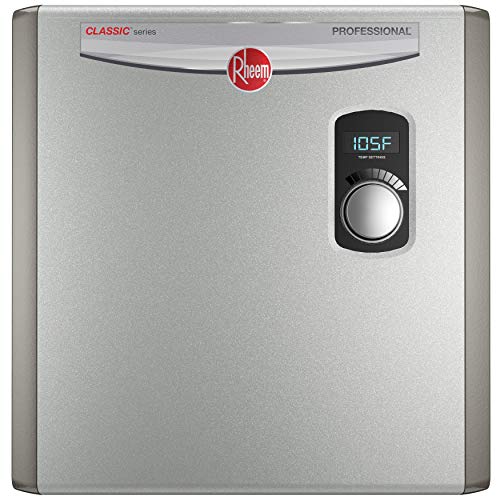 Rheem RTEX-24Best overall
 Rheem RTG-70DVLN-3Top UEF, indoor gas
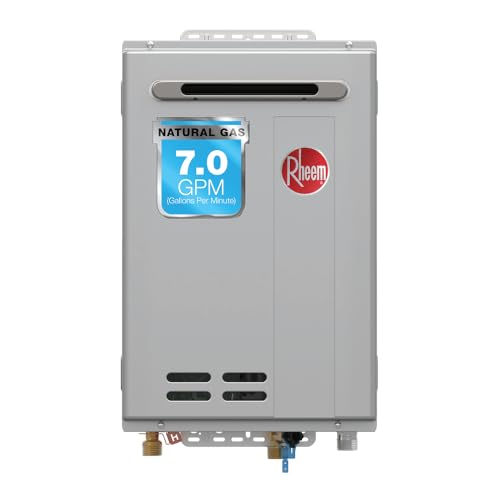 Rheem RTG-70XLN-3Outdoor gas, no venting
How the two types work
A tank water heater keeps a large volume of water hot all day. When you open a tap, hot water leaves the top of the tank and cold water refills the bottom. The tank loses a little heat even when nobody is home, which is why people call that standby loss.
A tankless heater has no storage. When you open a tap, a flow sensor fires up a gas burner or electric elements and heats the water as it passes through. You get hot water for as long as the heater can keep up, but only as much as its flow rating allows at one time.
That difference drives almost every trade-off below: space, upfront planning, efficiency, and how the heater behaves when several fixtures run together.
Tankless vs tank at a glance
This table covers the points most buyers weigh first. It describes the two types in general, so check the specs of any model you are considering.
| Factor | Tankless | Tank |
|---|---|---|
| Space | Compact, often wall mounted | Bulky, stands on the floor |
| Hot water supply | Continuous, limited by flow rating | Limited by tank size, then a recovery wait |
| Standby heat loss | None, heats only on demand | Yes, the tank stays hot all day |
| Install needs | Larger gas line, venting or heavy electrical service | Often a simple swap for a tank of similar size |
| Peak demand | Can struggle if too many fixtures run at once | Handles brief peaks from stored water |
| Upkeep | Periodic descaling in hard water areas | Periodic tank flushing and anode checks |
| Failure mode | Typically a part fails | A tank leak can release stored water |
Gas vs electric tankless
If you are comparing a tankless heater against a gas tank or an electric tank, the fuel matters as much as the type. Your home's existing hookups usually decide it.
Gas tankless units move a lot of water. The Rheem RTG-70DVLN-3 lists 7 GPM, a 0.82 UEF and a 160,000 BTU/hr output, which its listing ties to two or three simultaneous showers. The MIZUDO gas model lists 10.3 GPM, the highest flow among the products we compare. Gas units need a gas line and a way to exhaust fumes. The indoor Rheem uses a direct vent, while the outdoor RTG-70XLN-3 is built for outdoor mounting and its listing says that eliminates venting.
Electric whole-house units are simpler in some ways, but they pull a lot of power. The Rheem RTEX-24 is a 24 kW, 240V unit with a listed 5.9 GPM. Its listing calls for three 40-amp double-pole breakers and recommends a 200-amp household panel. Many older homes would need an electrical upgrade before that is possible.
Small electric units sit in a different category. Some products sold as tankless are really point-of-use heaters, such as the 3000 W Jflapil, whose listing says it is not for showers. Our best tankless water heater page flags these so you do not compare them with whole-house models by mistake.
When a tank is the better choice
A tank often makes sense when you want the least disruption. If your current heater is a tank and the closet already has the right gas line, vent or wiring, swapping in a similar tank can be quick.
It also suits households with light or predictable use, where the stored water covers the morning rush and the tank recovers overnight. And if your home lacks the panel capacity or gas supply a large tankless unit demands, a tank avoids those upgrade costs.
Small storage heaters have a role too. The GE 18 gal point-of-use model runs on 120V and is not hardwired, so it can serve a single sink or a small space, or boost a long pipe run. It is a storage heater, not a whole-house solution.
When tankless is the better choice
Tankless fits best where space is tight or where a tank would sit in the way. A wall-mounted unit frees up floor area. The RTG-70DVLN-3 listing highlights this wall-mount design.
It also suits households that run long showers back to back, since the heater does not drain a finite supply. Just remember that flow is the limit. If you run two showers, a dishwasher and a washing machine at once, add up the demand first and pick a flow rating that covers it.
On efficiency, tankless avoids standby loss. The Rheem gas listing claims savings of up to 34% on energy costs compared with 50-gallon electric tank heaters. That is a manufacturer claim for one comparison, so treat it as a rough pointer, not a promise for your home. Your climate, fuel and usage all change the result.
What to check before you buy
Work through these steps in order. They keep you from choosing a heater your home cannot support.
- Count your peak demand. List the fixtures that run at the same time and compare their combined need with the unit's max flow in GPM.
- Confirm your fuel and power. Check for a gas line of the right size, or electric service that meets the listed breaker and panel requirements.
- Plan the venting. Gas units need either a vent run or an outdoor location. Ask an installer which suits your home.
- Look for the UEF rating. Higher is better, but only five of the 17 products on our tankless page list one, with values from 0.8 to 0.82.
- Verify the type. Some listings are storage tanks or small point-of-use units, so read the heater type before you compare anything else.
- Check your altitude and climate. The MIZUDO listing does not recommend use above 3,000 feet and advises draining residual water in cold climates if the unit sits unused.
Safety notes
Gas and high-amp electrical work are not do-it-yourself jobs for most people. Have a licensed plumber or electrician install either type, and follow local code and permit rules.
Gas heaters must vent combustion gases safely. Install a carbon monoxide alarm near the heater and sleeping areas, and shut off the gas and call a pro if you smell gas.
Turn off the breaker before any work on an electric unit. Tank heaters also need a working temperature and pressure relief valve, so do not cap or block it.
Set the temperature with scalding in mind, especially in homes with children or older adults. If you are undecided after all this, our best water heater page lists tank and tankless options side by side.
Frequently asked questions
Will a tankless heater really give me endless hot water?
Only up to its flow rating. It heats continuously, but if demand exceeds the rated GPM, the water at the tap will turn lukewarm.
Do tankless heaters need maintenance?
Yes. In hard water areas, mineral scale can build up inside the heat exchanger, so descaling is commonly recommended. Follow the maker's manual for the schedule.
Can I put a tankless heater where my tank is now?
Sometimes, but not always. The gas line, vent path, water connections and electrical service may all need changes, so ask an installer to check first.
Is a heat pump water heater another option?
It is. It uses electricity to move heat into the water and still uses a storage tank. It is outside the scope of this comparison, so read its specs separately.