Should Garage Cabinets Be Off the Floor?
Yes, in most garages cabinets should sit a few inches off the concrete. A gap of roughly 4 to 6 inches keeps water, salt and dirt away from the base and lets you sweep underneath. Floor-standing steel cabinets can still work if they have feet or a raised base, and any tall cabinet should be anchored to the wall.
 Letaya 01Best overall
 Yizosh 72HLC-1850Top shelf rating, tied
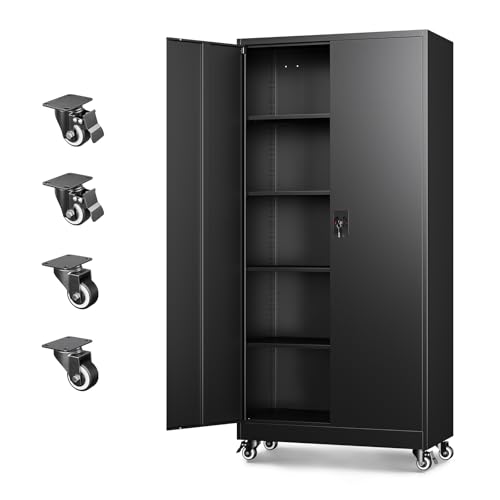 Letaya R694Rolling with wall mounting
Why lifting cabinets off the floor helps
Garage floors are not like kitchen floors. Concrete can be damp, and it collects meltwater, spilled fluids and grit. A cabinet base that sits flat on that surface stays wet longer than the rest of the cabinet.
Even powder-coated steel can rust where moisture sits against the bottom edge. Wood and particleboard cabinets can swell and break down if they soak up water from below. A small gap lets air move and lets the base dry out.
A raised base also makes the garage easier to keep clean. You can push a broom or a dust mop underneath instead of leaving a strip of debris along the wall.
- Less contact with puddles, snowmelt and cleaning water
- Room to sweep or vacuum along the wall
- Better airflow under the cabinet
- A way to level the cabinet on a floor that slopes toward a drain
How far off the floor should garage cabinets be?
For base cabinets, a gap of about 4 to 6 inches is a common target. Many cabinets are built with a toe-kick of around 4 inches, which gives you the clearance without making the unit look like it floats.
Go toward the higher end if your garage floor gets wet, if the slab slopes, or if you wash the floor often. Go toward the lower end if you want the cabinet to feel stable and have a flatter, drier floor.
Tall freestanding steel cabinets are a little different. They usually stand on small feet or leveling feet, so the gap may only be an inch or so. That is enough to keep the base from sitting in a puddle, but it will not fit a broom.
Mounting styles compared
The right choice depends on how wet your floor gets and how much weight you plan to store.
| Style | Typical gap | Good for | Watch out for |
|---|---|---|---|
| Base cabinets with a toe-kick | About 4 to 6 in | Workbench areas and heavy tools | Needs a level floor or shims |
| Wall-hung cabinets | Wide open floor below | Floods, wet floors and easy mopping | Must be fixed into studs or solid anchors |
| Freestanding steel cabinet on feet | A small gap | Renters and quick installs | Too little room to sweep underneath |
| Cabinet on casters | A small gap, and it can roll away | Moving cabinets around a shop | Wheels can leave the load on small contact points |
What the spec sheets say about feet, wheels and wall mounting
Our garage storage cabinet comparison lists feet, casters and wall mounting where the published specs include them. Several freestanding models are tall and narrow, so they depend on one of those features for stability.
The Letaya 72 in model measures 72 in tall, 36 in wide and 18 in deep. Its listing mentions adjustable feet and pre-holes on the back for wall mounting, and it lists 0.8 mm steel with a powder-coated finish. Adjustable feet help you level the cabinet on a sloped slab, and wall mounting handles tipping.
The Letaya model with wheels lists detachable 360° wheels, wall mounting and a 75 lb cabinet weight. The BYNSOE cabinet also lists wheels, with 180 lb shelves and an 80 lb cabinet weight. Wheels lift the cabinet off the floor, but they are a convenience feature rather than a drainage fix. Check whether a cabinet can be locked in place before you load it.
The BIG RED 8-piece set is 130 in wide, 76 in tall and 19 in deep. Its listing mentions leveling feet and says the tall cabinets can optionally be fixed to the wall. It is a good reminder that a system like this needs a plan for the wall, not just the floor.
Safety notes before you load or anchor a cabinet
A tall cabinet full of tools can tip. Anchor it to the wall studs with fasteners rated for the load, and do not rely on the cabinet weight alone. This matters most with wheels or adjustable feet, since both reduce friction with the floor.
Before drilling into a garage wall, check for electrical cable, conduit and plumbing. If you are not sure what is behind the surface, use a stud finder with wire detection or ask an electrician.
Keep cabinets clear of anything that burns or heats. Gas water heaters and furnaces need open space around them, so follow the clearances in their manuals. Keep paint, fuel and solvents in suitable containers and away from ignition sources. Do not store them where a pilot light could ignite fumes.
Wear safety glasses when you drill into masonry or overhead, and use hearing protection with a hammer drill. Get a second person to help lift tall or heavy pieces, and do not climb on shelves.
How to set up a cabinet off the floor
Use this order of steps for a clean install.
- Clear and sweep the wall area, and look for damp spots or drain slopes.
- Mark the stud locations and decide your finished height or gap.
- Level the cabinet using its adjustable feet or shims, and avoid stacking wood scraps that can soak up water.
- Anchor the cabinet to the wall through the back or the mounting holes.
- Load heavy items on lower shelves first, and stay well under the shelf rating.
- Recheck the level and fasteners after a week of use.
When a cabinet on the floor is fine
If your floor stays dry, the cabinet is steel with a good coating, and you can still clean around it, a small gap on feet is usually enough. Many renters do exactly this.
Move up to a larger gap or wall-hung cabinets if you see standing water, if you use a pressure washer, or if the garage floods in storms. Steel thickness also matters: our page notes that several products list 0.8 mm steel and others do not publish a thickness at all. When a listing leaves a spec out, treat it as unknown rather than assuming it is fine.
If you are still choosing, start with the wall you have, the shelf load you need and whether you want wheels. Then compare feet, anchoring and size in one place on our best garage storage cabinets page.
Frequently asked questions
Can I put a wood cabinet directly on a garage slab?
It is risky. Wood and particleboard can soak up moisture from concrete, which can cause swelling and decay. Raise it on a base or use a moisture-resistant material.
Do cabinets with wheels need to be anchored?
Yes, if they are tall. Wheels make a cabinet easier to push, and a loaded tall cabinet can still tip. Lock the wheels when in use and use the wall mounting holes if the model has them.
What can I put under a raised cabinet?
Keep it clear so you can clean. Avoid storing fuel, paint or other flammable items there. A shallow plastic tray can help in places where water collects.
Are wall-hung garage cabinets safe for heavy tools?
They can be if you fasten them into studs or solid masonry with the right hardware and stay within the cabinet rating. Spread the load across several anchor points.