Self-Propelled vs Push Mower: Which to Choose?
Choose a self-propelled mower if your lawn is large, sloped or hard to push through thick grass, or if pushing a mower tires you out. Choose a push mower if your lawn is small and flat, you want less weight to lift, and you don't mind supplying the forward motion yourself. Both cut grass the same way. The difference is who moves the mower forward.
 EGO Power+ LM2134SP-2Best overall
 Greenworks MO60L427Widest cutting path
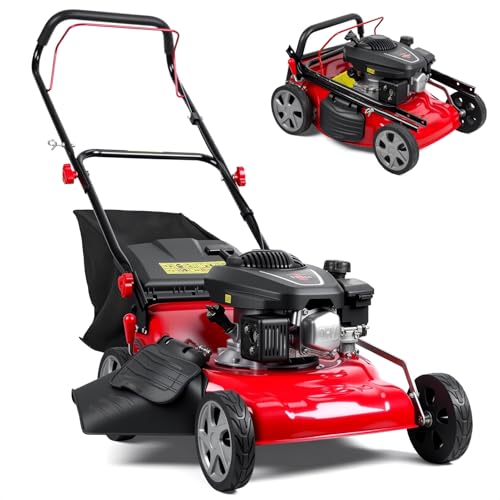 Rodiuiu 6981B6981B8999F706Biggest lawn per tank
The short version: what actually differs
A push mower has no drive system for the wheels. The engine or motor spins the blade, and you provide all the forward motion with your arms and legs. People also call this a non self propelled lawn mower, or a walk-behind mower without drive.
A self-propelled mower adds a drive that turns the wheels for you. You steer and set the pace, and the mower does most of the pulling. The blade, deck and cutting height work the same on both types.
Here is how the two compare on the points that matter most when choosing.
| Point | Push mower | Self-propelled mower |
|---|---|---|
| Forward motion | You supply it | Wheel drive supplies it |
| Effort on hills and thick grass | Higher | Lower |
| Moving parts | Fewer | Adds a drive system |
| Weight | Generally lighter, since there is no drive | Generally heavier |
| Walking speed | Whatever you choose | Fixed or adjustable, depending on model |
| Best fit | Small, flat, simple lawns | Larger, sloped or demanding lawns |
What a non self propelled mower is good at
A push mower is the simple option. With no drive to engage, there is less to adjust and less that can wear out. Many people like the direct feel, since the mower goes exactly where and as fast as they walk.
Because there is no drive system, push models are generally lighter. That helps if you lift the mower into a truck, up steps or onto a shelf in a crowded shed. It also helps in tight yards, where you spend more time turning and backing up than moving in long straight lines.
The trade-off is effort. On a long lawn, a slope, or damp, thick grass, the pushing adds up. If you have a bad back, sore knees or a big yard, that effort is the main reason people move to a drive system.
How self-propelled drive works
The drive sends power to either the front or rear wheels. Rear-wheel drive is common on mowers aimed at slopes because the weight shifts back as you climb, which helps traction. For example, the Greenworks 60V 25 in model lists rear-wheel drive, and so does the Greenworks 80V 21 in model.
Speed control is the other big difference. Some mowers have variable speed, so you can match your walking pace. The EGO Power+ LM2134SP-2 lists 0.9 to 3.1 miles per hour, and the Greenworks 60V model lists 3.5 to 4.5 miles per hour. Others use one fixed speed, such as the SENIX 22 in gas model, which is listed as single-speed.
A fixed speed works if it happens to match how you walk. If it doesn't, you end up either hurrying or holding the mower back. That is why variable speed is worth a close look on the spec sheet.
When a self-propelled mower is the better choice
The drive earns its place when pushing is the hard part of the job. These are the situations where it tends to help most:
- A large lawn with long passes, where fatigue builds over time
- Slopes or uneven ground where you need steady traction
- Thick or damp grass that makes a push mower feel heavy
- Heavy bagging, since a full grass bag adds to the load you push
- Any situation where you want to save your energy for trimming and edging
What to check on a self-propelled spec sheet
Once you decide on a drive, the spec sheet tells you which model fits. Our best self propelled lawn mower page puts several models side by side, and the same checks apply to any model you consider.
Start with weight. The drive does the pushing, but you still lift the mower. Among models that list weight on that page, the range runs from 63.9 lb (the EGO Power+ LM2134SP-2) to 74.95 lb (the Greenworks 80V 21 in).
Next, match width to your lawn. Cutting widths on that page run from 18 in to 25 in. A wider deck covers more grass per pass, while a narrower one turns more easily around beds and trees. The Greenworks 60V model has the 25 in deck, and the Rodiuiu gas mower has the 18 in deck.
Then pick the power type. Battery models list runtime and battery energy. The EGO lists up to 100 minutes, and the Skil PWR CORE 40 lists 50 minutes. Gas models skip charging, and the Rodiuiu lists 2 acres per tank, though gas also means fuel, oil and engine upkeep.
Finally, look at height positions. Models on that page list 6 to 8 positions, and more positions give finer control over how short you cut. If you want to compare drive and runtime across models, see our self-propelled mower comparison.
A simple way to decide
Walk through these questions in order. Your first firm answer usually settles it.
- Is your lawn small, flat and easy to reach? A push mower is likely enough.
- Do you struggle with slopes, long passes or thick grass? Choose self-propelled.
- Do you lift the mower often? Compare weights, and lean toward the lighter end.
- Do you want variable speed? Check the speed range, since some models list only one speed.
- Do you prefer no charging? A gas model fits, but plan for fuel and upkeep.
Safety notes for either type
Wear eye protection and closed-toe shoes with good grip whenever you mow. Gas mowers are loud, so add hearing protection. Clear sticks, stones and toys from the lawn first, since the blade can throw them.
Never put your hands or feet near the deck while the blade is moving. Stop the mower and, for a gas model, disconnect the spark plug wire, or, for a battery model, remove the battery before clearing a clogged chute or tipping the mower.
Refuel gas mowers outdoors, with the engine off and cool. Keep fuel in an approved container away from heat. On slopes, mow across the face with extra care and avoid wet grass, where footing is poor. Keep children and pets away from the mowing area.
Frequently asked questions
Can a self-propelled mower be used like a push mower?
Yes. On most models you can disengage the drive and push it yourself, which is handy for tight spots. Check the manual for how your model does this.
Do self-propelled mowers cut better?
Not by themselves. The cut depends on the blade, deck and height setting. The drive only changes how much effort it takes to move the mower.
Is rear-wheel drive better than front-wheel drive?
Rear-wheel drive often grips better on hills and when bagging, because weight sits over the drive wheels. Front-wheel drive can make turning easier. Choose based on whether slopes or tight turns matter more on your lawn.
Does self-propel drain a battery mower faster?
A drive adds load, so runtime can be shorter than on a push version of the same size. Published runtimes, such as the 50 to 100 minutes on our comparison page, are listed by the makers, and your results will vary with grass and terrain.