Precision Screwdriver vs Regular Screwdriver: Key Differences
A precision screwdriver has a much smaller tip and a slimmer handle than a regular screwdriver. It suits tiny screws in phones, laptops, glasses and watches. A regular screwdriver is built for larger screws and more turning force, such as furniture, outlet covers and appliance panels. Most households end up wanting both.
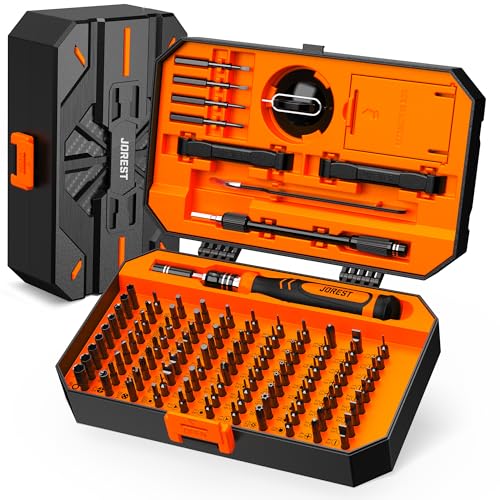 Jorest AJJOJM0201ORDDEP2
 SUNHZ MCKP YMX022Best for mixed household jobs
 Jorest AJJOJM0401ORDESR1Most bits included
The short version of how they differ
The two tools do the same basic job: turn a screw by fitting a tip into its head. The difference is scale and purpose. A precision screwdriver trades turning force for control and access, while a regular screwdriver trades fine control for strength.
If your screws are small enough that a standard tip does not seat properly, you need precision. If the screw is large and tight, you want the thicker shaft and bigger handle of a regular driver.
Side-by-side comparison
Here is how the two types compare on the points that matter most when you are choosing.
| Feature | Precision screwdriver | Regular screwdriver |
|---|---|---|
| Tip size | Very small tips for tiny fasteners | Larger tips for common household screws |
| Handle | Slim, often with a swivel cap on top | Thick, shaped for a full-hand grip |
| Turning force | Low, meant for delicate work | High, meant for tight or large screws |
| Typical jobs | Phones, laptops, consoles, eyeglasses, watches | Furniture, cabinets, outlet covers, appliance panels |
| Drive types | Often many, including Pentalobe, Triwing and Torx | Usually Phillips and flathead, sometimes Torx |
| Tips | Usually swappable bits, often magnetic | Often one fixed tip per driver, or a few bits |
| Storage | Case or pouch holding many small bits | Drawer, toolbox or roll |
Tip size and drive types
Tip size is the biggest practical difference. A regular Phillips driver will not seat correctly in a very small Phillips screw. It can slip and round out the head, which makes the screw harder to remove later.
Drive types matter just as much. Our best precision screwdriver set page notes that Pentalobe and Triwing screws fit many phones and some other devices, and that game consoles can use their own odd heads. Eyeglasses and watches need small flat and Phillips tips. Regular screwdriver sets rarely cover these.
As an example from our spec sheets, the AXTH 25-in-1 lists six drive types: Phillips, Torx, Triwing, Flathead, Pentalobe and Hex. It comes with 24 bits. The SUNHZ MCKP 66-piece set lists three drive types: Phillips, slotted and Torx. It includes 14 full-size drivers plus 40 bits. That mix shows how some kits blend both worlds.
Handle design and turning force
A regular screwdriver has a large handle you wrap your whole hand around. That gives you leverage for tight or stubborn screws. A precision handle is thin on purpose. You hold it with your fingertips and rotate it lightly, which lets you feel when a tiny screw is seated or about to strip.
Many precision handles have a swivel cap. The cap lets your palm press down on top while your fingers turn the shaft. That keeps the tip in the screw head and is especially helpful when the screw sits deep in a device.
Because the handle is small, a precision tool is not made for high torque. Avoid using it as a pry bar or to break loose a rusted screw. Small tips can chip or snap, and a snapped tip can fly off.
Which one should you use?
Match the tool to the screw, not to the job's importance. These quick rules cover most cases:
- Use a precision screwdriver for phones, tablets, laptops, game consoles, remote controls, eyeglasses and watches.
- Use a regular screwdriver for furniture assembly, cabinet hinges, outlet and switch plates, and most appliance panels.
- Use a precision tool for small appliance parts only if the screw head is small and the screw turns easily.
- Switch to a regular driver if a screw feels tight, the tip keeps slipping, or the head is large.
- If you are unsure, test the fit. The tip should sit snugly with no wobble in the screw head.
Precision set vs a single screwdriver
A precision set usually trades one fixed tool for many interchangeable bits. That is useful because the right bit for a tiny screw is often one you did not know you needed. A single regular screwdriver covers one size and one drive type.
Sets range widely in size. Our lineup on the precision screwdriver set comparison runs from 10 pieces to 152 pieces, and from 0.22 lb to 7.5 lb. A big kit gives you more drive types but is harder to carry. A compact kit fits a bag or pocket but may skip a rare size.
Compare a few examples from the data. The JOREST 152-in-1 lists 140 bits made from chrome vanadium steel. The AXTH 25-in-1 uses S2 alloy steel, has magnetic tips and weighs 0.42 lb in a hard case. The GRENPRO set has 10 pieces in a zippered canvas pouch with magnetic tips. Magnetic tips matter because tiny screws drop easily into a device.
Safety notes
Small repairs still carry real risks. Follow these steps every time:
- Power the device off and unplug it before opening it. For phones and laptops, disconnect the battery connector first if you can.
- Wear safety glasses. Tiny screws, springs and snapped tips can fly into your eyes.
- Do not puncture or press on a swollen battery. Stop and get it handled safely.
- Keep the screwdriver tip aligned with the screw and push down while turning, so it does not slip into a circuit board.
- Never open a power supply or anything plugged in. Some parts can hold a charge even when unplugged.
Frequently asked questions
Can I use a regular screwdriver on small electronics?
Only if the tip fits the screw head snugly, which is rare for phones, glasses and watches. A tip that is too large or too small can strip the screw head, so a precision tip is the safer choice.
Can a precision screwdriver replace a regular one?
Not for large or tight screws. The slim handle gives little leverage, and the small tips can bend or break under heavy force. Keep a regular driver for household jobs.
Why do some precision sets have a magnetizer tool?
Some sets do not have magnetic tips on every bit. A magnetizer tool adds magnetism so a bit holds a tiny screw. Our comparison page notes that some sets rely on one, so read the listing.
Do precision screwdrivers all use the same bits?
No. Bit shapes and sizes vary between sets, and some sets use different steels, such as S2 alloy steel or chrome vanadium. Check the drive types listed before you buy, so the bits match your devices.