Polisher vs Grinder: Which Tool Should You Use?
Use a polisher when you want to refine a surface: smoothing paint, buffing metal or bringing out shine on stone. Use an angle grinder when you need to remove material: cutting, shaping, grinding down welds or stripping rust. They look alike in some ways, but they are built for opposite goals, and swapping one for the other usually damages the surface.
 Niusken PGJ-21VBest cordless for beginners
 PORTER-CABLE 7424XP
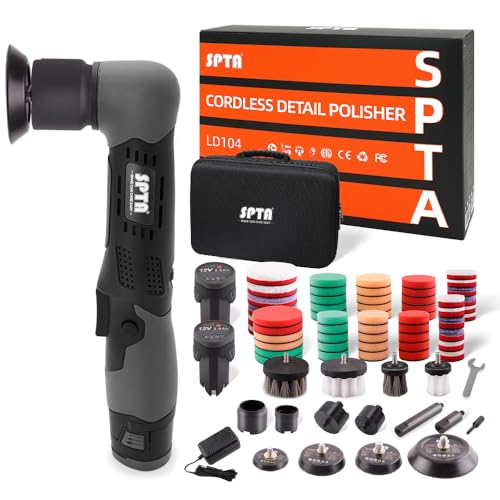 SPTA LD104USBest for tight areas
The core difference: removing versus refining
A grinder is a material removal tool. Its abrasive wheel or disc spins at very high speed and tears away metal, concrete, stone or old coatings. The goal is to change the shape or thickness of the workpiece.
A polisher is a finishing tool. A soft pad, with a compound or wax, levels out microscopic scratches and oxidation so the surface reflects light evenly. The goal is a better-looking surface, not a different shape.
A simple rule helps: if you can describe the job as cutting, shaping or stripping, reach for the grinder. If you can describe it as smoothing, shining or waxing, reach for the polisher.
Polisher vs angle grinder at a glance
The table below sums up how the two tools differ in daily use. The details of any one model will vary, so check the spec sheet before you buy.
| Feature | Polisher | Angle grinder |
|---|---|---|
| Main job | Smoothing and shining a surface | Cutting, grinding and shaping material |
| Typical accessories | Foam, wool and microfiber pads, polishing compounds, wax | Grinding wheels, cutoff discs, flap discs, wire wheels |
| Speed control | Usually adjustable, so you can match speed to the task | Often a single high speed, though variable-speed models exist |
| Risk to the surface | Burned paint or hazy marks if used carelessly | Deep gouges and heat damage if used carelessly |
| Best for | Car paint, boats, jewelry, stone finishing | Metalwork, masonry, rust and weld removal |
| Main hazards | Pad grabbing, cord tangles, heat build-up | Flying sparks, kickback, disc breakage |
When a polisher is the right tool
A polisher is the better choice any time the surface is already the right shape and you just want it to look better. Car paint is the classic example. Light scratches, swirl marks and dull oxidation can be leveled out with a pad and polish without removing more than a thin layer.
Polishers come in a few types, and picking the right one matters. Rotary polishers spin the pad in one circle and cut fast, which suits heavy oxidation but needs a careful hand. Dual action polishers wobble as they spin, which makes swirl marks far less likely and suits beginners. Our best polisher page compares both types on one spec sheet.
Speed range is a useful number to watch. Car polishers on that page run from about 1000 to 6000 rpm, with low speeds for spreading wax and higher speeds for cutting defects. The OFISPEED 1600 W rotary, for example, offers 7 speeds between 1000 and 3500 rpm, while the Protmex cordless dual action model offers 6 speeds from 2800 to 5500 rpm.
Polishers are also made for other materials. Bench polishers suit jewelry and small metal parts, and one model on our page reaches 10000 rpm with dust collection. Wet polishers with diamond pads suit stone countertops, and one kit covers 7 pads from 50 to 3000 grit.
When an angle grinder is the right tool
An angle grinder earns its place when the job involves removing real material. Typical tasks include cutting a bolt or a piece of steel, grinding down a rough weld, stripping heavy rust, sharpening a blade edge or shaping masonry and tile.
The disc you fit decides what the tool does. A cutoff disc slices, a grinding wheel removes bulk material, a flap disc blends and smooths, and a wire wheel cleans off rust and paint. Always use a disc rated for the tool, the material and the speed.
Grinders are not made for finishing paint. A grinding disc is far too aggressive for a car's clear coat and can cut through it in seconds. If your goal is a glossy finish, this is not the tool.
Safety notes for both tools
Both tools spin fast and can hurt you if you rush. A grinder carries the higher risk because of sparks, flying fragments and kickback, but a polisher can still grab clothing, hair or a loose cord.
- Wear safety glasses or a face shield with either tool. Grinders also call for gloves, long sleeves and hearing protection.
- Use a dust mask or respirator when grinding metal, masonry or stone, and when sanding or polishing materials that make fine dust.
- Keep sparks away from flammable liquids, fuel, rags and sawdust. Clear your work area before you start.
- Use the guard that comes with a grinder, and keep it in place. Never remove it to reach a tight spot.
- Check discs and pads for cracks or wear before every use, and let the tool reach full speed before it touches the work.
- Unplug a corded tool or remove the battery before you change a disc or pad. Keep cords clear of the spinning head.
- Hold the tool with both hands and stand to the side of the disc, not directly behind it.
Can one tool do both jobs?
Not well. Some people fit a polishing pad on an angle grinder, but a standard grinder runs too fast and has no fine speed control, so it can burn paint or leave heat damage in seconds. Variable-speed models are less risky, yet a purpose-built polisher is still easier to control.
Stone work shows how the two tools can team up. Fabricators typically grind first with coarse wheels, then move through finer grits to polish. That is a sequence of two stages, and each stage uses abrasives made for it. The same idea applies elsewhere: remove the problem first, then refine the surface.
If you do both kinds of work, owning both tools is the safer route. Use the grinder for shaping and the polisher for the final finish.
How to choose between them
Start with your material and your goal. Ask what the surface looks like now and what you want it to look like when you finish.
If you are working on paint, boats or other glossy surfaces, choose a polisher. Beginners usually do best with a dual action model, since it is far safer on paint. Weight matters too: several cordless dual action models on our page weigh just 3.3 lb, and the 1600 W rotary pick weighs 4.5 lb.
Corded or cordless is the next choice. Corded rotaries give steady power for long sessions, while cordless dual action polishers move freely around a car. Kits with two batteries let you finish a full car without stopping to recharge. You can compare all of these on our polisher comparison page.
If you are cutting, shaping or stripping, choose the angle grinder and match the disc to the material. For jobs that need both, plan on grinding first and polishing second.
Frequently asked questions
Is a polisher the same as a buffer?
People often use the words interchangeably. Both spin a pad to smooth and shine a surface. Some listings use "buffer" for wax application and light finishing, and "polisher" for tools that also correct defects.
Can I use an angle grinder to polish my car?
It is not a good idea. A standard grinder spins too fast and gives you little control, so it can burn through paint quickly. Use a dual action or rotary polisher built for paint instead.
Which tool is better for removing rust?
An angle grinder with a wire wheel or flap disc is the usual choice for heavy rust on metal. A polisher is better for the light finishing that comes after.
Do I need a rotary or a dual action polisher?
A dual action model is the safer pick for beginners because it makes swirl marks and paint burns much less likely. A rotary cuts faster and suits heavy oxidation, but it needs a careful hand.