MIG Wire for Mild Steel vs Flux Core, Carbon Steel, and Chromoly
For mild steel, ER70S-6 solid MIG wire run with shielding gas is the standard choice. Flux core wire is the better pick when the steel is thick, dirty, or you are welding outdoors. Mild steel is a type of carbon steel, so the same wire covers most low-carbon work, but chromoly needs a different filler and more care.
 HYW Products ER70S603504544Best overall
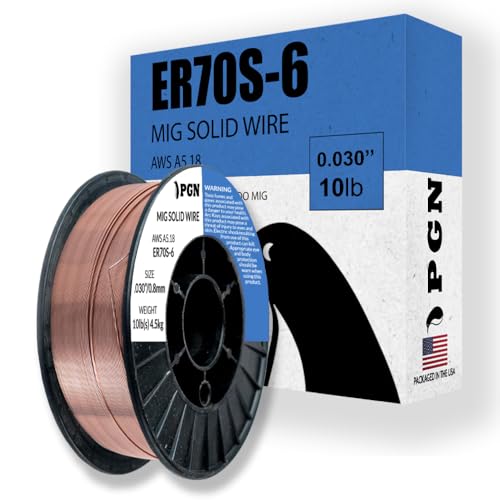 PGN Bearings WW-ER70S6-030-10LBBest for hobby welders
 PGN Bearings WW-ER70S6-035-33LBBest mid-size spool
The quick comparison
These terms get mixed up because they describe different things. MIG wire for mild steel is a wire choice. Flux core is a wire style. Carbon steel and chromoly are base metals. Wire welding is the umbrella term for any process that feeds wire through a gun.
The table below lines up the main options so you can see where each one fits.
| Option | Shielding | Best fit | Main trade-off |
|---|---|---|---|
| ER70S-6 solid MIG wire | Shielding gas required | Mild steel, sheet to medium plate, clean welds | Needs a gas bottle and a draft-free spot |
| Flux core wire | Self-shielded, or gas-shielded types | Thicker steel, rusty or dirty metal, outdoor work | More smoke and spatter, slag to chip off |
| Carbon steel (low carbon) | Same as mild steel | Most structural and fabrication jobs | Higher carbon content needs more care |
| Chromoly (such as 4130) | Usually TIG, sometimes MIG or flux core with the right filler | Roll cages, bike frames, tube structures | Needs matched filler and tighter heat control |
MIG wire vs flux core wire
Solid MIG wire is a plain steel wire. A gas, often an argon and CO2 mix, protects the molten puddle from air. Because the gas does the shielding, you get a clean bead with little slag and less spatter.
Flux core wire is hollow and filled with flux. As it melts, the flux makes its own shielding gas and a layer of slag. Self-shielded types need no bottle at all, which is handy outside where wind would blow shielding gas away.
Flux core also tends to cope better with rust, mill scale and oil, and it is often chosen for thicker mild steel where deeper penetration matters. The cost is cleanup. You will chip slag, wire-brush the weld, and breathe more smoke, so ventilation matters.
If you weld mostly indoors on clean or lightly scaled steel and want tidy beads, solid wire is usually the easier path. Our best MIG wire for mild steel page compares ER70S-6 wires on one spec sheet.
Mild steel vs carbon steel
This is less of a choice than it sounds. Mild steel is simply low-carbon steel, so you are comparing a subset with the whole family. ER70S-6 is built for mild steel, and its extra silicon and manganese deoxidizers help it handle light rust and mill scale and leave a smooth, wetted bead.
Trouble starts as carbon content goes up. Medium and high carbon steels cool hard, crack more easily and often need preheating, slower cooling and a filler chosen for that grade. A general-purpose mild steel wire may not be the right match.
Before you weld a carbon steel part, find out what it is. These steps help:
Check the material certificate or the supplier's grade label.
Look for the carbon level, since higher carbon calls for more care.
If you cannot identify the metal, test a scrap piece first and inspect the weld, or ask a welding supplier.
- Check the material certificate or the supplier's grade label.
- Look for the carbon level, since higher carbon calls for more care.
- If you cannot identify the metal, practice on a scrap piece and inspect the weld before committing to the real part.
Mild steel vs chromoly
Chromoly is steel alloyed with chromium and molybdenum, with 4130 being the common tubing grade. It is stronger than mild steel, and it reacts more to heat. Fast cooling and hydrogen can lead to hard, brittle zones, so heat control and clean prep matter more than they do on mild steel.
Many fabricators weld thin-wall chromoly tube with TIG because it gives fine heat control. MIG can be used, and low-alloy flux core wires exist for chromoly, but the filler needs to be matched to the job. Standard ER70S-6 is a mild steel wire, so confirm it is acceptable before using it on a chromoly part.
Anything that carries people, such as a roll cage, a race car chassis or a bike frame, may have rules or engineering requirements about filler and procedure. Follow those rather than a general guide. When in doubt, ask the person or organization that specified the part.
Wire welding is the bigger category
When people ask about "wire welding," they usually mean any wire-feed process. That covers MIG with solid wire, gas-shielded flux core, and self-shielded flux core. The machine feeds wire at a set speed, you pull the trigger, and the wire becomes both the electrode and the filler.
So the real question is which wire fits your metal, thickness and location. A hobbyist fixing a trailer in the driveway may like self-shielded flux core. Someone building furniture frames in a garage may prefer solid wire and gas for a smoother finish.
Picking diameter and spool size for mild steel
Once you choose solid ER70S-6, two specs matter most: diameter and spool size. The wires on our comparison page run from 0.023 to 0.035 in. in diameter. Thinner wire suits thin sheet and smaller welders, while thicker wire suits heavier steel.
Spool weights on that page run from 2 to 44 lb. A 10 lb spool of 0.030 in. wire is a common fit for hobby machines, while larger 33 lb and 44 lb rolls of 0.035 in. wire suit people who weld often and want fewer spool changes. Check what your welder's spool holder accepts before buying a big roll.
Keep spools dry and covered. Damp or rusty wire can cause porosity and feeding trouble. Some wires on our list are vacuum-sealed for this reason.
Safety notes
Wire welding carries real hazards, so set up before you strike an arc.
Wear a welding helmet with the right shade, plus safety glasses underneath. Flux core slag can fly off when chipped, so eye protection stays on during cleanup.
Use ventilation or fume extraction. Do not weld galvanized, plated or painted metal without removing the coating first and moving fresh air through the space. Alloy steels such as chromoly also call for good fume control.
Wear dry leather gloves and non-flammable clothing, and keep flammables away from the work area. Never touch live parts, and keep cables in good shape.
Secure gas cylinders upright, and wear hearing protection when grinding.
Frequently asked questions
Can I use flux core wire in a MIG welder?
Often yes, if the welder is set up for it. Self-shielded flux core usually needs the polarity reversed and a drive roll made for tubular wire. Check your welder's manual first.
Do I need shielding gas with ER70S-6?
Yes. ER70S-6 is a solid wire and relies on external shielding gas to protect the weld pool. Without it, the weld will be porous and weak.
Is flux core stronger than solid MIG wire?
Strength depends on the specific wire and how well the weld is made, not on the wire style alone. Compare the published classification and mechanical specs for the exact wire.
Why does my solid wire weld look porous?
Common causes are low gas flow, drafts, a dirty or rusty surface, and damp wire. Check the gas, shield the work from wind, and clean the joint.