Jointing Long Boards on a Benchtop Jointer: Limits and Methods
A benchtop jointer can flatten and straighten long boards, but only if you add support at both ends and take light passes. The real limit is not a fixed board length. It is how well the table length, your stands, and your technique keep the board from rocking or sagging. If a board is much longer than you can support steadily, joint the worst areas first, cut it to rough length, or use a different method.
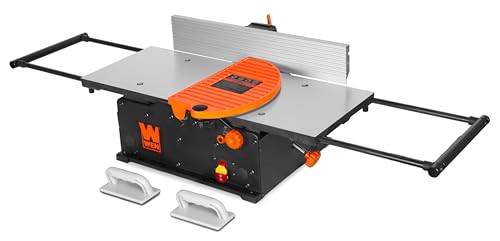 WEN JT1224HBest overall
 CUTECH 401120HI-IF#1 on our Best Score
 CUTECH 40180HBMid-size 8 in spiral
What actually limits board length
No jointer has a single maximum board length printed on it. The limit comes from how much of the board rests on the tables and how much hangs off the ends. Benchtop machines have shorter tables than stationary ones, so a long board spends most of its length unsupported.
When a board hangs off the infeed end, its weight pulls it down. As you push it forward, the free end rises and falls, and the cut follows that motion. The result is a board that feels straight but has a shallow belly or a taper. The same thing happens on the outfeed side, where the board can droop after it leaves the cutterhead.
Width matters too. The cutterhead width in the published specifications caps how wide a board you can face joint. Length is a support problem, while width is a hard limit. Check both numbers on the spec sheet before you commit to a project. If you are still choosing a machine, our best benchtop jointer comparison lists table length and cutterhead width side by side.
Check the machine before you start
Long boards magnify small setup errors. An outfeed table set even a little too low or too high will cut a taper that gets worse over distance. Spend a few minutes on setup before you feed anything long.
Unplug the machine before you touch the knives or the table adjusters.
- Make sure the outfeed table is level with the knives at the top of their swing. Use a straightedge across the knives and the outfeed table.
- Confirm the fence is square to the tables. A fence that leans will give you an edge that is not square, however straight it looks.
- Check that the tables are not twisted. Lay a straightedge along both tables to see if they line up.
- Look at the knives. Dull or nicked knives tear out grain and force you to push harder, which makes control worse.
Support is the real fix
The most useful upgrade for long boards is support, not a bigger machine. Set up roller stands or a sturdy outfeed stand so the board stays at table height for its whole length. Do the same on the infeed side.
Match the height carefully. A support that is slightly high lifts the board off the table and gives you a convex cut. A support that is slightly low lets the board sag and gives you a hollow. Set the stand height with the board resting flat on the infeed table, then check it again once the board is partly through.
Benchtop jointers are light, so also make sure the machine itself cannot walk or tip when a heavy board leans on it. Clamp or bolt it to a solid bench. A machine that shifts mid-cut can kick back or ruin the pass.
Step by step: edge jointing a long board
Edge jointing is the usual job for long boards, such as stock for a tabletop glue-up. Here is a reliable routine.
- Pick the better face and keep it against the fence.
- Sight down the edge. If the board has a crown or bow, put the hollow side down so the board rests on its two high ends. That keeps it from rocking.
- Set a light cut. A shallow depth gives you smoother results and more control than a deep one.
- Start with the board's front end on the infeed table and press down just ahead of the cutterhead.
- As the cut begins, shift your downward pressure to the outfeed side. Keep the board tight to the fence.
- Use push blocks near the cutterhead. Never let your hands pass over the knives.
- Keep a steady, unhurried feed speed all the way through. Stopping in the middle leaves a mark.
- Repeat until the cutter takes a continuous shaving along the full length.
Methods compared for very long boards
Sometimes the board is simply too long or too heavy for the tables you have. These options trade speed for accuracy in different ways.
| Method | Best for | Main drawback |
|---|---|---|
| Joint the full length with stands | Boards you can support steadily | Needs careful stand setup |
| Cut to rough length first, then joint | Boards you plan to shorten anyway | Wastes some stock |
| Joint the high spots, then plane by hand | Boards with a strong bow or twist | Slower, takes practice |
| Use a straightedge and router jig | Very long edges and slabs | Extra setup before cutting |
| Joint a jointer-length section, then rip to a line | Rough boards with a wavy edge | Needs a clean straight edge on the saw |
Safety notes
Jointers remove wood quickly and the cutterhead is exposed during every pass, so treat each cut seriously. Keep your hands on top of the board and use push blocks, never your fingers near the cutter.
Wear eye and hearing protection. Jointers are loud, and chips can fly. Use dust collection or wear a dust mask, since fine dust builds up quickly. Avoid loose sleeves and jewelry that could catch.
Do not joint boards that are too short to control safely, and watch for knots and loose grain that can break off. If a long board feels unstable at any point, stop, unplug the machine, and rethink your support.
When to switch tools
Some jobs are better handled by a different machine. If you often work with long, wide, or heavy lumber, a longer-bed machine will carry more of the board's length on the tables. Our best jointer comparison covers both benchtop and stationary options, so you can see what a longer table offers.
For occasional long boards, a router sled, a hand plane, or a straightedge guide on a table saw can give you a good edge without buying anything new. The best choice depends on how often you do this and how straight the finished board needs to be.
Frequently asked questions
Can a benchtop jointer face joint a very wide board?
Only up to the cutterhead width listed in the specifications. For anything wider, joint the board in halves, use a router sled, or flatten it with a hand plane.
Why does my long board come out tapered?
Usually the outfeed table is set too low or too high, or the outfeed support is at the wrong height. Reset the outfeed table to match the knives and adjust your stands.
Is it okay to take a deeper cut to save time?
A light cut is safer and gives better control on long stock. Deeper cuts raise tearout and make the board harder to hold steady.
Should I joint before or after cutting a board to length?
If the board is much longer than you can support, cut it to rough length first, then joint. Leave extra length so you can trim the ends afterward.