Is TIG or MIG Better for Aluminum? Key Differences
For most home welders, MIG with a spool gun is the better starting point because it is faster, more forgiving and works well on thicker aluminum. AC TIG gives cleaner, more controlled welds, especially on thin or visible work, but it needs an AC TIG machine and more practice. If you want the best-looking weld and have the time to learn, choose TIG. If you want to get thicker pieces joined with less fuss, choose MIG.
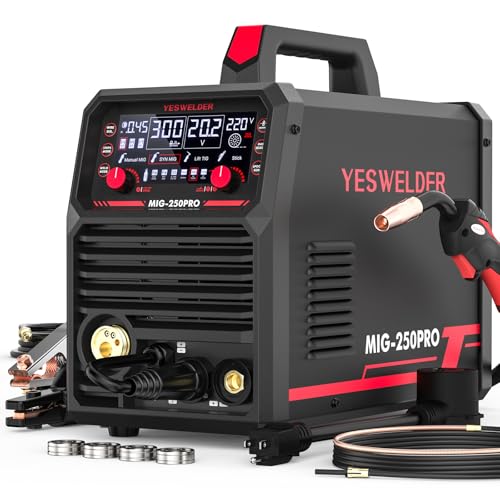 YESWELDER MIG-250DS PROBest overall
 BILT HARD WLD-1603Lightest
 ARCCAPTAIN MIG200Best finishing controls
The short comparison
Both processes can weld aluminum well. They differ in how you feed filler metal, how much skill each one asks for, and what kind of job each suits.
MIG feeds a wire through the gun automatically, so you control the trigger and travel speed. TIG uses a tungsten electrode that makes the arc, and you add filler rod by hand with your other hand while a foot pedal or torch control adjusts heat. That extra control is why TIG welds look so tidy, and also why it takes longer to learn.
| Factor | MIG with spool gun | AC TIG |
|---|---|---|
| Skill needed | Moderate | High |
| Speed | Faster | Slower |
| Best thickness | Medium to thick | Thin to medium |
| Weld appearance | Good with practice | Cleanest, most precise |
| Heat control | Set on the machine | Adjustable while welding |
| Equipment | Spool gun plus argon | AC TIG machine plus argon |
| Filler handling | Automatic wire feed | Hand-fed rod |
Why aluminum is harder than steel
Aluminum conducts heat fast, so the heat you put in spreads away from the joint. It also melts with little warning. Steel glows and sags before it fails, but aluminum can go from solid to a hole in a moment.
There is a second problem. The oxide skin on the surface melts at a far higher temperature than the metal underneath. If you do not clean it off, it traps dirt in the weld and makes the arc behave badly. This is true for both MIG and TIG, so good prep matters more than which process you pick.
When MIG is the better choice
MIG suits you if you want speed, if you weld thicker aluminum, or if you already own a multi-process welder. Once the settings are right, you pull the trigger and move along the joint, which is easier to learn than coordinating a torch, a filler rod and a pedal.
The catch is the wire. Aluminum wire is soft and tends to bunch up or tangle in a long standard MIG gun. A spool gun solves this by holding a small spool of wire right at the gun, so the wire only travels a short distance. That is why our best welding for aluminum page focuses on multi-process welders that reach aluminum through MIG with a spool gun.
Some product data shows how this works in practice. The YESWELDER MIG-250DS PRO lists .035 and .045 inch aluminum wire for spool gun MIG, and notes that the spool gun is an additional purchase. The BILT HARD WLD-1603 also lists .035 and .045 inch aluminum wire and spool gun MIG, with the spool gun not included. Check this on any machine you consider.
When TIG is the better choice
Choose AC TIG when appearance and control come first. Thin sheet, visible seams, repairs on cast parts and precise fit-up all favor TIG, because you can raise or lower the heat as the metal warms up. That helps with aluminum's habit of absorbing heat and then suddenly overheating.
The key requirement is AC output. Aluminum needs alternating current so the arc can break up the oxide skin. A machine with only DC lift TIG or DC HF TIG is not set up for that job in the usual way. Many multi-process welders list TIG, but the TIG mode is often meant for steel and stainless.
This is worth knowing before you buy. Every machine on our aluminum welder comparison reaches aluminum through MIG with a spool gun, and none lists AC TIG. The FEMEROL MTC200PRO lists HF TIG alongside plasma cutting, but that listing does not mean it has AC TIG for aluminum. If AC TIG is your goal, look for a machine that clearly states AC output.
What to check before you buy
Whichever process you lean toward, a few specs decide whether a welder is a sensible fit for aluminum.
Aluminum needs more heat than steel of the same thickness, so output current matters. The machines on our comparison page offer 200 to 250A. The ARCCAPTAIN MIG200 is rated at 200A, while the YESWELDER MIG-250DS PRO and BILT HARD WLD-1603 are rated at 250A.
- Spool gun support: confirm the gun is compatible and whether it comes in the box.
- Aluminum wire sizes: look for .035 or .040 inch wire in the listed range. The ARCCAPTAIN MIG200 lists .035 and .040 inch aluminum wire, and it lists the spool gun connector as optional.
- Output current: more headroom helps on thicker sections.
- Duty cycle: the BILT HARD WLD-1603 lists 60% at 250A, which tells you how long it can weld before needing a rest.
- Weight: the BILT HARD WLD-1603 lists 21.49 lb, which matters if you move your welder around.
- Gas support: you need to run pure argon, not the mixed gas used for steel.
Prep and setup basics
Prep is where most aluminum welds are won or lost. Use these steps for either process.
Clean the metal with a stainless steel brush kept only for aluminum, and do it just before welding. The oxide layer comes back quickly, so do not clean it and then wait an hour. Wipe off oil and grease with a suitable degreaser first, because brushing can push contamination into the surface.
Then follow this order:
- Degrease the joint and let it dry fully.
- Brush the weld area with a dedicated stainless brush.
- Set pure argon gas flow and check for leaks.
- Fit the spool gun or AC TIG torch and confirm the right wire or rod.
- Practice on scrap of the same thickness before welding the real part.
- Weld soon after cleaning, and keep the gun moving so heat does not build up.
Safety notes
Welding involves electric shock, intense light, heat and fumes, so treat setup seriously. Wear a proper welding helmet with the right shade, flame-resistant clothing, gloves and closed shoes. Arc light can burn your eyes and skin within moments, and the burn can show up later.
Work in a well-ventilated space and keep flammable materials away. Aluminum fumes and degreaser residue should not be breathed, so use extraction or outdoor airflow. If you use a dual voltage welder, follow the maker's instructions for the supply you connect to. For example, the ARCCAPTAIN listing says not to switch between 110V and 220V while the screen is still on.
Argon cylinders are under high pressure. Secure them upright, use the correct regulator, and keep them away from heat. Wear hearing protection if you also grind or brush metal nearby.
Frequently asked questions
What type of welding is best for aluminum?
MIG with a spool gun and AC TIG are the two practical routes. MIG is easier and faster, while AC TIG gives the finest control and appearance.
Can I use regular steel MIG wire for aluminum?
No. Aluminum needs aluminum wire, typically in alloys sold for that purpose, along with pure argon shielding gas. Steel wire and mixed gas will not work.
Do I need a spool gun for MIG welding aluminum?
It is the most reliable setup because it keeps the soft wire from tangling. Some listings, such as the FEMEROL MIG 250PRO, mention a Teflon feed tube as another way, but the spool gun is the usual approach.
Is a lift TIG mode enough for aluminum?
Not on its own. Aluminum is normally TIG welded with AC output, so a machine that lists only DC TIG modes is not a good match.
Should a beginner start with TIG or MIG on aluminum?
Most beginners find MIG easier to learn. TIG rewards patience and practice, so it suits people who want precision more than speed.